3 d animation request
Author: A4KENYA
-
KENYA EDUCATION SYSTEM: EMBRACING INTERNET TO REDUCE COSTS.
KENYA EDUCATION SYSTEM: EMBRACING INTERNET TO REDUCE COSTS.
Kenya spends a lot of its revenue on education.
The education system used in Kenya requires major structural changes to reflect the changing times and adapt to new challenges.
As a Kenyan rightfully stated:
‘The problem with Africa is it produces what it doesn’t consume and consumes what it doesn’t produce’.PORTUGAL.
Kenya should borrow heavily form the Portugal System of education.
In Portugal, the system was much like Kenya’s, with all students going through a set curriculum, much like Kenya’s 8-4-4- system.
After the Portuguese Government realized that the system was only producing unemployed graduates with undergraduate, masters and PHD degrees.
The solution was to create an education system that would provide various exit points and allow for early specialization.
This way, no resources will be lost in training millions of students in curriculum subjects that they will never use in their lifetime.
This creates a complete strain on the country’s budget and churns out millions of unemployed graduates in the long run.MOBILE PHONE REPAIR.
Take an example of mobile phone repairing. The thousands of mobile phone repair shops across all towns in Kenya are run by people who developed a passion to repair phones after completing the basic Primary or Secondary school education. There is no formal training for this. However, there are millions of video tutorials available for free online. Self-initiative in learning new technology as it comes is the main driving force. With the entrant of Google android phones in the market which are different from the popular symbian phones, it will not require a masters or PHD degree to gain the knowledge to repair. All it will require is the basic primary school education plus a self-initiative drive to learn this new technology online through video tutorials on Youtube.
In the Kenyan situation, most families will struggle to put their children through the expensive secondary schools. These children will learn subjects that they will never use in their life times at the expense of their parents and the country as a whole.EARLY SPECIALISATION.
The Curriculum needs to include options whereby students want to start specializing in a certain sector early. If a child’s dream is to become a gadget repair technician, this could be handled within a set education system as opposed to the current situation whereby as such students are left to grope for this solution without Government’s guidance.
If a child’s dream is to become a doctor/medial sector, they should be given a chance to specialize in medicine early enough –possibly within the upper Primary to Secondary school level.
This will help to produce students who possess skills that can put bread on the table after completing secondary school.
As it is, a secondary school graduate in Kenya can at best work as a cyber café attendant. The amount of resource put into training the secondary school graduate is so huge compared to the output after graduation due to poor training in subjects they will never use in their lives.ARCHITECTURE.
In a field lie Architecture for example, many new Computer Aided Design software complete with online video tutorials are present. All of them offer a free student-version download and tutorial.
A keen student in this field might want to start specialize in as early as secondary school stage. This means that by the time they graduate from secondary school, they will possess a skill that can be of value to fellow Kenyans as opposed to the current 8-4-4 system grandaunts. This resonates in many other disciplines that Kenyan students may want to specialize in.Architect Francis Gichuhi Kamau.
www.a4architect.com
+254721410684 -
History Of Online Building Plan Approval Portals: Another 1st I.T. Solution From Africa.
History Of Online Building Plan Approval Portals: Another 1st I.T. Solution From Africa.
The most notable 1st IT solution from Africa is the Mobile phone payments solution, most notably Mpesa. Apart from Mpesa, another solution that enables building plan approvals to be done online originates from Kenya in Africa.
The original idea that it could be possible for Building plans application to be carried out online was borne by Nairobi –based Kenyan Architect Francis Gichuhi Kamau of www.a4architect.com.
The architect, who was in the process of coming up with such a portal, divulged the information to the World Bank’s Doing Business team in February 2008.
The World Bank went ahead and hired Computer Programmers to come up with the portal and implemented it at Nairobi City Council at a cost of USD 200,000.


BETTER SOLUTION.
Architect Francis Gichuhi developed his idea further to come up with a better solution http://www.a4architect.com/submit-drawings/
Countries and Cities who would like to implement online building approval methods and Environmental Control within their Local Governments are encouraged to contact/partner with www.a4architect.com for a homegrown solution.OTHER COUNTRIES .
Other notable entrants after the first idea mooted in 2008 are countries who are active members of the World Bank.These are:
India-Combatore ,Pune City Municipal councils.
Malaysia-Kuala Lumpur City Municipal Council
United Kingdom.
In Africa, the World Bank has announced that it is already in talks with the City of Kigali,Rwanda, and Lusaka ,Zambia to implement the same.ADVANTAGES.
The spread of this idea to other countries is commended due to the many advantages that this online building plan approval offers to the world as a whole, including reducing the Carbon footprint. To increase this reach further, Architect Francis Gichuhi of www.a4architect.com offers consulting services to Countries and Cities who would like to implement this online plan approval method.AFRICA PRIDE.
Once again, Kenya and Africa feels proud to be the originator of online building plans approval method. It is an honor to offer to the whole world including Developed 1st world nations a new idea and method of carrying out building plans approval using the internet.Architect Francis Gichuhi Kamau.
www.a4architect.com
info@a4architect.com
+254721410684 -
ADVANTAGES OF www.a4architect.com ONLINE SUBMISION OF LOCAL AUTHORITY AND NEMA PERMIT APPROVAL APPLICATIONS.
ADVANTAGES OF www.a4architect.com ONLINE SUBMISSION OF LOCAL AUTHORITY AND NEMA PERMIT APPROVAL APPLICATIONS.
ADVANTAGES TO APPLICANTS.
Click here to submit your drawings.SAVINGS ON TRANSPORT COSTS.
The never-ending Nairobi traffic jam costs a lot in terms of transport. Fuel prices are high. The traffic jam also costs a lot in time of lost man-hours.
Case study.
For example, a simple visit to Kajiado County Council will cost a minimum of KES 1,000 in transport. The time wasted in the traffic jam especially along Uhuru Highway and Mombasa road near Nyayo stadium Roundabout will be an average of 2 hours.
Once the applicant gets to Kajiado county council, he/she has to wait in the queue for their tun to be served. This is another 1 to2 hours lost. After seeing the personnel, he/she is supposed to visit other related offices located several kilometers from the Council offices. Other offices such as Public health are located over 100km away in Ngong town. This movement is virtually not impossible to cover within a day. This means the applicant will have to set complete days off for each visit. Assuming there will be a minimum of 7 visits till final approval, this translates to loss of 7 working days and a minimum of KES 7000 in transport.
SAVINGS ON TIME.
With the Online application, once the drawings are uploaded on www.a4architect.com, the Kajiado council will be able to give feedback simultaneously with the Structural engineering department and the Public Health department at the same time even though each of these offices are located kilometers apart.Ability to view comments on a mobile device also increases the speed and ease of communication between all parties.
There will be virtually zero time lost since uploading the application takes approximately 3 minutes and initial physical visits will not be needed until the final signing of the permit at the issuance of the hard-copy permit to build/change user/subdivide/building maintenance.
To most consultants and permit applicants, saving time is very important.
PRINTING COSTS.
After the application, the Council representatives usually give comments regarding the drawings. Some comments require rectification which requires re-printing the drawings. The costs associated with re-printing the drawings i.e. transport, printing costs for a simple 3 bedroomed house are in the tune of KES 1,000.
Through online submission of drawings on www.a4architect.com, the drawings in digital format can be commented upon and the changes done electronically, reducing costs associated with printing costs.
After the drawings are amended electronically and Approval recommended, the applicant can then print hard copies for future reference.
This will reduce the huge storage space required by Local Authorities/N.E.M.A for storing the drawings.
ADVANTAGES TO LOCAL AUTHORITIES/N.E.M.A.
CALCULATION OF AREAS.
The Local Authorities base the charges o the size of the buildings and number of plots.
In the usual hard-copy method, its cumbersome, time wasting and very easy to make errors in manually calculating the floor areas of buildings. In the Online submission method, the council/N.E.M.A can easily calculate electronically using CAD software from the CAD files submitted in the application. This will increase Council/NE.E.M.A Revenue since chances of error will be reduced. It will now be possible for Local Authorities and N.E.M.A to effectively ascertain plinth areas and estimated construction costs. With the current manual system, revenue is lost when the floor areas are under measured [Local Authority] and estimated construction costs undervalued [N.E.MA.].
SAVINGS ON TRANSPORT COST TO VISIT SITE.
Using the current manual method of submitting applications, the Local Authority/N.E.M.A is required to visit the site to ascertain location. This costs time in terms of transportation and man-hours. The Local Authority/N.E.MA. employees can only manage to visit one or two sites per day hence delay in offering services to Kenyans. With the online www.a4architect.com submission, the Local Authority/N.E.M.A employees can easily obtain applicant’s location and location details without visiting the site by using the embedded Google map. Applicants can mark their site location within the application. The Local Authority/N.E.M.A. can conveniently see the exact plot location and be able to advice on the zoning controls required.
This will increase the number of applicants served hence increase revenue. The employees will also save the time and effort used in site visits to improve workforce on other productive activities within the Offices.
RECORD KEEPING.
Use of online permit application will reduce the space needed to store drawings for Local Authorities and N.E.MA. Record keeping and retrieving will also be aided since these will now be able to stored perpetually and retrieved electronically though the a4architct.com internal filing system and internal search engine on behalf of Local Authorities and N.E.M.A .
PAYMENTS.
Payments can be done electronically using Safaricom’s Mpesa,Airtel Money and Yu Cash PAYBILL services directly to the specific Local Authority/N.E.AM.A office. This reduces chances of fraud and the convenience will make it easy for more people to apply for permits. Use of fake permits will also decline since it will be easy to ascertain permit issuance through internet Google search.
MOBILE PHONE CONVENIENCE.
The ability for Local Authority/N.E.MA.A officials to issue comments on applications through internet-enabled mobile phones will aid in making the working conditions easier since the employees can e able to work from remote locations away from their offices conveniently.
Likewise, applicants will also be able to view comments made on their applications on their mobile phones hence aid convenience in information transfer.
Currently, applicants apply to both Local Authority and N.E.M.A separately. This will harmonize the application such that applicants can apply to both at the same time simultaneously.
USING THE SERVICES:
There are 2 options .
- Fees charged to applicants per application.
- Outright purchase of portal by Local Authority/N.E.MA.
Fees charged per applicant.
A fee of accessing the portal will be levied per application. This fee will enable the applicant access the Local Government/N.E.M.A communication. More technical support in regards to amending the applications to meet the requirements s commented on the Local Authority/N.E.M.A will be provided to applicants at a cost set in relation to the building size in m2. Delivery of Hard Copied and signed hard-copy application forms after comments have been agreed on will also be given as an add-on premium service. Courier services such as FedEx,DHL will deliver the hard copies to the Planning department head .
Outright purchase of portal.
This will include setting up of the portal for the Local Authority/N.E.M.A with their preferred url address and training of their personnel to use the service.
Users will then access the portal and fees for accessing will be set by Local Authority/N.E.M.A and included within the statutory fees.
Click here to submit your drawings.Architect Francis Gichuhi Kamau
+254721410684.
-
DIAMOND HOUSE- PHASE 2.
DIAMOND HOUSE- PHASE 2. COST ESTIMATE: KES 750,000.
57M2.

COST BREAKDOWN;DIAMOND HOUSE- PHASE 2. COST ESTIMATE: KES 750,000.
57M2.
COST BREAKDOWN;
MAIN SUMMARY
Substructures 150,696.00 Reinforced Concrete Frame – Superstructure walling 98,201.60 Roof structure, covering, finishes and rainwater goods 93,760.00 Windows 39,040.00 Doors 56,704.00 External finishes – Floor Finishes 10,780.00 Wall Finishes 37,200.00 Ceiling Finishes 44,552.00 Sanitary Fittings 29,920.00 CONSULTANCY FEES – Prime Cost and Provisional sums 145,000.00 Sub Total 705,853.60 Technical Support 42,351.22 CONSULTANCY FEES BREAKDOWN.
Outline proposal 7,500.00 – Scheme design 11,250.00 – Detailed design 15,000.00 Tender action to completion 11,250.00 NOTES.
The foundation is based on a4architect.com’s Diamond House technology. This technology reduces costs associated with reinforced concrete by replacing Reinforced concrete in foundations with masonry walling.
In this case, using Reinforced concrete would have costed KES 40,000. Using a4architect.com Diamond technology is estimated at KES 30,000, resulting in a KES 10,000 savings.
The floor is masonry as opposed to the usual reinforced concrete. This results in a further savings of KES 700 per m2.
Roof.
The roof pitch is as specified in the Diamond House technology.
This represents an estimated cost of KES 13,000 per m2 inclusive of external works and accessories.
Architect Francis Gichuhi Kamau
+254721410684
-
KENYA COLONIAL ARCHITECTURE-BUILT TO LAST FOREVER.
KENYA COLONIAL ARCHITECTURE-BUILT TO LAST FOREVER.
The British colonial architecture spread all over Kenya was designed to very high standards.
The buildings done in the early 1900s are still standing strong due to the design, materials and building technology used.
MASONRY WALLING.
A characteristic of these buildings is the hand-dressed dark grey masonry walling.
Buildings such as Kipande house http://farm5.static.flickr.com/4067/5133373584_cf319a998b.jpg

were designed with very intricate masonry walling patterns.
The grey stone used is very strong and till today, no signs of cracks or failure are visible.
The railways houses along Ojijo road near KI and Parklands sports club are also standing strong after tens of years since they were constructed.

ojijo road
Another masterpiece is the Lord Egerton caste in Nakuru.
To date, no signs of cracks or failure can be seen.

egerton castle
TECHNOLOGY USED.
The British used strip foundation for the foundation, hand-dressed masonry for the walling, timber trusses for the roof structure and clay tiles for roof surface.
Labour to dress the stones to the intricate patterns was abundant from the enslaved Africans. The workmanship was so thorough and to the exact point. A quick look at the masonry stones at the corners of Kipande house still shows the razor-thin stone edges that had been shaped by hand. To achieve this, thousands of man-hours were needed so as to get this fine piece of art.
With the current labour situation and labour laws, it will cost an arm and a leg to get the same quality since you will have to pay for all those man-hours. This is the reason that most current buildings to don’t embrace such intricate masonry stylings.
LESSONS LEARNT.
The buildings to date are a very good source on building construction technology. Unfortunately, with the rapid urbanization in most parts of Africa, the zoning regulations are changing rapidly hence no great need to design buildings that last over 50 years.
These British pieces of architecture dotting Nairobi suburbs such as Upper Hill, Hurlingham have now been caught up with new planning laws that require for demolition to pave way for high-rise structures. Unfortunately, due to the good workmanship, these can last for another 50 years but they have to pave way for more high-density structures.
The British had envisioned a much greater stay within the Kenya colony. It looks like the 1963 Uhuru was premature to them since they had not calculated this into their architecture planning.
Architect Francis Gichuhi Kamau.
www.a4architect.fom
info@a4architect.com
=254721410684 -
MOBILE INTERNET PENETRATION IN AFRICA: AN END TO LARGE GOVERNMENT EXPENDITURE?
MOBILE INTERNET PENETRATION IN AFRICA: AN END TO LARGE GOVERNMENT EXPENDITURE?
Africa holds the number two position after Asia as the continent with the 2nd highest mobile internet users.
Source: http://asiancorrespondent.com/43116/asia-recognised-as-worlds-biggest-mobile-internet-user/
http://digitaljournal.com/article/314828
Africa has not heavily invested in physical infrastructure such as schools, hospitals and roads. This puts it in a unique position compared to other continents who have already heavily invested in these physical infrastructures. This means that Africa can afford more room for innovative mobile –internet-based solutions to augment roles played heavily by Governments.EDUCATION.
In regions where African Governments have not heavily invested in building schools such as North Eastern Province in Kenya, the internet can augment the need for heavy physical investment especially in secondary and tertiary education level.For example, the need for students to enroll in secondary or tertiary institutions so as to learn mandatory subjects such as calculus, periodic table, human anatomy e.t.c which chances are very high that they might not use in their life. In such situations, students should be able to learn only what is of interest to them through the millions of tutorials available in the internet in written and video format.
This will in turn lead to less Government involvement in Education sector. Students will be able to follow their passions to very detailed education levels.
The Government can in turn assist and regulate this by changing the curriculum such that students can be able to specialize at n early age. For instance, if a student shows interest in biology, he/she can pursue the knowledge online beginning form Primary school until PhD level.PARLIAMENT.
Political deliberations can be designed such that political representatives can deliberate both physically in parliament and online through forums. This will enable representatives in fur areas or on travel to equally participate in deliberations. This will also enable citizens to join in the debates and air their views.LOCAL GOVERNMENT.
The use of internet portals that allow for Local Authority to communicate with building, land subdivision and other applicants online such as this http://www.a4architect.com/submit-drawings/ will go a long way in reducing Government expenditure in terms of mobilizing for transport, stationery and time.
CONCLUSION.
There are many other Government ministry roles that can be made more efficient through use of internet. The number is only limited by our imaginations.
Now that Africa has not invested in heavy physical infrastructure, it’s time for new solutions to this using unique and innovative methods. This lack of physical infrastructure could be the proverbial lemon that Africa should now make lemonade with so as to make the big leap into economic prosperity.
Architect Francis Gichuhi Kamau.
info@a4architect.com
www.a4architect.com
+254721410684 -
INTERNET: SOLUTION TO AFRICA’S COMMUNICATION INFRASTRUCTURE .
INTERNET: SOLUTION TO AFRICA’S COMMUNICATION INFRASTRUCTURE .
Africa’s road and railway network does not link well between countries and cities.
This hampers and slows down communication between country to country and city to city.
In Nairobi, the traffic jam creates a perpetual grid-lock that hampers transport from one region to the other within the city.
Transport network between African counties e.g. between East Africa -Kenya and West Africa-Nigeria is poor.
Capital cost of laying road and rail networks is high.
For example, the new Thika road super highway which is 48km in length cost KES 35 Billion, translating to KES 700 Million per kilometer for the 8-lane super-highway.The total length of the road can be calculated by multiplying the 48km by the number of lanes. This translates to approximately KES 100m per km per lane.
With mind-boggling costs like these, super highway road networks will not be a common feature in African roads soon.COST-EFFECTIVE COMMUNICATION.
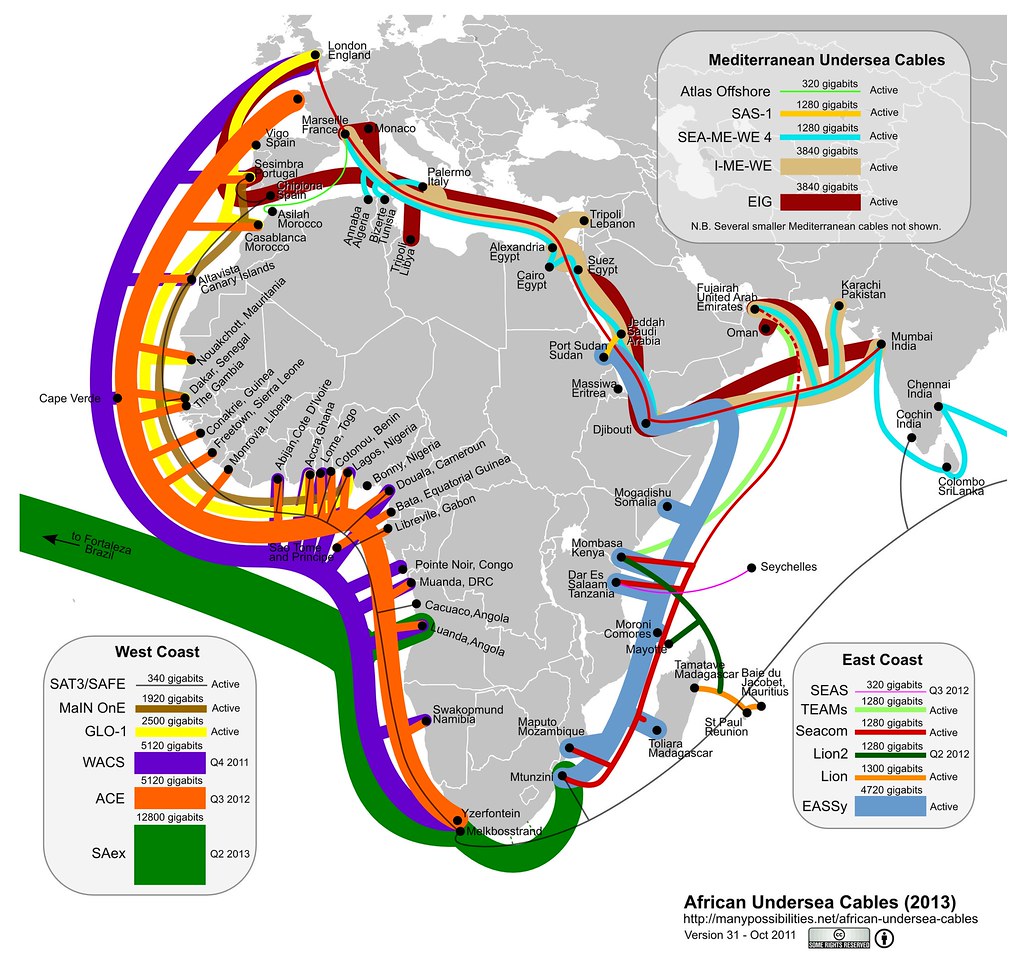
http://farm7.static.flickr.com/6219/6220166808_7ab0aea646_b.jpg
Under-sea cables have come to solve the communication crisis in Africa.
Africa coastline is surrounded by 8 different Sea Cable companies, namely SACOM, EASSy, TEAMs,WACS,MainOne,GL01,ACE and SAex.
EASSy, which is 90% Africa owned, costed KES 2.6million per kilometer. Its 10000 km long.The comparison in cost between road cost and fibre optic cable per km shows a very large variance.
The amount it costs to lay the fibre-optic cables per km is affordable for most African countries.
Internet therefore poses the best bet for communication between African countries.
It has its drawbacks compared to road in that it does not allow for physical face-to face meetings.INTER-GOVERNMENT COMMUNICATION.
Many African Governments lag behind in embracing internet communication. In Africa, internet communication is mainly between citizens communicating to each other.
In Kenya for example, the internet users are over 8 million. Most Government ministries still don’t communicate using the internet. Some ministries have their websites down e.g Ministry of local Government http://www.localgovernment.go.ke/
Others still have outdated info such as this http://www.statehousekenya.go.ke/government/local.htm
Its nearly impossible to get an email reply if you contact the Kenya Government online –except if you email representatives directly through their personal email addresses.
The Permanent Secretary in the Ministry of Information in Kenya, Dr. Bitange Ndemo is very active in online social media and promptly replies to any queries directed to the Ministry of Information.
In Zambia, the Zambia State House website has no contact address .This means that its impossible for any one to contact the Zambian Government online.
http://www.statehouse.gov.zm/
Countries with working websites and prompt online communications in Africa are Uganda, Rwanda, Burundi, South Africa and Zimbabwe.
North African countries such as Tunisia, Sudan and Egypt have their websites in Arabic hence language barrier.
These should include a link to translate to English so that other Africans can communicate with them.
In Nigeria, the number of citizens using the internet for communication is very high yet most Nigeria Government websites are inaccessible and will not reply to communication sent through email.AFRICAN CITIZENS TO DRIVE INTERNET CONNECTIVITY.
It’s obvious that African citizens have embraced internet communication with 118 million users representing 11.5% of total African population.
Source: http://www.internetworldstats.com/stats1.htm
African Governments have lagged behind in offering Government communication to its citizenry through the internet.
Advocacy towards educating Africa Governments, Kenya included, on the benefits of embracing internet as a main method of communication is crucial.AFRICAN CITIZENS COMMUNICATION.
Communication between African citizens has been made efficient through the internet. The lack of Government controls and interference between internet communication has aided in increasing business between African Countries. For example, it’s possible to design a building in Senegal, Rwanda or Uganda through internet communication between an architect’s office in Kenya and the clients in the respective countries.
The bottle neck to this efficient business communication comes in once physical meetings are planned. There are no tarmac link roads and passports are needed to move from one African country to the other. Government permit applications are also not available online-one has to be physically present to make an application. These are bottle-necks created by Governments through their slow uptake of internet communication. If they embrace IT, business will be very efficient. Online building plan and environment impact assessment portals such as http://www.a4architect.com/submit-drawings/ should be used within African Governments to aid in faster, more efficient communication.Architect Francis Gichuhi Kamau
info@a4architect.com
+254721410684