All children, except one, grow up. They soon know that they will grow up, and the way Wendy knew was this. One day when she was two years old she was playing in a garden, and she plucked another flower and ran with it to her mother. I suppose she must have looked rather delightful, for Mrs. Darling put her hand to her heart and cried, “Oh, why can’t you remain like this for ever!” This was all that passed between them on the subject, but henceforth Wendy knew that she must grow up. You always know after you are two. Two is the beginning of the end.
Author: A4KENYA
-
A4ARCHITECT Lead-Paint Hazard Bill
Based on the U.S.A Government Residential Lead-Based Paint Hazard Reduction Act of 1992–Title X
Residential Lead-Based Paint Hazard Reduction Bill of 2010—A4ARCHITECT Lead-Paint Hazard Bill
DRAFT BILL
10th Parliament,
Republic of Kenya
October 2010
SEC. 1001. SHORT TITLE.
This title may be cited as the “Residential Lead-Based Paint
Hazard Reduction Act of 2010.”SEC. 1002. FINDINGS.
Scientific research show that Lead poisoning caused permanent neurological damage to humans especially children under 6 years old. Source:
Radiological Society of North America (2009, December 2). Childhood lead exposure causes permanent brain damage. ScienceDaily. Retrieved October 5, 2010, from http://www.sciencedaily.com/releases/2009/12/091201084152.htmSurveys undertaken in South Africa have shown that a large proportion of children are exposed to lead from a variety of sources.Source:
Lead in Paint: Three Decades Later and Still a Hazard for African Children?
Angela Mathee, Halina Röllin, Jonathan Levin, and Inakshi Naik
Environ Health Perspect. 2007 March; 115(3): 321–322. Published online 2006 December 14. doi: 10.1289/ehp.9575.
PMCID: PMC1849931Scientific Research finds that —
(1) low-level lead poisoning is widespread among Kenyan
children under age 6,with minority and low-income communities disproportionatelyaffected;
(2) at low levels, lead poisoning in children causes
intelligence quotient deficiencies, reading and learning
disabilities, impaired hearing, reduced attention span,
hyperactivity, and behavior problems;
(3) pre-1990 Kenyan housing stock contains high levels of lead in the form of lead-based paint.
(4) the ingestion of household dust containing lead from
deteriorating or abraded lead-based paint is the most common
cause of lead poisoning in children;
(5) the health and development of children living in thousands of Kenyan homes is endangered by chipping or peeling lead paint, or excessive amounts of lead-contaminated dust in their homes;
(6) the danger posed by lead-based paint hazards can be
reduced by abating lead-based paint or by taking interim measures
to prevent paint deterioration and limit children’s exposure to
lead dust and chips;(8) the Kenyan Government must take a leadership role in
building the infrastructure — including an informed public,
County and local delivery systems, certified inspectors,
contractors, and laboratories, trained workers, and available
financing and insurance — necessary to ensure that the national
goal of eliminating lead-based paint hazards in housing can be
achieved as expeditiously as possible.SEC. 1003. PURPOSES.
The purposes of this Act are —
(1) to develop a national strategy to build the
infrastructure necessary to eliminate lead-based paint hazards in
all housing as expeditiously as possible;
(2) to reorient the national approach to the presence of
lead- based paint in housing to implement, on a priority basis, a
broad program to evaluate and reduce lead-based paint hazards in
the Nation’s housing stock;
(3) to encourage effective action to prevent childhood lead
poisoning by establishing a workable framework for lead-based
paint hazard evaluation and reduction and by ending the current
confusion over reasonable standards of care;
(4) to ensure that the existence of lead-based paint hazards is taken into
account in the development of Government housing policies and in
the sale, rental, and renovation of homes and apartments;
(5) to mobilize national resources expeditiously, through a
partnership among all levels of government and the private
sector, to develop the most promising, cost-effective methods for
evaluating and reducing lead-based paint hazards;
(6) to reduce the threat of childhood lead poisoning in
housing owned, assisted, or transferred by the Kenya
Government; and
(7) to educate the public concerning the hazards and sources
of lead-based paint poisoning and steps to reduce and eliminate
such hazards.SEC. 1004. DEFINITIONS.
For the purposes of this Act, the following definitions shall
apply:
(1) Abatement. The term “abatement” means any set of
measures designed to permanently eliminate lead-based paint
hazards in accordance with standards established by appropriate
Government agencies. Such term includes —
(A) the removal of lead-based paint and
lead-contaminated dust, the permanent containment or
encapsulation of lead-based paint, the replacement of
lead-painted surfaces or fixtures, and the removal or covering of
lead contaminated soil; and
(B) all preparation, cleanup, disposal, and
postabatement clearance testing activities associated with such
measures.(2) Accessible surface.
The term “accessible surface” means
an interior or exterior surface painted with lead-based paint
that is accessible for a young child to mouth or chew.(3) Certified contractor. The term “certified contractor”
means —
(A) a contractor, inspector, or supervisor who has
completed a training program certified by the Ministry of Public Works and has met any other requirements for certification or
licensure established by such agency
and
(B) workers or designers who have fully met training
requirements established by the Ministry of Public Works.(4) Contract for the purchase and sale of residential real
property. The term “contract for the purchase and sale of
residential real property” means any contract or agreement in
which one party agrees to purchase an interest in real property
on which there is situated 1 or more residential dwellings used
or occupied, or intended to be used or occupied, or intended to
be used or occupied, in whole or in part, as the home or
residence of 1 or more persons.(5) Deteriorated paint. The term “deteriorated paint” means
any interior or exterior paint that is peeling, chipping,
chalking or cracking or any paint located on an interior or
exterior surface or fixture that is damaged or deteriorated.(6) Evaluation. The term “evaluation” means a risk
assessment, inspection, or risk assessment and inspection.(7) Government assisted housing. The term “Government assisted
housing” means residential dwellings receiving project-based
assistance from the Government of Kenya.(8) Government owned housing. The term “Government owned
housing” means residential dwellings owned or managed by a
Kenyan Governemnt agency, or for which a Government agency is a trustee or
conservator. For the purpose of this paragraph, the term “Governemnt
agency” includes the Ministry of Housing,
the Ministry of Local Authorities,
the Ministry of State of Defense,
the Ministry of Transportation, and any other Governemnt agency.(9) Government supported work. The term “Government supported
work” means any lead hazard evaluation or reduction activities
conducted in Government owned or assisted housing or funded in
whole or in part through any financial assistance program of the
Ministry of Housing.(10) Friction surface. The term “friction surface” means an
interior or exterior surface that is subject to abrasion or
friction, including certain window, floor, and stair surfaces.(11) Impact surface. The term “impact surface” means an
interior or exterior surface that is subject to damage by
repeated impacts, for example, certain parts of door frames.(12) Inspection. The term “inspection” means a surface-by-
surface investigation to determine the presence of lead-based
paint as provided in the Lead-Based Paint Poisoning Prevention Act and the provision of a report explaining the results of the investigation.(13) Interim controls. The term “interim controls” means a
set of measures designed to reduce temporarily human exposure or
likely exposure to lead-based paint hazards, including
specialized cleaning, repairs, maintenance, painting, temporary
containment, ongoing monitoring of lead-based paint hazards or
potential hazards, and the establishment and operation of
management and resident education programs.(14) Lead-based paint. The term “lead-based paint” means
paint or other surface coatings that contain lead in excess of
limits established under the Kenyan Law on the Lead-Based Paint
Poisoning Prevention Act.(15) Lead-based paint hazard. The term “lead-based paint
hazard” means any condition that causes exposure to lead from
lead- contaminated dust, lead-contaminated soil,
lead-contaminated paint that is deteriorated or present in
accessible surfaces, friction surfaces, or impact surfaces that
would result in adverse human health effects as established by
the appropriate Government agency.(16) Lead-contaminated dust. The term “lead-contaminated
dust” means surface dust in residential dwellings that contains
an area or mass concentration of lead in excess of levels
determined by the appropriate Government agency to pose a threat of
adverse health effects in pregnant women or young children.(17) Lead-contaminated soil. The term “lead-contaminated
soil” means bare soil on residential real property that contains
lead at or in excess of the levels determined to be hazardous to
human health by the appropriate Government agency.(18) Mortgage loan. The term “mortgage loan” includes any
loan (other than temporary financing such as a construction loan)
that —
(A) is secured by a first lien on any interest in
residential real property; and
(B) either —
(i) is insured, guaranteed, made, or assisted by
the Ministry of Housing ,
or by
any other agency of the Kenya Government; or
(ii) is intended to be sold by each originating
mortgage institution to any Government chartered secondary
mortgage market institution.(19) Originating mortgage institution. The term “originating
mortgage institution” means a lender that provides mortgage
loans.(20) Priority housing. The term “priority housing” means
target housing that qualifies as affordable housing under Kenyan Law including housing that receives assistance under Kenyan Law.(21) Public housing. The term “public housing” has the same
meaning given the term in the relevant section of Kenyan Law.(22) Reduction. The term “reduction” means measures designed
to reduce or eliminate human exposure to lead-based paint hazards
through methods including interim controls and abatement.(23) Residential dwelling. The term “residential dwelling”
means —
(A) a single-family dwelling, including attached
structures such as porches and stoops; or
(B) a single-family dwelling unit in a structure that
contains more than 1 separate residential dwelling unit, and in
which each such unit is used or occupied, or intended to be used
or occupied, in whole or in part, as the home or residence of 1
or more persons.(24) Residential real property. The term “residential real
property” means real property on which there is situated 1 or
more residential dwellings used or occupied, or intended to be
used or occupied, in whole or in part, as the home or residence
of 1 or more persons.(25) Risk assessment. The term “risk assessment” means an
on-site investigation to determine and report the existence,
nature, severity and location of lead-based paint hazards in the
residential dwellings, including —
(A) information gathering regarding the age and history
of the housing and occupancy by children under age 6;
(B) visual inspection;
(C) limited wipe sampling or other environmental
sampling techniques;
(D) other activity as may be appropriate; and
(E) provision of a report explaining the results of the
investigation.(26) Minister. The term “Minister” means the Minister of
Housing .(27) Target housing. The term “target housing” means any
housing constructed prior to 2010, except housing for the elderly
or persons with disabilities (unless any child who is less than 6
years of age resides or is expected to reside in such housing for
the elderly or persons with disabilities) or any 0-bedroom
dwelling.SUBTITLE A — LEAD-BASED PAINT HAZARD REDUCTION
SEC. 1011. GRANTS FOR LEAD-BASED PAINT HAZARD REDUCTION IN TARGET
HOUSING.(a) General Authority. The Minister is authorized to provide
grants to eligible applicants to evaluate and reduce lead-based
paint hazards in priority housing that is not Government assisted
housing, Government owned housing, or public housing, in
accordance with the provisions of this section.(b) Eligible Applicants. A County or unit of local government that
has an approved comprehensive housing affordability strategy
under the Laws of Kenya is eligible to apply for a grant
under this section.(c) Form of Applications. To receive a grant under this section,
a County or unit of local government shall submit an application
in such form and in such manner as the Minister shall prescribe.
An application shall contain —
(1) a copy of that portion of an applicant’s comprehensive
housing affordability strategy required by the relevant Kenyan Law
(2) a description of the amount of assistance the applicant
seeks under this section;
(3) a description of the planned activities to be undertaken
with grants under this section, including an estimate of the
amount to be allocated to each activity;
(4) a description of the forms of financial assistance to
owners and occupants of priority housing that will be provided
through grants under this section; and
(5) such assurances as the Minister may require regarding
the applicant’s capacity to carry out the activities.(d) Selection Criteria. The Minister shall award grants under
this section on the basis of the merit of the activities proposed
to be carried out and on the basis of selection criteria, which
shall include —
(1) the extent to which the proposed activities will reduce
the risk of lead-based paint poisoning to children under the age
of 6 who reside in priority housing;
(2) the degree of severity and extent of lead-based paint
hazards in the jurisdiction to be served;
(3) the ability of the applicant to leverage County, local,
and private funds to supplement the grant under this section;
(4) the ability of the applicant to carry out the proposed
activities; and
(5) such other factors as the Minister determines
appropriate to ensure that grants made available under this
section are used effectively and to promote the purposes of this
Act.
(e) Eligible Activities. A grant under this section may be used
to —
(1) perform risk assessments and inspections in priority
housing;
(2) provide for the interim control of lead-based paint
hazards in priority housing;
(3) provide for the abatement of lead-based paint hazards in
priority housing;(4) provide for the additional cost of reducing lead-based
paint hazards in units undergoing renovation funded by other
sources;
(5) ensure that risk assessments, inspections, and
abatements are carried out by certified contractors in accordance
with the relevant sections of Knenyan Law;
(6) monitor the blood-lead levels of workers involved in
lead hazard reduction activities funded under this section;
(7) assist in the temporary relocation of families forced to
vacate priority housing while lead hazard reduction measures are
being conducted;
(8) educate the public on the nature and causes of lead
poisoning and measures to reduce the exposure to lead, including
exposure due to residential lead-based paint hazards;
(9) test soil, interior surface dust, and the blood-lead
levels of children under the age of 6 residing in priority
housing after lead-based paint hazard reduction activity has been
conducted, to assure that such activity does not cause excessive
exposures to lead; and
(10) carry out such activities that the Minister determines
appropriate to promote the purposes of this Act.(f) Forms of Assistance. The applicant may provide the services
described in this section through a variety of programs,
including grants, loans, equity investments, revolving loan
funds, loan funds, loan guarantees, interest write-downs, and
other forms of assistance approved by the Minister.(g) Technical Assistance and Capacity Building. —
(1) In general. The Minister shall develop the capacity of
eligible applicants to carry out the requirements of the relevant sections of Kenyan Law and to carry out activities under this section.
(2) Set-aside. Of the total amount approved in appropriation
Acts under subsection (o), there shall be set aside to carry out
this subsection an ammount deemed as sufficient by the Minister.(h) Matching Requirement. Each recipient of a grant under this
section shall make contributions toward the cost of activities
that receive assistance under this section in an amount not less
than 10 percent of the total grant amount under this section.(i) Prohibition of Substitution of Funds. Grants under this
subtitle may not be used to replace other amounts made available
or designated by County or local governments for use for the
purposes under this subtitle.(j) Limitation on Use. An applicant shall ensure that not more
than 10 percent of the grant will be used for administrative
expenses associated with the activities funded.(k) Financial Records. An applicant shall maintain and provide
the Minister with financial records sufficient, in the
determination of the Minister, to ensure proper accounting and
disbursing of amounts received from a grant under this section.(l) Report. An applicant under this section shall submit to the
Minister, for any fiscal year in which the applicant expends
grant funds under this section, a report that —
(1) describes the use of the amounts received;
(2) States the number of risk assessments and the number of
inspections conducted in residential dwellings;
(3) States the number of residential dwellings in which
lead- based paint hazards have been reduced through interim
controls;
(4) States the number of residential dwellings in which
lead- based paint hazards have been abated; and
(5) provides any other information that the Minister
determines to be appropriate.(m) Notice of Funding Availability. The Minister shall publish a
Notice of Funding Availability pursuant to this section not later
than 120 days after funds are appropriated for this section.(n) Relationship to Other Law. Effective 2 years after the date
of promulgation of regulations under the relevsnt Laws of Kenya, no grants for lead-based paint hazard evaluation or reduction may be awarded to a County under this section unless such County has an authorized program under the relevant Laws of Kenya.(o) Authorization of Appropriations. For the purposes of carrying
out this Act, there are authorized to be appropriated an ammount deemed as sufficient by the Minister .SEC. 1012. EVALUATION AND REDUCTION OF LEAD-BASED PAINT HAZARDS
IN GOVERNMENT ASSISTED HOUSING.(a) General Requirements. The relevant Laws of Kenya regarding the Lead-Based Paint-Poisoning Prevention Act is amended —
(1) by inserting:“REQUIREMENTS FOR HOUSING RECEIVING GOVERNMENT ASSISTANCE”;
(2) by inserting: “Beginning on January 1, 2011, such procedures shall
apply to all such housing that constitutes target housing, as
defined in section 1004 of the Residential Lead-Based Paint
Hazard Reduction Act of 2010, and shall provide for appropriate
measures to conduct risk assessments, inspections, interim
controls, and abatement of lead- based paint hazards. At a
minimum, such procedures shall require —
“(A) the provision of lead hazard information
pamphlets, developed pursuant to the relevant Laws of Kenya, to purchasers and tenants;
“(B) periodic risk assessments and interim controls in
accordance with a schedule determined by the Minister, the
initial risk assessment of each unit constructed prior to 2010 to
be conducted not later than January 1, 2011, and for units
constructed between 1960 and 2010 —
“(i) not less than 25 percent shall be performed
by January 1, 2011;
“(ii) not less than 50 percent shall be performed
by January 1, 2012; and
“(iii) the remainder shall be performed by January
1, 2015;
“(C) inspection for the presence of lead-based paint
prior to Government-funded renovation or rehabilitation that is
likely to disturb painted surfaces;
“(D) reduction of lead-based paint hazards in the
course of rehabilitation projects receiving less than KES 2,500,000
per unit in Government funds;
“(E) abatement of lead-based paint hazards in the
course of substantial rehabilitation projects receiving more than
KES 2,500,000 per unit in Government funds;
“(F) where risk assessment, inspection, or reduction
activities have been undertaken, the provision of notice to
occupants describing the nature and scope of such activities and
the actual risk assessment or inspection reports (including
available information on the location of any remaining lead-based
paint on a surface-by-surface basis); and
“(G) such other measures as the Minister deems
appropriate(b) Measurement Criteria. The Lead-Based Paint Poisoning Prevention Act is amended by striking “for the detection” and all that follows through the end
of paragraph (2) and inserting “for the risk assessment, interim
control, inspection, and abatement of lead-based paint hazards in
housing covered by this section shall be based upon guidelines
developed pursuant to section 1017 of the Residential Lead-Based
Paint Hazard Reduction Act of 2010.”.(c) HOME Investment Partnerships. The relevant section of the Kenyan Law on Housing Act is amended by adding at the end the following new
paragraph:
“(3) Lead-based paint hazards. A participating jurisdiction
may use funds provided under this subtitle for the evaluation and
reduction of lead-based paint hazards, as defined in section 1004
of the Residential Lead-Based Paint Hazard Reduction Act of
2010.”.(f) Community Development Block Grants. The relevant section of Kenyan Law
is amended —
(1) by adding at the end the following new paragraph:
“(a) lead-based paint hazard evaluation and reduction,
as defined in section 1004 of the Residential Lead-Based Paint
Hazard Reduction Act of 2010.”.(g) Section 8 Rental Assistance. The relevant section of the Kenyan Law is amended by adding at the end the following: “The Minister may (at the
discretion of the Minister and subject to the availability of
appropriations for contract amendments), on a project by project
basis for projects receiving project-based assistance, provide
adjustments to the maximum monthly rents to cover the costs of
evaluating and reducing lead-based paint hazards, as defined in
section 1004 of the Residential Lead-Based Paint Hazard Reduction
Act of 2010.”.[h] The relevant section of Kenyan Law is amended to read:
“Alterations, repairs, and improvements upon or in
connection with existing structures may also include the
evaluation and reduction of lead-based paint hazards.”; and
(1) by adding at the end the following:
“(a) the terms’evaluation’, ‘reduction’, and ‘lead-based paint hazard’ have the same meanings given those terms in section 1004 of the Residential Led-Based Paint Hazard Reduction Act of 2010.”.
(2) Rehabilitation loans. The relevant section of Kenyan Law is amended by adding at the end the following: “The term ‘rehabilitation’ may
also include measures to evaluate and reduce lead-based paint
hazards, as such terms are defined in section 1004 of the
Residential Lead-Based Paint Hazard Reduction Act of 2010.”.(l) Insurance for Multifamily Housing. The relevant section on Kenyan Law is
amended by inserting the following:
“(including the cost of evaluating and reducing lead-based paint hazards, as such terms are defined in section 1004 of the Residential Lead-Based Paint Hazard Reduction Act of 2010)”.SEC. 1013. DISPOSITION OF GOVERNMENT OWNED HOUSING.
The Lead-Based Paint Poisoning Prevention Actis amended by adding at the end the following:
“(3) Disposition of Government owned housing. —
“(A) Pre-2010 target housing. Beginning on January 1,
2011, procedures established under paragraphs (1) and (2) shall
require the inspection and abatement of lead-based paint hazards
in all Govwernment owned target housing constructed prior to 2010.
“(B) Target housing constructed between 1960 and 2010.
Beginning on January 1, 2011, procedures established under
paragraphs (1) and (2) shall require an inspection for lead-based
paint and lead-based paint hazards in all Government owned target
housing constructed between 1960 and 2010. The results of such
inspections shall be made available to prospective purchasers,
identifying the presence of lead-based paint and lead-based paint
hazards on a surface-by-surface basis. The Minister shall have
the discretion to waive the requirement of this subparagraph for
housing in which a Government funded risk assessment, performed by
a certified contractor, has determined no lead-based paint
hazards are present.
“(C) Budget authority. To the extent that subparagraphs
(A) and (B) increase the cost to the Government of outstanding
direct loan obligations or loan guarantee commitments, such
activities shall be treated as modifications under the relevant section of Kenyan Law and shall be subject to the availability of appropriations. To the extent that paragraphs
(A) and (B) impose additional costs to the Resolution Trust
Corporation and the Government Deposit Insurance Corporation, its
requirements shall be carried out only if appropriations are
provided in advance in an appropriations Act. In the absence of
appropriations sufficient to cover the costs of subparagraphs (A)
and (B), these requirements shall not apply to the affected
agency or agencies.
“(D) Definitions. For the purposes of this subsection,
the terms ‘inspection’, ‘abatement’, ‘lead-based paint hazard’,
‘Government owned housing’, ‘target housing’, ‘risk assessment’,
and ‘certified contractor’ have the same meaning given such terms
in section 1004 of the Residential Lead-Based Paint Hazard
Reduction Act of 2010.
“(4) Definitions. For purposes of this subsection, the terms
‘risk assessment’, ‘inspection’, ‘interim control’, ‘abatement’,
‘reduction’, and ‘lead-based paint hazard’ have the same meaning
given such terms in section 1004 of the Residential Lead-Based
Paint Hazard Reduction Act of 2010.SEC. 1014. COMPREHENSIVE HOUSING AFFORDABILITY STRATEGY.
The relevant Section of Kenyan Lawis amended —
By inserting the following new paragraph:
“(1) estimate the number of housing units within the
jurisdiction that are occupied by low-income families or very
low-income families and that contain lead-based paint hazards, as
defined in section 1004 of the Residential Lead-Based Paint
Hazard Reduction Act of 2010, outline the actions proposed or
being taken to evaluate and reduce lead-based paint hazards, and
describe how lead- based paint hazard reduction will be
integrated into housing policies and programs.”;(B) by adding at the end the following new paragraph:
“(2) Lead-based paint hazards. When preparing that portion of a
housing strategy required by law a jurisdiction
shall consult with County or local health and child welfare
agencies and examine existing data related to lead-based paint
hazards and poisonings, including health Ministry data on the
addresses of housing units in which children have been identified
as lead poisoned.”SEC. 1015. TASK FORCE ON LEAD-BASED PAINT HAZARD REDUCTION AND
FINANCING.(a) In General. The Minister, in consultation with the
Environmental Protection Agency N.E.M.A shall establish a task force to make recommendations on expanding resources and efforts to evaluate and reduce lead-based paint hazards in private housing.(b) Membership. The task force shall include individuals
representing the Ministry of Housing ,National Housing Corporation,
the Environmental Protection Agency N.E.M.A,
employee organizations in the building and construction trades
industry, landlords, tenants, primary lending institutions,
private mortgage insurers, single-family and multifamily real
estate interests, nonprofit housing developers, property
liability insurers, public housing agencies, low-income housing
advocacy organizations, national, County and local lead-poisoning
prevention advocates and experts, and community-based
organizations located in areas with substantial rental housing.
(c) Responsibilities. The task force shall make recommendations
to the Minister and the Drector-General of the Environmental
Protection Agency N.E.M.A.concerning —
(1) incorporating the need to finance lead-based paint
hazard reduction into underwriting standards;
(2) developing new loan products and procedures for
financing lead-based paint hazard evaluation and reduction
activities;
(3) adjusting appraisal guidelines to address lead safety;
(4) incorporating risk assessments or inspections for
lead-based paint as a routine procedure in the origination of new
residential mortgages;
(5) revising guidelines, regulations, and educational
pamphlets issued by the Ministry of Housing and other Government agencies relating to lead-based paint poisoning prevention;
(6) reducing the current uncertainties of liability related
to lead-based paint in rental housing by clarifying standards of
care for landlords and lenders, and by exploring the “safe
harbor” concept;
(7) increasing the availability of liability insurance for
owners of rental housing and certified contractors and
establishing alternative systems to compensate victims of
lead-based paint poisoning; and
(8) evaluating the utility and appropriateness of requiring
risk assessments or inspections and notification to prospective
lessees of rental housing.(d) Compensation. The members of the task force shall not receive
Government compensation for their participation.SEC. 1016. NATIONAL CONSULTATION ON LEAD-BASED PAINT HAZARD
REDUCTION.In carrying out this Act, the Minister shall consult on an
ongoing basis with the Director-General of the Environmental
Protection Agency, the Director of the Centers for Disease
Control, other Government agencies concerned with lead poisoning
prevention, and the task force established pursuant to section
1015.SEC. 1017. GUIDELINES FOR LEAD-BASED PAINT HAZARD EVALUATION AND
REDUCTION ACTIVITIES.Not later than 12 months after the date of enactment of this Act,
the Minister, in consultation with the Director-General of the
Environmental Protection Agency, the Minister of Labor, and the
Minister of Health (acting through the
Director of the Centers for Disease Control), shall issue
guidelines for the conduct of all Government supported work
involving risk assessments, inspections, interim controls, and
abatement of lead-based paint hazards. Such guidelines shall be
based upon criteria that measure the condition of the housing
(and the presence of children under age 6 for the purposes of
risk assessments) and shall not be based upon criteria that
measure the health of the residents of the housing.SEC. 1018. DISCLOSURE OF INFORMATION CONCERNING LEAD UPON
TRANSFER OF RESIDENTIAL PROPERTY.(a) Lead Disclosure in Purchase and Sale or Lease of Target
Housing. —
(1) Lead-based paint hazards. Not later than 2 years after
the date of enactment of this Act, the Minister and the
Director-General of the Environmental Protection Agency N.E.M.A shall
promulgate regulations under this section for the disclosure of
lead-based paint hazards in target housing which is offered for
sale or lease. The regulations shall require that, before the
purchaser or lessee is obligated under any contract to purchase
or lease the housing, the seller or lessor shall —
(A) provide the purchaser or lessee with a lead hazard
information pamphlet, as prescribed by the Director-General of the
Environmental Protection Agency N.E.M.A under the Toxic
Substances Control Act;
(B) disclose to the purchaser or lessee the presence of
any known lead-based paint, or any known lead-based paint
hazards, in such housing and provide to the purchaser or lessee
any lead hazard evaluation report available to the seller or
lessor; and
(C) permit the purchaser a 10-day period (unless
the parties mutually agree upon a different period of time) to
conduct a risk assessment or inspection for the presence of
lead-based paint hazards.
(2) Contract for purchase and sale. Regulations promulgated
under this section shall provide that every contract or the
purchase and sale of any interest in target housing shall contain
a Lead Warning Countyment and a Countyment signed by the purchaser
that the purchaser has —
(A) read the Lead Warning Countyment and understands its
contents;
(B) received a lead hazard information pamphlet; and
(C) had a 10-day opportunity (unless the parties
mutually agreed upon a different period of time) before becoming
obligated under the contract to purchase the housing to conduct a
risk assessment or inspection for the presence of lead-based
paint hazards.
(3) Contents of lead warning Countyment. The Lead Warning
Countyment shall contain the following text printed in large type
on a separate sheet of paper attached to the contract:
“Every purchaser of any interest in residential real
property on which a residential dwelling was built prior to 2010
is notified that such property may present exposure to lead from
lead-based paint that may place young children at risk of
developing lead poisoning. Lead poisoning in young children may
produce permanent neurological damage, including learning
disabilities, reduced intelligence quotient, behavioral problems,
and impaired memory. Lead poisoning also poses a particular risk
to pregnant women. The seller of any interest in residential real
property is required to provide the buyer with any information on
lead-based paint hazards from risk assessments or inspections in
the seller’s possession and notify the buyer of any known
lead-based paint hazards. A risk assessment or inspection for
possible lead-based paint hazards is recommended prior to
purchase.”.
(4) Compliance Assurance. Whenever a seller or lessor has
entered into a contract with an agent for the purpose of selling
or leasing a unit of target housing, the regulations promulgated
under this section shall require the agent, on behalf of the
seller or lessor, to ensure compliance with the requirements of
this section.
(5) Promulgation. A suit may be brought against the
Minister of Housing and the Director-General
of the Environmental Protection Agency N.E.M.A under the
Toxic Substances Control Act to compel promulgation of the
regulations required under this section and the Government High
court shall have jurisdiction to order such promulgation.(b) Penalties for Violations. —
(1) Monetary penalty. Any person who knowingly violates any
provision of this section shall be subject to civil money
penalties in accordance with the provisions of the
Ministry of Housing Act .
(2) Action by Minister. The Minister is authorized to take
such lawful action as may be necessary to enjoin any violation of
this section.
(3) Civil liability. Any person who knowingly violates the
provisions of this section shall be jointly and severally liable
to the purchaser or lessee in an amount equal to 3 times the
amount of damages incurred by such individual.
(4) Costs. In any civil action brought for damages pursuant
to paragraph (3), the appropriate court may award court costs to
the party commencing such action, together with reasonable
attorney fees and any expert witness fees, if that party
prevails.
(5) Prohibited act. It shall be a prohibited act under
the Toxic Substances Control Act for any person to fail or refuse to comply with a provision of this section or with any rule or order issued under this section. For purposes of enforcing this section under the Toxic Substances Control Act, the penalty for each violation applicable under that Act shall not be more than KES 100,000.(c) Validity of Contracts and Liens. Nothing in this section
shall affect the validity or enforceability of any sale or
contract for the purchase and sale or lease of any interest in
residential real property or any loan, loan agreement, mortgage,
or lien made or arising in connection with a mortgage loan, nor
shall anything in this section create a defect in title.(d) Effective Date. The regulations under this section shall take
effect 3 years after the date of the enactment of this title.SUBTITLE B — LEAD EXPOSURE REDUCTION
SEC. 1021. CONTRACTOR TRAINING AND CERTIFICATION.
(a) Amendment to the Toxic Substances Control Act. The Toxic
Substances Control Act is amended by adding the following new title:“TITLE IV — LEAD EXPOSURE REDUCTION
” DEFINITIONS.
“For the purposes of this title:
“(1) Abatement. The term ‘abatement’ means any set of measures
designed to permanently eliminate lead-based paint hazards in
accordance with standards established by the Director-General under
this title. Such term includes —
“(A) the removal of lead-based paint and lead-contaminated
dust, the permanent containment or encapsulation of lead-based
paint, the replacement of lead-painted surfaces or fixtures, and
the removal or covering of lead-contaminated soil; and
“(B) all preparation, cleanup, disposal, and postabatement
clearance testing activities associated with such measures.
“(2) Accessible surface. The term ‘accessible surface’ means an
interior or exterior surface painted with lead-based paint that
is accessible for a young child to mouth or chew.
“(3) Deteriorated paint. The term ‘deteriorated paint’ means any
interior or exterior paint that is peeling, chipping, chalking or
cracking or any paint located on an interior or exterior surface
or fixture that is damaged or deteriorated.
“(4) Evaluation. The term ‘evaluation’ means risk assessment,
inspection, or risk assessment and inspection.
“(5) Friction surface. The term ‘friction surface’ means an
interior or exterior surface that is subject to abrasion or
friction, including certain window, floor, and stair surfaces.
“(6) Impact surface. The term ‘impact surface’ means an interior
or exterior surface that is subject to damage by repeated
impacts, for example, certain parts of door frames.
“(7) Inspection. The term ‘inspection’ means
“(A) a surface-by-surface investigation to determine the
presence of lead-based paint, as provided in the Lead-Based Paint Poisoning Prevention Act, and
“(B) the provision of a report explaining the results of the
investigation.
“(8) Interim controls. The term ‘interim controls’ means a set of
measures designed to reduce temporarily human exposure or likely
exposure to lead-based paint hazards, including specialized
cleaning, repairs, maintenance, painting, temporary containment,
ongoing monitoring of lead-based paint hazards or potential
hazards, and the establishment an operation of management and
resident education programs.
“(9) Lead-based paint. The term ‘lead-based paint’ means paint or
other surface coatings that contain lead in excess of 1.0
milligrams per centimeter squared or 0.5 percent by weight or
“(A) in the case of paint or other surface coatings on
target housing, such lower level as may be established by the
Minister of Housing, as defined in the Lead-Based Paint Poisoning Prevention Act, or
“(B) in the case of any other paint or surface coatings,
such other level as may be established by the Director-General.
“(10) Lead-based paint hazard. The term ‘lead-based paint hazard’
means any condition that causes exposure to lead from
lead-contaminated dust, lead-contaminated soil, lead-contaminated
paint that is deteriorated or present in accessible surfaces,
friction surfaces, or impact surfaces that would result in
adverse human health effects as established by the Director-General
under this title.
“(11) Lead-contaminated dust. The term ‘lead-contaminated dust’
means surface dust in residential dwellings that contains an area
or mass concentration of lead in excess of levels determined by
the Director-General under this title to pose a threat of adverse
health effects in pregnant women or young children.
“(12) Lead-contaminated soil. The term ‘lead-contaminated soil’
means bare soil on residential real property that contains lead
at or in excess of the levels determined to be hazardous to human
health by the Director-General under this title.
“(13) Reduction. The term ‘reduction’ means measures designed to
reduce or eliminate human exposure to lead-based paint hazards
through methods including interim controls and abatement.
“(14) Residential dwelling. The term ‘residential dwelling’
means–
“(A) a single-family dwelling, including attached structures
such as porches and stoops; or
“(B) a single-family dwelling unit in a structure that
contains more than 1 separate residential dwelling unit, and in
which each such unit is used or occupied, or intended to be used
or occupied, in whole or in part, as the home or residence of 1
or more persons.
“(15) Residential real property. The term ‘residential real
property’ means real property on which there is situated 1 or
more residential dwellings used or occupied, or intended to be
used or occupied, in whole or in part, as the home or residence
of 1 or more persons.
“(16) Risk assessment. The term ‘risk assessment’ means an
on-site investigation to determine and report the existence,
nature, severity and location of lead-based paint hazards in
residential dwellings, including —
“(A) information gathering regarding the age and history of
the housing and occupancy by children under age 6;
“(B) visual inspection;
“(C) limited wipe sampling or other environmental sampling
techniques;
“(D) other activity as may be appropriate; and
“(E) provision of a report explaining the results of the
investigation.
“(17) Target housing. The term ‘target housing’ means any housing
constructed prior to 2010, except housing for the elderly or
persons with disabilities (unless any child who is less than 6
years of age resides or is expected to reside in such housing for
the elderly or persons with disabilities) or any 0-bedroom
dwelling.“SEC. 402. LEAD-BASED PAINT ACTIVITIES TRAINING AND
CERTIFICATION.“(a) Regulations. —
“(1) In general. Not later than 18 months after the date of
the enactment of this section, the Director-General shall, in
consultation with the Minister of Labor, the Minister of
Housing, and the Minister of Health and Health Services (acting through the
Director of Public Health), promulgate final regulations governing lead-based
paint activities to ensure that individuals engaged in such activities are
properly trained; that training programs are accredited; and that contractors
engaged in such activities are certified. Such regulations shall contain
standards for performing lead-based paint activities, taking into
account reliability, effectiveness, and safety. Such regulations
shall require that all risk assessment, inspection, and abatement
activities performed in target housing shall be performed by
certified contractors, as such term is defined in section 1004 of
the Residential Lead-Based Paint Hazard Reduction Act of 2010.
The provisions of this section shall supersede the provisions set
forth under the heading ‘Lead Abatement Training and
Certification’ and under the heading ‘Training Grants’ in title
III of the Act entitled ‘An Act making appropriations for the
Ministrys of Home Affairs and Housing, and for sundry independent agencies,
commissions,corporations, and offices for the fiscal year ending September
30, 2011, and for other purposes’, Public Law, and upon
the enactment of this section the provisions set forth in such
public law under such headings shall cease to have any force and
effect.
“(2) Accreditation of training programs. Final regulations
promulgated under (1) shall contain specific requirements for the
accreditation of lead-based paint activities training programs
for workers, supervisors, inspectors and planners, and other
individuals involved in lead-based paint activities, including,
but not limited to, each of the following:
“(A) Minimum requirements for the accreditation of
training providers.
“(B) Minimum training curriculum requirements.
“(C) Minimum training hour requirements.
“(D) Minimum hands-on training requirements.
“(E) Minimum trainee competency and proficiency
requirements.
“(F) Minimum requirements for training program quality
control.
“(3) Accreditation and certification fees. The Director-General
(or the County in the case of an authorized County program) shall
impose a fee on —
“(A) persons operating training programs accredited
under this title; and
“(B) lead-based paint activities contractors certified
in accordance with paragraph (1).The fees shall be established at such level as is necessary to
cover the costs of administering and enforcing the standards and
regulations under this section which are applicable to such
programs and contractors. The fee shall not be imposed on any
County, local government, or nonprofit training program. The
Director-General (or the County in the case of an authorized County
program) may waive the fee for lead-based paint activities
contractors under subparagraph (A) for the purpose of training
their own employees.“(b) Lead-Based Paint Activities. For purposes of this title, the
term ‘lead-based paint activities’ means —
“(1) in the case of target housing, risk assessment,
inspection, and abatement; and
“(2) in the case of any public building constructed before
2010, commercial building, bridge, or other structure or
super-structure, identification of lead-based paint and materials
containing lead-based paint, deleading, removal of lead from
bridges, and demolition.For purposes of paragraph (2), the term ‘deleading’ means
activities conducted by a person who offers to eliminate
lead-based paint or lead-based paint hazards or to plan such
activities.“(c) Renovation and Remodeling. —
“(1) Guidelines. In order to reduce the risk of exposure to
lead in connection with renovation and remodeling of target
housing, public buildings constructed before 2010, and commercial
buildings, the Director-General shall, within 18 months after the
enactment of this section, promulgate guidelines for the conduct
of such renovation and remodeling activities which may create a
risk of exposure to dangerous levels of lead. The Director-General
shall disseminate such guidelines to persons engaged in such
renovation and remodeling through hardware and paint stores,
employee organizations, trade groups, County and local agencies,
and through other appropriate means.
“(2) Study of certification. The Director-General shall conduct
a study of the extent to which persons engaged in various types
of renovation and remodeling activities in target housing, public
buildings constructed before 2010, and commercial buildings are
exposed to lead in the conduct of such activities or disturb lead
and create a lead-based paint hazard on a regular or occasional
basis. The Director-General shall complete such study and publish
the results thereof within 30 months after the enactment of this
section.
“(3) Certification determination. Within 4 years after the
enactment of this section, the Director-General shall revise the
regulations under subsection (a) to apply the regulations to
renovation or remodeling activities in target housing, public
buildings constructed before 2010, and commercial buildings that
create lead-based paint hazards. In determining which contractors
are engaged in such activities, the Director-General shall utilize
the results of the study under paragraph (2) and consult with the
representatives of labor organizations, lead-based paint
activities contractors, persons engaged in remodeling and
renovation, experts in lead health effects, and others. If the
Director-General determines that an category of contractors engaged
in renovation or remodeling does not require certification, the
Director-General shall publish an explanation of the basis for that
determination.“SEC. 403. IDENTIFICATION OF DANGEROUS LEVELS OF LEAD.
“Within 18 months after the enactment of this title, the
Director-General shall promulgate regulations which shall identify,
for purposes of this title, and the Residential Lead-Based Paint
Hazard Reduction Act of 2010, lead-based paint hazards,
lead-contaminated dust, and lead-contaminated soil.“SEC. 404. AUTHORIZED COUNTY PROGRAMS.
“(a) Approval. Any County which seeks to administer and enforce
the standards, regulations, or other requirements established
under the relevant Laws, may, after notice and
opportunity for public hearing, develop and submit to the
Director-General an application, in such form as the Director-General
shall require, for authorization of such a County program. Any
such County may also certify to the Director-General at the time of
submitting such program that the County program meets the
requirements of paragraphs (1) and (2) of subsection (b). Upon
submission of such certification, the County program shall be
deemed to be authorized under this section, and shall apply in
such County in lieu of the corresponding Government program under
section 402 or 406, or both, as the case may be, until such time
as the Director-General disapproves the program or withdraws the
authorization.“(b) Approval or Disapproval. Within 180 days following
submission of an application under subsection (a), the
Director-General shall approve or disapprove the application. The
Director-General may approve the application only if, after notice
and after opportunity for public hearing, the Director-General finds
that —
“(1) the County program is at least as protective of human
health and the environment as the Government program under the relevant Laws as the case may be, and
“(2) such County program provides adequate enforcement.Upon authorization of a County program under this section, it
shall be unlawful for any person to violate or fail or refuse to
comply with any requirement of such program.“(c) Withdrawal of Authorization. If a County is not administering
and enforcing a program authorized under this section in
compliance with standards, regulations, and other requirements of
this title, the Director-General shall so notify the County and, if
corrective action is not completed within a reasonable time, not
to exceed 180 days, the Director-General shall withdraw
authorization of such program and establish a Government program
pursuant to this title.“(d) Model County Program. Within 18 months after the enactment of
this title, the Director-General shall promulgate a model County
program which may be adopted by any County which seeks to
administer and enforce a County program under this title. Such
model program shall, to the extent practicable, encourage Countys
to utilize existing County and local certification and
accreditation programs and procedures. Such program shall
encourage reciprocity among the Countys with respect to the
certification under section 402.“(e) Other County Requirements. Nothing in this title shall be
construed to prohibit any County or political subdivision thereof
from imposing any requirements which are more stringent than
those imposed by this title.“(f) County and Local Certification. The regulations under this
title shall, to the extent appropriate, encourage Countys to seek
program authorization and to use existing County and local
certification and accreditation procedures, except that a County
or local government shall not require more than 1 certification
under this section for any lead-based paint activities contractor
to carry out lead-based paint activities in the County or
political subdivision thereof.“(g) Grants to Countys. The Director-General is authorized to make
grants to Countys to develop and carry out authorized County
programs under this section. The grants shall be subject to such
terms and conditions as the Director-General may establish to
further the purposes of this title.“(h) Enforcement by Director-General. If a County does not have a
County program authorized under this section and in effect by the
date which is 2 years after promulgation of the regulations under
section 402 or 406, the Director-General shall, by such date,
establish a Government program for such County and administer and enforce such program in such County.“SEC. 405. LEAD ABATEMENT AND MEASUREMENT.
“(a) Program To Promote Lead Exposure Abatement. The
Director-General, in cooperation with other appropriate Government
Ministrys and agencies, shall conduct a comprehensive program
to promote safe, effective, and affordable monitoring, detection,
and abatement of lead-based paint and other lead exposure
hazards.“(b) Standards for Environmental Sampling Laboratories. (1) The
Director-General shall establish protocols, criteria, and minimum
performance standards for laboratory analysis of lead in paint
films, soil, and dust. Within 2 years after the enactment of
this title, the Director-General, in consultation with the Minister
of Health and Health Services, shall establish a program to
certify laboratories as qualified to test substances for lead
content unless the Director-General determines, by the date
specified in this paragraph, that effective voluntary
accreditation programs are in place and operating on a nationwide
basis at the time of such determination. To be certified under
such program, a laboratory shall, at a minimum, demonstrate an
ability to test substances accurately for lead content.
“(2) Not later than 24 months after the date of the
enactment of this section, and annually thereafter, the
Director-General shall publish and make available to the public a
list of certified or accredited environmental sampling
laboratories. “(3) If the Director-General determines under
paragraph (1) that effective voluntary accreditation programs are
in place for environmental sampling laboratories, the
Director-General shall review the performance and effectiveness of
such programs within 3 years after such determination. If, upon
such review, the Director-General determines that the voluntary
accreditation programs are not effective in assuring the quality
and consistency of laboratory analyses, the Director-General shall,
not more than 12 months thereafter, establish a certification
program that meets the requirements of paragraph (1).“(c) Exposure Studies.
(1) The Ministers of Health and Health Services (hereafter in
this subsection referred to as the ‘Ministers’), acting through
the Director of Public Health, and the
Director of Environmental Health, shall jointly conduct a study of the sources
of lead exposure in children who have elevated blood lead levels (or
other indicators of elevated lead body burden), as defined by the
Director of the Centers for Disease Control.
“(2) The Minister, in consultation with the Director of the
National Institute for Occupational Safety and Health, shall
conduct a comprehensive study of means to reduce hazardous
occupational lead abatement exposures. This study shall include,
at a minimum, each of the following —
“(A) Surveillance and intervention capability in the
Countys to identify and prevent hazardous exposures to lead
abatement workers.
“(B) Demonstration of lead abatement control methods
and devices and work practices to identify and prevent hazardous
lead exposures in the workplace.
“(C) Evaluation,
in consultation with the National Institute of Environmental
Health, of health effects of low and high levels of
occupational lead exposures on reproductive, neurological, renal,
and cardiovascular health.
“(D) Identification of high risk occupational settings
to which prevention activities and resources should be targeted.
“(E) A study assessing the potential exposures and
risks from lead to janitorial and custodial workers.
“(3) The studies described in paragraphs (1) and (2) shall,
as appropriate, examine the relative contributions to elevated
lead body burden from each of the following:
“(A) Drinking water.
“(B) Food.
“(C) Lead-based paint and dust from lead-based paint.
“(D) Exterior sources such as ambient air and lead in
soil.
“(E) Occupational exposures, and other exposures that
the Minister determines to be appropriate.
“(4) Not later than 30 months after the date of the
enactment of this section, the Minister shall submit a report to
the Parliament concerning the studies described in paragraphs (1)
and (2).“(d) Public Education. (1) The Director-General, in conjunction with
the Minister of Health and Health Services, acting through the
Director of the Pharmarcy and Poisons Board,
and in conjunction with the Minister of Housing, shall sponsor public education and outreach activities to increase public awareness of —
“(A) the scope and severity of lead poisoning from
household sources;
“(B) potential exposure to sources of lead in schools
and childhood day care centers;
“(C) the implications of exposures for men and women,
particularly those of childbearing age;
“(D) the need for careful, quality, abatement and
management actions;
“(E) the need for universal screening of children;
“(F) other components of a lead poisoning prevention
program;
“(G) the health consequences of lead exposure resulting
from lead-based paint hazards;
“(H) risk assessment and inspection methods for
lead-based paint hazards; and
“(I) measures to reduce the risk of lead exposure from
lead-based paint.
“(2) The activities described in paragraph (1) shall be
designed to provide educational services and information to —
“(A) health professionals;
“(B) the general public, with emphasis on parents of
young children;
“(C) homeowners, landlords, and tenants;
“(D) consumers of home improvement products;
“(E) the residential real estate industry; and
“(F) the home renovation industry.
“(3) In implementing the activities described in paragraph
(1), the Director-General shall assure coordination with the
President’s Commission on Environmental Quality’s education and
awareness campaign on lead poisoning.
“(4) The Director-General in consultation with the Chairman of
the Consumer Product Safety Commission, shall develop information
to be distributed by retailers of home improvement products to
provide consumers with practical information related to the
hazards of renovation and remodeling where lead-based paint may
be present.“(e) Technical Assistance. —
“(1) Clearinghouse. Not later than 6 months after the
enactment of this subsection, the Director-General shall establish,
in consultation with the Minister of Housing and the Director of the Centers for Disease Control,
a National Clearinghouse on Childhood Lead Poisoning (hereinafter
in this section referred to as ‘Clearinghouse’). The
Clearinghouse shall–
“(A) collect, evaluate, and disseminate current
information on the assessment and reduction of lead-based paint
hazards, adverse health effects, sources of exposure, detection
and risk assessment methods, environmental hazards abatement, and
clean-up standards;
“(B) maintain a rapid-alert system to inform certified
lead-based paint activities contractors of significant
developments in research related to lead-based paint hazards; and
“(C) perform any other duty that the Director-General
determines necessary to achieve the purposes of this Act.
“(2) Hotline. Not later than 6 months after the enactment of
this subsection, the Director-General, in cooperation with other
Government agencies and with County and local governments, shall
establish a single lead-based paint hazard hotline to provide the
public with answers to questions about lead poisoning prevention
and referrals to the Clearinghouse for technical information.“(f) Products for Lead-Based Paint Activities. Not later than 30
months after the date of enactment of this section, the President
shall, after notice and opportunity for comment, establish by
rule appropriate criteria, testing protocols, and performance
characteristics as are necessary to ensure, to the greatest
extent possible and consistent with the purposes and policy of
this title, that lead-based paint hazard evaluation and reduction
products introduced into commerce after a period specified in the
rule are effective for the intended use described by the
manufacturer. The rule shall identify the types or classes of
products that are subject to such rule. The President, in
implementation of the rule, shall to the maximum extent possible,
utilize independent testing laboratories, as appropriate, and
consult with such entities and others in developing the rules.
The President may delegate the authorities under this subsection
to the Environmental Protection Agency N.E.M.A or the Minister of
Trade or such other appropriate agency.“SEC. 406. LEAD HAZARD INFORMATION PAMPHLET.
“(a) Lead Hazard Information Pamphlet. Not later than 2 years
after the enactment of this section, after notice and opportunity
for comment, the Director-General of the Environmental Protection
Agency, in consultation with the Minister of Housing and with the Minister of Health and Health Services,
shall publish, and from time to time revise, a lead hazard
information pamphlet to be used in connection with this title and
section 1018 of the Residential Lead-Based Paint Hazard Reduction
Act of 2010. The pamphlet shall —
“(1) contain information regarding the health risks
associated with exposure to lead;
“(2) provide information on the presence of lead-based paint
hazards in Government assisted, Government owned, and target
housing;
“(3) describe the risks of lead exposure for children under
6 years of age, pregnant women, women of childbearing age,
persons involved in home renovation, and others residing in a
dwelling with lead-based paint hazards;
“(4) describe the risks of renovation in a dwelling with
lead-based paint hazards;
“(5) provide information on approved methods for evaluating
and reducing lead-based paint hazards and their effectiveness in
identifying, reducing, eliminating, or preventing exposure to
lead-based paint hazards;
“(6) advise persons how to obtain a list of contractors
certified pursuant to this title in lead-based paint hazard
evaluation and reduction in the area in which the pamphlet is to
be used;
“(7) State that a risk assessment or inspection for
lead-based paint is recommended prior to the purchase, lease, or
renovation of target housing;
“(8) State that certain County and local laws impose
additional requirements related to lead-based paint in housing
and provide a listing of Government, County, and local agencies in
each County, including address and telephone number, that can
provide information about applicable laws and available
governmental and private assistance and financing; and
“(9) provide such other information about environmental
hazards associated with residential real property as the
Director-General deems appropriate.“(b) Renovation of Target Housing. Within 2 years after the
enactment of this section, the Director-General shall promulgate
regulations under this subsection to require each person who
performs for compensation a renovation of target housing to
provide a lead hazard information pamphlet to the owner and
occupant of such housing prior to commencing the renovation.“SEC. 407. REGULATIONS.
“The regulations of the Director-General under this title shall
include such recordkeeping and reporting requirements as may be
necessary to insure the effective implementation of this title.
The regulations may be amended from time to time as necessary.“SEC. 408. CONTROL OF LEAD-BASED PAINT HAZARDS AT GOVERNMENT
FACILITIES.“Each Ministry, agency, and instrumentality of executive,
legislative, and judicial branches of the Government (1)
having jurisdiction over any property or facility, or (2) engaged
in any activity resulting, or which may result, in a lead-based
paint hazard, and each officer, agent, or employee thereof, shall
be subject to, and comply with, all Government, County, interCounty,
and local requirements, both substantive and procedural
(including any requirement for certification, licensing,
recordkeeping, or reporting or any provisions for injunctive
relief and such sanctions as may be imposed by a court to enforce
such relief) respecting lead-based paint, lead-based paint
activities, and lead-based paint hazards in the same manner, and
to the same extent as any nongovernmental entity is subject to
such requirements, including the payment of reasonable service
charges. The Government, County, interCounty, and local substantive
and procedural requirements referred to in this subsection
include, but are not limited to, all administrative orders and
all civil and administrative penalties and fines regardless of
whether such penalties or fines are punitive or coercive in
nature, or whether imposed for isolated, intermittent or
continuing violations. The Kenya Government hereby expressly waives
any immunity otherwise applicable to the Kenya Governement with
respect to any such substantive or procedural requirement
(including, but not limited to, any injunctive relief,
administrative order, or civil or administrative penalty or fine
referred to in the preceding sentence, or reasonable service
charge). The reasonable service charges referred to in this
section include, but are not limited to, fees or charges assessed
for certification and licensing, as well as any other
nondiscriminatory charges that are assessed in connection with a
Government, County, interCounty, or local lead-based paint, lead-based
paint activities, or lead-based paint hazard activities program.
No agent, employee, or officer of the Kenya Government shall be
personally liable for any civil penalty under any Government, County,
interCounty, or local law relating to lead-based paint, lead-based
paint activities, or lead-based paint hazards with respect to any
act or omission within the scope of his official duties.“SEC. 409. PROHIBITED ACTS.
“It shall be unlawful for any person to fail or refuse to comply
with a provision of this title or with any rule or order issued
under this title.“SEC. 410. RELATIONSHIP TO OTHER GOVERNMENT LAW.
“Nothing in this title shall affect the authority of other
appropriate Government agencies to establish or enforce any
requirements which are at least as stringent as those established
pursuant to this title.“SEC. 411. GENERAL PROVISIONS RELATING TO ADMINISTRATIVE
PROCEEDINGS.“(a) Applicability. This section applies to the promulgation or
revision of any regulation issued under this title.“(b) Rulemaking Docket. Not later than the date of proposal of an
action to which this section applies, the Director-General shall
establish a rulemaking docket for such action (hereinafter in
this subsection referred to as a ‘rule’). Whenever a rule applies
only within a particular County, a second (identical) docket shall
be established in the appropriate regional office of the
Environmental Protection Agency.“(c) Inspection and Copying. (1) The rulemaking docket required
under subsection (b) shall be open for inspection by the public
at reasonable times specified in the notice of proposed
rulemaking. Any person may copy documents contained in the
docket. The Director-General shall provide copying facilities which
may be used at the expense of the person seeking copies, but the
Director-General may waive or reduce such expenses in such instances
as the public interest requires. Any person may request copies by
mail if the person pays the expenses, including personnel costs
to do the copying.
“(2)(A) Promptly upon receipt by the agency, all written
comments and documentary information on the proposed rule
received from any person for inclusion in the docket during the
comment period shall be placed in the docket. The transcript of
public hearings, if any, on the proposed rule shall also be
included in the docket promptly upon receipt from the person who
transcribed such hearings. All documents which become available
after the proposed rule has been published and which the
Director-General determines are of central relevance to the
rulemaking shall be placed in the docket as soon as possible
after their availability.
“(B) The drafts of proposed rules submitted by the
Director-General to the Office of Management and Budget for any
interagency review process prior to proposal of any such rule,
all documents accompanying such drafts, and all written comments
thereon by other agencies and all written responses to such
written comments by the Director-General shall be placed in the
docket no later than the date of proposal of the rule. The drafts
of the final rule submitted for such review process prior to
promulgation and all such written comments thereon, all documents
accompanying such drafts, and written responses thereto shall be
placed in the docket no later than the date of promulgation.“(d) Explanation. (1) The promulgated rule shall be accompanied
by an explanation of the reasons for any major changes in the
promulgated rule from the proposed rule.
“(2) The promulgated rule shall also be accompanied by a
response to each of the significant comments, criticisms, and new
data submitted in written or oral presentations during the
comment period.
“(3) The promulgated rule may not be based (in part or
whole) on any information or data which has not been placed in
the docket as of the date of such promulgation.“(e) Judicial Review. The material referred to in subsection
(c)(2)(B) shall not be included in the record for judicial
review.“(f) Effective Date. The requirements of this section shall take
effect with respect to any rule the proposal of which occurs
after 90 days after the date of the enactment of this section.“SEC. 412. AUTHORIZATION OF APPROPRIATIONS.
“There are authorized to be appropriated to carry out the
purposes of this title such sums as may be necessary.”.“TITLE IV — LEAD EXPOSURE REDUCTION
“Sec. 401. Definitions.
“Sec. 402. Lead-based paint activities training and
certification.“Sec. 403. Identification of dangerous levels of lead.
“Sec. 404. Authorized County programs.
“Sec. 405. Lead abatement and measurement.
“Sec. 406. Lead hazard information pamphlet.
“Sec. 407. Regulations.
“Sec. 408. Control of lead-based paint hazards at Government
facilities.“Sec. 409. Prohibited acts.
“Sec. 410. Relationship to other Government law.
“Sec. 411. General provisions relating to administrative
proceedings.“Sec. 412. Authorization of appropriations.”.
(c) Short Title. This subtitle may be cited as the “Lead- Based
Paint Exposure Reduction Act”.SUBTITLE C — WORKER PROTECTION
SEC. 1031. WORKER PROTECTION.
Not later than 180 days after the enactment of this Act, the
Minister of Labor shall issue an interim final regulation
regulating occupational exposure to lead in the construction
industry. Such interim final regulation shall provide employment
and places of employment to employees which are as safe and
healthful as those which would prevail under the Ministry of
Housing guidelines .
Such interim final regulations shall take effect upon issuance
(except that such regulations may include a reasonable delay in
the effective date), shall have the legal effect of an
Occupational Safety and Health Standard, and shall apply until a
final standard becomes effective under the
Occupational Safety and Health Act.SEC. 1032. COORDINATION BETWEEN ENVIRONMENTAL PROTECTION AGENCY
AND MINISTRY OF LABOR.The Minister of Labor, in promulgating regulations under section
1031, shall consult and coordinate with the Director-General of the
Environmental Protection Agency N.E.M.A for the purpose of achieving the
maximum enforcement of title IV of the Toxic Substances Control
Act and the Occupational Safety and Health Act while
imposing the least burdens of duplicative requirements on those
subject to such title and Act and for other purposes.SEC. 1033. RESPONSIBILITIES.
The Occupational Safety and Health Act is amended by adding the following new subsection at the end
thereof:“(g) Lead-Based Paint Activities. —
“(1) Training grant program.
“(A) The Institute, in conjunction with the
Director-General of the Environmental Protection Agency, may make
grants for the training and education of workers and supervisors
who are or may be directly engaged in lead-based paint
activities.
“(B) Grants referred to in subparagraph (A) shall be
awarded to nonprofit organizations (including colleges and
universities, joint labor-management trust funds, Countys, and
nonprofit government employee organizations) —
“(i) which are engaged in the training and
education of workers and supervisors who are or who may be
directly engaged in lead-based paint activities (as defined in
title IV of the Toxic Substances Control Act),
“(ii) which have demonstrated experience in
implementing and operating health and safety training and
education programs, and
“(iii) with a demonstrated ability to reach, and
involve in lead-based paint training programs, target populations
of individuals who are or will be engaged in lead-based paint
activities.
Grants under this subsection shall be awarded only to
those organizations that fund at least 30 percent of their
lead-based paint activities training programs from non-Government
sources, excluding in-kind contributions. Grants may also be made
to local governments to carry out such training and education for
their employees.
“(C) There are authorized to be appropriated, at a
minimum, KES 10O,000.00 to the Institute for each of the fiscal
years to make grants under this paragraph.
“(2) Evaluation of programs. The Institute shall conduct
periodic and comprehensive assessments of the efficacy of the
worker and supervisor training programs developed and offered by
those receiving grants under this section. The Director shall
prepare reports on the results of these assessments addressed to
the Director-General of the Environmental Protection Agency N.E.M.A to
include recommendations as may be appropriate for the revision of
these programs. The sum of KES 50,000 is authorized to be
appropriated to the Institute for each of the fiscal years
to carry out this paragraph.”SUBTITLE D — RESEARCH AND DEVELOPMENT
PART 1 — HUD RESEARCH
SEC. 1051. RESEARCH ON LEAD EXPOSURE FROM OTHER SOURCES.
The Minister, in cooperation with other Government agencies, shall
conduct research on strategies to reduce the risk of lead
exposure from other sources, including exterior soil and interior
lead dust in carpets, furniture, and forced air ducts.SEC. 1052. TESTING TECHNOLOGIES.
The Minister, in cooperation with other Government agencies, shall
conduct research to —
(1) develop improved methods for evaluating lead-based paint
hazards in housing;
(2) develop improved methods for reducing lead-based paint
hazards in housing;
(3) develop improved methods for measuring lead in paint
films, dust, and soil samples;
(4) establish performance standards for various detection
methods, including spot test kits;
(5) establish performance standards for lead-based paint
hazard reduction methods, including the use of encapsulants;
(6) establish appropriate cleanup standards;
(7) evaluate the efficacy of interim controls in various
hazard situations;
(8) evaluate the relative performance of various abatement
techniques;
(9) evaluate the long-term cost-effectiveness of interim
control and abatement strategies; and
(10) assess the effectiveness of hazard evaluation and
reduction activities funded by this Act.SEC. 1053. AUTHORIZATION.
Of the total amount approved in appropriation Acts under section
1011(o), there shall set aside to carry out this part KES 5,000,000
for fiscal year 2011.PART 2 — REPORT
SEC. 1056. GOVERNMENT IMPLEMENTATION AND INSURANCE STUDY.
(a) Government Implementation Study. The Attorney General of the
Government of Kenya shall assess the effectiveness of Government
enforcement and compliance with lead safety laws and regulations,
including any changes needed in annual inspection procedures to
identify lead-based paint hazards in units receiving assistance
under the Kenya Government Housing Act.(b) Insurance Study. The Attorney Generalof the Kenyan Government
shall assess the availability of liability insurance for owners
of residential housing that contains lead-based paint and persons
engaged in lead-based paint hazard evaluation and reduction
activities. In carrying out the assessment, the Attorney
General shall —
(1) analyze any precedents in the insurance industry for the
containment and abatement of environmental hazards, such as
asbestos, in Government assisted housing;
(2) provide an assessment of the recent insurance experience
in the public housing lead hazard identification and reduction
program; and
(3) recommend measures for increasing the availability of
liability insurance to owners and contractors engaged in
Government supported work.SUBTITLE E — REPORTS
SEC. 1061. REPORTS OF THE MINISTER OF HOUSING.
.(a) Annual Report. The Minister shall transmit to the Parliament
an annual report that —
(1) sets forth the Minister’s assessment of the progress
made in implementing the various programs authorized by this
title;
(2) summarizes the most current health and environmental
studies on childhood lead poisoning, including studies that
analyze the relationship between interim control and abatement
activities and the incidence of lead poisoning in resident
children;
(3) recommends legislative and administrative initiatives
that may improve the performance by the Ministry of Housing and
Urban Development in combating lead hazards through the expansion
of lead hazard evaluation and reduction activities;
(4) describes the results of research carried out in
accordance with subtitle D; and
(5) estimates the amount of Government assistance annually
expended on lead hazard evaluation and reduction activities.(b) Biennial Report. —
(1) In general. 24 months after the date of enactment of
this Act, and at the end of every 24-month period thereafter, the
Minister shall report to the Parliament on the progress of the
Ministry of Housing in implementing expanded lead-based paint hazard evaluation and reduction
activities.
(2) Contents. The report shall —
(A) assess the effectiveness of section 1018 in making
the public aware of lead-based paint hazards;
(B) estimate the extent to which lead-based paint
hazard evaluation and reduction activities are being conducted in
the various categories of housing;
(C) monitor and report expenditures for lead-based
paint hazard evaluation and reduction for programs within the
jurisdiction of the Ministry of Housing and Urban Development;
(D) identify the infrastructure needed to eliminate
lead-based paint hazards in all housing as expeditiously as
possible, including cost-effective technology, standards and
regulations, trained and certified contractors, certified
laboratories, liability insurance, private financing techniques,
and appropriate Government subsidies;
(E) assess the extent to which the infrastructure
described in subparagraph (D) exists, make recommendations to
correct shortcomings, and provide estimates of the costs of
measures needed to build an adequate infrastructure; and
(F) include any additional information that the
Minister deems appropriate.Draft
Francis Gichuhi Kamau B.Arch. U.o.N M.A.A.K[A]
Registered Architect
www.a4architect.com
-
A4ARCHITECT Wood Products BILL 2010
Based on the U.S.A Government Formaldehyde Standards for Composite Wood Products ACT 2010
DRAFT BILL
10th Parliament of the Republic of Kenya
October 2010
An Act
To reduce the emissions of formaldehyde from composite wood products, and for other purposes.
Be it enacted by the Parliament of the Republic of Kenya assembled,
SECTION 1. SHORT TITLE.
This Act may be cited as the `Formaldehyde Standards for Composite Wood Products BILL’ [A4ARCHITECT Wood Products BILL].FINDINGS
Research has shown that high formaldehyde emission from Wood products can cause Cancer in Humans: Source:
Mortality from solid cancers among workers in formaldehyde industries.
Hauptmann M, Lubin JH, Stewart PA, Hayes RB, Blair A.
Division of Cancer Epidemiology and Genetics, National Cancer Institute, Department of Health and Human Services, Bethesda, MD 20892, USA. hauptmann@nih.govSEC. 2. FORMALDEHYDE STANDARDS FOR COMPOSITE WOOD PRODUCTS.
(a) Amendment- The Toxic Substances Control Act is amended by adding at the end the following:
`TITLE –FORMALDEHYDE STANDARDS FOR COMPOSITE WOOD PRODUCTS
`SEC. 1. FORMALDEHYDE STANDARDS.
`(a) Definitions- In this section:
`(1) FINISHED GOOD-
`(A) IN GENERAL- The term `finished good’ means any good or product (other than a panel) containing–
`(i) hardwood plywood;
`(ii) particleboard; or
`(iii) medium-density fiberboard.
`(B) EXCLUSIONS- The term `finished good’ does not include–
`(i) any component part or other part used in the assembly of a finished good; or
`(ii) any finished good that has previously been sold or supplied to an individual or entity that purchased or acquired the finished good in good faith for purposes other than resale, such as–
`(I) an antique; or
`(II) secondhand furniture.
`(2) HARDBOARD- The term `hardboard’ has such meaning as the Administrator shall establish, by regulation, pursuant to subsection (d).
`(3) HARDWOOD PLYWOOD-
`(A) IN GENERAL- The term `hardwood plywood’ means a hardwood or decorative panel that is–
`(i) intended for interior use; and
`(ii) composed of (as determined under the standard numbered ANSI/HPVA HP-1-2009) an assembly of layers or plies of veneer, joined by an adhesive with–
`(I) lumber core;
`(II) particleboard core;
`(III) medium-density fiberboard core;
`(IV) hardboard core; or
`(V) any other special core or special back material.
`(B) EXCLUSIONS- The term `hardwood plywood’ does not include–
`(i) military-specified plywood;
`(ii) curved plywood; or
`(iii) any other product specified in–
`(I) the standard entitled `Voluntary Product Standard–Structural Plywood’ and numbered PS 1-07; or
`(II) the standard entitled `Voluntary Product Standard–Performance Standard for Wood-Based Structural-Use Panels’ and numbered PS 2-04.
`(C) LAMINATED PRODUCTS-
`(i) RULEMAKING-
`(I) IN GENERAL- The Administrator shall conduct a rulemaking process pursuant to subsection (d) that uses all available and relevant information from State authorities, industry, and other available sources of such information, and analyzes that information to determine, at the discretion of the Administrator, whether the definition of the term `hardwood plywood’ should exempt engineered veneer or any laminated product.
`(II) MODIFICATION- The Administrator may modify any aspect of the definition contained in clause (ii) before including that definition in the regulations promulgated pursuant to subclause (I).
`(ii) LAMINATED PRODUCT- The term `laminated product’ means a product–
`(I) in which a wood veneer is affixed to–
`(aa) a particleboard platform;
`(bb) a medium-density fiberboard platform; or
`(cc) a veneer-core platform; and
`(II) that is–
`(aa) a component part;
`(bb) used in the construction or assembly of a finished good; and
`(cc) produced by the manufacturer or fabricator of the finished good in which the product is incorporated.
`(4) MEDIUM-DENSITY FIBERBOARD- The term `medium-density fiberboard’ means a panel composed of cellulosic fibers made by dry forming and pressing a resinated fiber mat (as determined under the standard numbered ANSI A208.2-2009).
`(5) MODULAR HOME- The term `modular home’ means a home that is constructed in a factory in 1 or more modules–
`(A) each of which meet applicable State and local building codes of the area in which the home will be located; and
`(B) that are transported to the home building site, installed on foundations, and completed.
`(6) NO-ADDED FORMALDEHYDE-BASED RESIN-
`(A) IN GENERAL- (i) The term `no-added formaldehyde-based resin’ means a resin formulated with no added formaldehyde as part of the resin cross-linking structure in a composite wood product that meets the emission standards in subparagraph (C) as measured by–
`(I) one test conducted pursuant to test method ASTM E-1333-96 (2002) or, subject to clause (ii), ASTM D-6007-02; and
`(II) 3 months of routine quality control tests pursuant to ASTM D-6007-02 or ASTM D-5582 or such other routine quality control test methods as may be established by the Administrator through rulemaking.
`(ii) Test results obtained under clause (i)(I) or (II) by any test method other than ASTM E-1333-96 (2002) must include a showing of equivalence by means established by the Administrator through rulemaking.
`(B) INCLUSIONS- The term `no-added formaldehyde-based resin’ may include any resin made from–
`(i) soy;
`(ii) polyvinyl acetate; or
`(iii) methylene diisocyanate.
`(C) EMISSION STANDARDS- The following are the emission standards for composite wood products made with no-added formaldehyde-based resins under this paragraph:
`(i) No higher than 0.04 parts per million of formaldehyde for 90 percent of the 3 months of routine quality control testing data required under subparagraph (A)(ii).
`(ii) No test result higher than 0.05 parts per million of formaldehyde for hardwood plywood and 0.06 parts per million for particleboard, medium-density fiberboard, and thin medium-density fiberboard.
`(8) PARTICLEBOARD-
`(A) IN GENERAL- The term `particleboard’ means a panel composed of cellulosic material in the form of discrete particles (as distinguished from fibers, flakes, or strands) that are pressed together with resin (as determined under the standard numbered ANSI A208.1-2009).
`(B) EXCLUSIONS- The term `particleboard’ does not include any product specified in the standard entitled `Voluntary Product Standard–Performance Standard for Wood-Based Structural-Use Panels’ and numbered PS 2-04.
`(9) RECREATIONAL VEHICLE- The term `recreational vehicle’ has the meaning given under the Laws of Kenya (as in effect on the date of promulgation of regulations pursuant to subsection (d).`(10) ULTRA LOW-EMITTING FORMALDEHYDE RESIN-
`(A) IN GENERAL- (i) The term `ultra low-emitting formaldehyde resin’ means a resin in a composite wood product that meets the emission standards in subparagraph (C) as measured by–
`(I) 2 quarterly tests conducted pursuant to test method ASTM E-1333-96 (2002) or, subject to clause (ii), ASTM D-6007-02; and
`(II) 6 months of routine quality control tests pursuant to ASTM D-6007-02 or ASTM D-5582 or such other routine quality control test methods as may be established by the Administrator through rulemaking.
`(ii) Test results obtained under clause (i)(I) or (II) by any test method other than ASTM E-1333-96 (2002) must include a showing of equivalence by means established by the Administrator through rulemaking.
`(B) INCLUSIONS- The term `ultra low-emitting formaldehyde resin’ may include–
`(i) melamine-urea-formaldehyde resin;
`(ii) phenol formaldehyde resin; and
`(iii) resorcinol formaldehyde resin.
`(C) EMISSION STANDARDS-
`(i) The Administrator may, pursuant to regulations issued under subsection (d), reduce the testing requirements for a manufacturer only if its product made with ultra low-emitting formaldehyde resin meets the following emission standards:
`(I) For hardwood plywood, no higher than 0.05 parts per million of formaldehyde.
`(II) For medium-density fiberboard–
`(aa) no higher than 0.06 parts per million of formaldehyde for 90 percent of 6 months of routine quality control testing data required under subparagraph (A)(ii); and
`(bb) no test result higher than 0.09 parts per million of formaldehyde.
`(III) For particleboard–
`(aa) no higher than 0.05 parts per million of formaldehyde for 90 percent of 6 months of routine quality control testing data required under subparagraph (A)(ii); and
`(bb) no test result higher than 0.08 parts per million of formaldehyde.
`(IV) For thin medium-density fiberboard–
`(aa) no higher than 0.08 parts per million of formaldehyde for 90 percent of 6 months of routine quality control testing data required under subparagraph (A)(ii); and
`(bb) no test result higher than 0.11 parts per million of formaldehyde.
`(ii) The Administrator may not, pursuant to regulations issued under subsection (d), exempt a manufacturer from third party certification requirements unless its product made with ultra low-emitting formaldehyde resin meets the following emission standards:
`(I) No higher than 0.04 parts per million of formaldehyde for 90 percent of 6 months of routine quality control testing data required under subparagraph (A)(ii).
`(II) No test result higher than 0.05 parts per million of formaldehyde for hardwood plywood and 0.06 parts per million for particleboard, medium-density fiberboard, and thin medium-density fiberboard.
`(b) Requirement-
`(1) IN GENERAL- Except as provided in an applicable sell-through regulation promulgated pursuant to subsection (d), effective beginning on the date that is 180 days after the date of promulgation of those regulations, the emission standards described in paragraph (2), shall apply to hardwood plywood, medium-density fiberboard, and particleboard sold, supplied, offered for sale, or manufactured in the United States.
`(2) EMISSION STANDARDS- The emission standards referred to in paragraph (1), based on test method ASTM E-1333-96 (2002), are as follows:
`(A) For hardwood plywood with a veneer core, 0.05 parts per million of formaldehyde.
`(B) For hardwood plywood with a composite core–
`(i) 0.08 parts per million of formaldehyde for any period after the effective date described in paragraph (1) and before July 1, 2012; and
`(ii) 0.05 parts per million of formaldehyde, effective on the later of the effective date described in paragraph (1) or July 1, 2012.
`(C) For medium-density fiberboard–
`(i) 0.21 parts per million of formaldehyde for any period after the effective date described in paragraph (1) and before July 1, 2011; and
`(ii) 0.11 parts per million of formaldehyde, effective on the later of the effective date described in paragraph (1) or July 1, 2011.
`(D) For thin medium-density fiberboard–
`(i) 0.21 parts per million of formaldehyde for any period after the effective date described in paragraph (1) and before July 1, 2012; and
`(ii) 0.13 parts per million of formaldehyde, effective on the later of the effective date described in paragraph (1) or July 1, 2012.
`(E) For particleboard–
`(i) 0.18 parts per million of formaldehyde for any period after the effective date described in paragraph (1) and before July 1, 2011; and
`(ii) 0.09 parts per million of formaldehyde, effective on the later of the effective date described in paragraph (1) or July 1, 2011.
`(3) COMPLIANCE WITH EMISSION STANDARDS- (A) Compliance with the emission standards described in paragraph (2) shall be measured by–
`(i) quarterly tests shall be conducted pursuant to test method ASTM E-1333-96 (2002) or, subject to subparagraph (B), ASTM D-6007-02; and
`(ii) quality control tests shall be conducted pursuant to ASTM D-6007-02, ASTM D-5582, or such other test methods as may be established by the Administrator through rulemaking.
`(B) Test results obtained under subparagraph (A)(i) or (ii) by any test method other than ASTM E-1333-96 (2002) must include a showing of equivalence by means established by the Administrator through rulemaking.
`(C) Except where otherwise specified, the Administrator shall establish through rulemaking the number and frequency of tests required to demonstrate compliance with the emission standards.
`(4) APPLICABILITY- The formaldehyde emission standard referred to in paragraph (1) shall apply regardless of whether an applicable hardwood plywood, medium-density fiberboard, or particleboard is–
`(A) in the form of an unfinished panel; or
`(B) incorporated into a finished good.
`(c) Exemptions- The formaldehyde emission standard referred to in subsection (b)(1) shall not apply to–
`(1) hardboard;
`(2) structural plywood, as specified in the standard entitled `Voluntary Product Standard–Structural Plywood’ and numbered PS 1-07;
`(3) structural panels, as specified in the standard entitled `Voluntary Product Standard–Performance Standard for Wood-Based Structural-Use Panels’ and numbered PS 2-04;
`(4) structural composite lumber, as specified in the standard entitled `Standard Specification for Evaluation of Structural Composite Lumber Products’ and numbered ASTM D 5456-06;
`(5) oriented strand board;
`(6) glued laminated lumber, as specified in the standard entitled `Structural Glued Laminated Timber’ and numbered ANSI A190.1-2002;
`(7) prefabricated wood I-joists, as specified in the standard entitled `Standard Specification for Establishing and Monitoring Structural Capacities of Prefabricated Wood I-Joists’ and numbered ASTM D 5055-05;
`(8) finger-jointed lumber;
`(9) wood packaging (including pallets, crates, spools, and dunnage);
`(10) composite wood products used inside a new–
`(A) vehicle (other than a recreational vehicle) constructed entirely from new parts that has never been–
`(i) the subject of a retail sale; or
`(ii) registered with the appropriate State agency or authority responsible for motor vehicles or with any foreign state, province, or country;
`(B) rail car;
`(C) boat;
`(D) aerospace craft; or
`(E) aircraft;
`(11) windows that contain composite wood products, if the window product contains less than 5 percent by volume of hardwood plywood, particleboard, or medium-density fiberboard, combined, in relation to the total volume of the finished window product; or
`(12) exterior doors and garage doors that contain composite wood products, if–
`(A) the doors are made from composite wood products manufactured with no-added formaldehyde-based resins or ultra low-emitting formaldehyde resins; or
`(B) the doors contain less than 3 percent by volume of hardwood plywood, particleboard, or medium-density fiberboard, combined, in relation to the total volume of the finished exterior door or garage door.
`(d) Regulations-
`(1) IN GENERAL- Not later than January 1, 2013, the Administrator shall promulgate regulations to implement the standards required under subsection (b) in a manner that ensures compliance with the emission standards described in subsection (b)(2).
`(2) INCLUSIONS- The regulations promulgated pursuant to paragraph (1) shall include provisions relating to–
`(A) labeling;
`(B) chain of custody requirements;
`(C) sell-through provisions;
`(D) ultra low-emitting formaldehyde resins;
`(E) no-added formaldehyde-based resins;
`(F) finished goods;
`(G) third-party testing and certification;
`(H) auditing and reporting of third-party certifiers;
`(I) recordkeeping;
`(J) enforcement;
`(K) laminated products; and
`(L) exceptions from the requirements of regulations promulgated pursuant to this subsection for products and components containing de minimis amounts of composite wood products.
The Administrator shall not provide under subparagraph (L) exceptions to the formaldehyde emission standard requirements in subsection (b).
`(3) SELL-THROUGH PROVISIONS-
`(A) IN GENERAL- Sell-through provisions established by the Administrator under this subsection, with respect to composite wood products and finished goods containing regulated composite wood products (including recreational vehicles, manufactured homes, and modular homes), shall–
`(i) be based on a designated date of manufacture (which shall be no earlier than the date 180 days following the promulgation of the regulations pursuant to this subsection) of the composite wood product or finished good, rather than date of sale of the composite wood product or finished good; and
`(ii) provide that any inventory of composite wood products or finished goods containing regulated composite wood products, manufactured before the designated date of manufacture of the composite wood products or finished goods, shall not be subject to the formaldehyde emission standard requirements under subsection (b)(1).
`(B) IMPLEMENTING REGULATIONS- The regulations promulgated under this subsection shall–
`(i) prohibit the stockpiling of inventory to be sold after the designated date of manufacture; and
`(ii) not require any labeling or testing of composite wood products or finished goods containing regulated composite wood products manufactured before the designated date of manufacture.
`(C) DEFINITION- For purposes of this paragraph, the term `stockpiling’ means manufacturing or purchasing a composite wood product or finished good containing a regulated composite wood product between the date of enactment of the Formaldehyde Standards for Composite Wood Products Act and the date 180 days following the promulgation of the regulations pursuant to this subsection at a rate which is significantly greater (as determined by the Administrator) than the rate at which such product or good was manufactured or purchased during a base period (as determined by the Administrator) ending before the date of enactment of the Formaldehyde Standards for Composite Wood Products Act.
`(4) IMPORT REGULATIONS- Not later than July 1, 2013, the Administrator, in coordination with the Commissioner of Customs and Border Protection and other appropriate Kenya Government departments and agencies, shall revise regulations promulgated pursuant to section 13 as the Administrator determines to be necessary to ensure compliance with this section.
`(5) SUCCESSOR STANDARDS AND TEST METHODS- The Administrator may, after public notice and opportunity for comment, substitute an industry standard or test method referenced in this section with its successor version.
`(e) Prohibited Acts- An individual or entity that violates any requirement under this section (including any regulation promulgated pursuant to subsection (d)) shall be considered to have committed a prohibited act under the Laws of Kenya’.
(b) Conforming Amendment- The table of contents of the Toxic Substances Control Act of the Laws of Kenya is amended by adding at the end the following:
`TITLE 2–FORMALDEHYDE STANDARDS FOR COMPOSITE WOOD PRODUCTS
`Sec. 1. Formaldehyde standards.’.SEC. 3. REPORTS TO PARLIAMENT.
Not later than one year after the date of enactment of this Act, and annually thereafter through December 31, 2014, the Administrator of the Environmental Protection Agency shall submit to the Committee on Environment of the Parliament and the Committee on Energy and Trade of the Parliament a report describing, with respect to the preceding year–
(1) the status of the measures carried out or planned to be carried out pursuant to title 2 of the Toxic Substances Control Act; and
(2) the extent to which relevant industries have achieved compliance with the requirements under that title.SEC. 4. MODIFICATION OF REGULATION.
Not later than 180 days after the date of promulgation of regulations pursuant to the Toxic Substances Control Act (as amended by section 1), the Minister of Housing shall update the regulation contained in the Laws of Kenya (as in effect on the date of enactment of this Act), to ensure that the regulation reflects the standards established by the Toxic Substances Control Act.
Speaker of the National Assembly.
Vice President of the Republic of Kenya .
President of the Republic of Kenya.
ENDFrancis Gichuhi Kamau B.Arch. U.o.N M.A.A.K[A]
Registered Architect
www.a4architect.com -
GREENVILLE ESTATE-NAIROBI . GREEN ARCHITECTURE AT AN AFFORDABLE PRICE.
GREENVILLE ESTATE-NAIROBI . GREEN ARCHITECTURE AT AN AFFORDABLE PRICE.
[youtube http://www.youtube.com/watch?v=AiVTDqYX4Xk&fs=1&hl=en_US&rel=0]
[youtube http://www.youtube.com/watch?v=UUg2hBIU4vo&fs=1&hl=en_US&rel=0]
Maisonette Units:
3 Bed roomed Maisonette-KES 3,950,000
I Bedroomed Unit -1,975,000Maisonette Units:
3 Bed roomed [2 bedrooms ensuite] -KES 3,950,000[phase 1 only]. I Bedroomed Unit-KES 1,975,000.
The Maisonette has been designed to be easily converted into 2 separate one-bedroomed units, each unit on its own floor level [1st floor and Second floor. Ground Floor contains the car park].The purchasers of the 3 bedroomed maisonettes get two titles each for a 1 bedroomed unit. This will enable the maisonette purchasers to re-sell or mortgage 1 one-bedroomed unit in future when such need arises.The 3 Bedroomed unit has been designed in such a way that it can be converted as below in future as the initial family unit changes in size:
http://picasaweb.google.com/s/c/bin/slideshow.swf
-1 Bed roomed[Ground floor] plus 1 bed roomed rental unit upstairs-I bed roomed [Ground floor] plus 2 No. bedsitters for rent upstairs
Greenville estate is located in Nairobi and has been designed with the concept of ‘Green Architecture’ in mind.
Solar power
The houses have the electrical wiring designed such that it can accommodate both KPLC wiring and Solar Power wiring. This gives the owners a choice to choose between KPLC electricity usage or Free Solar electricity or both.
All rooms have been designed with adequate window openings so as to save on using electricity to light up the house during the day.
All rooms also have been designed to allow for natural cross-ventialtion thereby avoiding use of mechanical ventilation[air conditioning].24 Hr. Irrigated gardens.
The ‘grey’ water from the kitchen sinks and showers is drained separately to soak pits along the landscaped gardens. This recycles the water which is then used to irrigate the gardens and maintain a green fresh look all year round at no cost.
Palm trees around the car park area are also irrigated form this water.
Edible fruit-bearing trees and edible flowers have been used as part of the decorating landscaping on the lawns.
These can be used to increase nutrition levels of the owners.Communal Car Park -SAFE CHILDREN’S PLAY AREA
-
GREENVILLE ESTATE, MOMBASA ROAD, NAIROBI. Superior design that lets you Rent out the space you are not using in your home.
GREENVILLE ESTATE, MOMBASA ROAD, NAIROBI.
PROJECT SOLD OUT!
CLICK HERE TO SEE OTHER HOUSES FOR SALESuperior design that lets you Rent out the space you are not using in your home.
[youtube http://www.youtube.com/watch?v=AiVTDqYX4Xk&fs=1&hl=en_US&rel=0]
3 Bed roomed [2 bedrooms ensuite] -KES 3,950,000[phase 1 only]. I Bedroomed Unit-KES 1,975,000.
The Maisonette has been designed to be easily converted into 2 separate one-bedroomed units, each unit on its own floor level [1st floor and Second floor. Ground Floor contains the car park].The purchasers of the 3 bedroomed maisonettes get two titles each for a 1 bedroomed unit. This will enable the maisonette purchasers to re-sell or mortgage 1 one-bedroomed unit in future when such need arises.[youtube http://www.youtube.com/watch?v=UUg2hBIU4vo&fs=1&hl=en_US&rel=0]
Greenville estate at Syokimau off Mombasa road has been designed by the firm of A4architect, Kenya to cater for a dynamic household.
http://picasaweb.google.com/s/c/bin/slideshow.swf
As time goes by, the family unit starts small, only requiring usage of 1 bedroom.
Later on, the need for an extra bed space arises once the family unit gets their first child. This also necessitates for a house help accommodation.Greenville estate has been designed with this in mind and hence the initial unit which has one bedroom and one bed space on the Ground floor.
As time goes by, the financial ability of the occupants also increases. The family size also increases and hence a need for more space or more rental income.
The first floor rooms have been designed to be easily converted to:
[a] 2 No. Ensuite bedrooms
[b] 1 no. One bed roomed unit
[c] 2 No. Bedsitter units
It’s the prerogative of the owner to choose how they want to use the upstairs spaces.
This design aids to improve the quality of living for the owner in that the owner can have extra space for more bedrooms and hence more utility derived from the house or the owner can choose to rent out the first floor for an additional rental income.Architectural Design
Ground Floor
Living Room
The main entrance is strategically positioned in an indented groove to offer privacy to the entry area.
The Living room overlooks the landscaped front lawn.
The living room has an area designated for an extra bed-space if need arises for such. This area can easily change back to the living room when not in use as an extra bed space.
The space under the staircase comes in handy to provide the much needed extra storage space in the living room.Kitchen.
The Kitchen has been designed to
-
GREENVILLE ESTATE-SYOKIMAU. BUY AT KES 4,950,000
GREENVILLE ESTATE-SYOKIMAU.
BUY AT KES 4,950,000
PROJECT SOLD OUT!
CLICK HERE TO SEE OTHER HOUSES FOR SALE[youtube http://www.youtube.com/watch?v=AiVTDqYX4Xk&fs=1&hl=en_US&rel=0]
3 Bed roomed [2 bedrooms ensuite] -KES 4,950,000[phase 1 only]. I Bedroomed Unit-KES 1,975,000.
The Maisonette has been designed to be easily converted into 2 separate one-bedroomed units, each unit on its own floor level [1st floor and Second floor. Ground Floor contains the car park].The purchasers of the 3 bedroomed maisonettes get two titles each for a 1 bedroomed unit. This will enable the maisonette purchasers to re-sell or mortgage 1 one-bedroomed unit in future when such need arises.GREENVILLE Estate is located at Syokimau, 10 to 15 minutes drive from Nairobi CBD.
The estate comprises of residential unts each with direct access to the ground floor.
The individual unit comprises of living room ,kitchen, toilet cum bathroom and 3 bedrooms.http://picasaweb.google.com/s/c/bin/slideshow.swf
The housing unit is being sold as a 3 bedroomed maisonette under sectional properties title.
Once a buyer purchases the ground floor unit, he has an option to create either of the below on the 1st floor room space:
[a] 2 No. extra ensuite bedrooms
[b] One 1-bedroomed unit [rental income of KES 12,500 per month]
[c] 2 No. Bedsitters [rental income of KES 17,000 per month]Case Study
Currently, estates such as Buru Buru in Nairobi are already coming up with such extensions to the original houses .This shows that as time moves on, the space requirements for the original occupants changes from the time a family gets children to the time the children move out of the house.
This requires architectural designs that take care of this dynamic change in space needs.
Greenville Estate provides for this change in that the Ground floor unit has one bedroom and a provision for an extra bedspace if the population increases.Return On Investment
The sale price is set at KES 4,950,000 for the 3 bedro0med unit.
Return On Investment
Scenario 1.
Buyer buys residential unit for owner-occupation.
In this scenario, the buyer will save on the rent that he pays in that the same rent will go to offsetting his loan faclity of purchase of the house.
The average Nairobi surburb rent for a 3 bedroomed house of the same quality is KES 30,000 per month.
This is the same ammount of money that can be used to offset a loan facility .
This will provide a good return since the owner will eventually fully pay the mortgage facility and free themselves from rent payment eventually.Return On Investment
Scenario 2.
Buyer buys 3 bedroomed unit and Develops First floor to 2 No. Bedsitters for Rent.
In this scenario, the Buyer buys the 3 bedroomed unit at KES 4,950,000 .
The averge rent for 1 bedroomed such as this is KES 12,500 per month.
The average Rent for the Bedsitters will be :
the larger one at KES 9,000 per month and the smaller one at aKES 8,000 per month.The total rental income for all units is =12,500 + 9,000 + 8,000= KES 29,500 per month.
This totals to KES 354,000 per year and should recoup the initial cost within 7-9 years bearing in mind that rental income increases over time and by the time the 7-9 years are over, rental income could have doubled.
20% yearly rental increase
5 years ago,rent was an average of KES 7,500 for a 2 bedroomed house in a lower middle class area such as Umoja ,Kasarani ,Athi River or Kitengela. Currently, the same rent has increased to KES 15,000 per month .
This is roughly double within a period of 5 years hence a 20% increase per year.
If you factor a 20 % increase in rent per year, the ammount will be repaid back within an average of less than 10 years.This makes a very good Return On Investment since within less than 10 years, the buyer will be able to fully own the property and enjoy a monthly rent that starts at around KES 29,500 and increases every year by an average of 20%.
Francis Gichuhi Kamau B.Arch. U.o.N M.A.A.K[A] Registered Architect.
www.a4architect.com
+254721410684 -
GREENVILLE ESTATE-SYOKIMAU-KES 4,950,000 per unit.
GREENVILLE ESTATE-SYOKIMAU-KES 4,950,000 per unit.
PROJECT SOLD OUT!
CLICK HERE TO SEE OTHER HOUSES FOR SALE[youtube http://www.youtube.com/watch?v=AiVTDqYX4Xk&fs=1&hl=en_US&rel=0]
3 Bed roomed [2 bedrooms ensuite] -KES 4,950,000[phase 1 only]. I Bedroomed Unit-KES 2,975,000.
The Maisonette has been designed to be easily converted into 2 separate one-bedroomed units, each unit on its own floor level [1st floor and Second floor. Ground Floor contains the car park].The purchasers of the 3 bedroomed maisonettes get two titles each for a 1 bedroomed unit. This will enable the maisonette purchasers to re-sell or mortgage 1 one-bedroomed unit in future when such need arises.LOCATION
Greenville estate is located in Syokimau, 15 minutes drive from Nairobi CBD.[youtube http://www.youtube.com/watch?v=UUg2hBIU4vo&fs=1&hl=en_US&rel=0]
Syokimau Estate is situated 10 -15 minutes drive [17 km] from Nairobi’s Central Business District along Mombassa Road. The estate is served by an all weather road with the site of the proposed construction being found approximately 1.1 kilometers off the recently upgraded Mombassa Road.
The estate is connected to the mains water supply from the Mavoko Municipal Council and also has easily connected electricity supply from KPLC.The immediate locality consists of subdivisions each measuring an eighth an acre. Developments in this area are predominantly single family residences. The occupancy is predominantly homeowners. The majority of the buildings here are of reasonably well constructed and maintained.
The Project targets the Low to Middle income bracket of which the majority of potential home.
Recently, Kenyan Parliament approved the demolition of old dilapidated housing estates in Nairobi Eastlands. This will pave way for high-rise residential flats.
The addition of these new units will affect the housing prices around Nairobi resulting to lower prices especially in the high and upper middle class market.Forward Planning
For example, the recent completion of Nyayo Estate in Embakasi has reduced the rents of surrounding individual buildings to KES 15000 for 2 bedroomed from a high of KES 22,000 due to the injection of new high-quality 3 bedroomed housing units within the Nyayo Estate renting out at approximately KES 23,000 per month. Source: www.hassconsult.co.ke
http://picasaweb.google.com/s/c/bin/slideshow.swf
Another example is in the City of Sesena in Spain. An influx of high-rise low cost residential units by Developers has resulted to a Ghost town with numerous housing units un-occupied. Source: news.bbc.co.ukGuaranteed Future Value increase
Therefore, the Greenville units which offer low density occupation [ground floor + 1 level] will still offer value to buyers and continue with an upward increase in value since this is not in direct competition with high-rise flats which offer high-density occupation.
It’s therefore prudent for buyers to purchase low and develop the property further as the value increases as planned and architecturally designed within the Greenville Estate.THE PROJECT
The project comprises of 5 No. residential units. Each unit has been designed to accommodate 1 bedroom on the Ground floor and 2 other spacious bedrooms on the 1st floor .The upstairs extension has also been designed to be easily converted into 2 No. self-contained bedsitters or 1No. One-bed roomed house in case the owner requires extra rental income in future to offset his mortgage repayments.
Property Value Appreciation
Land prices are rapidly increasing in Nairobi due to the fact that the population is increasing while land remains constant.
An eighth of prime land close to Mombasa road at Syokimau costed KES 400,000 in 2006.
The same costs KES 1,700,000 currently.
This is a change of 425% in the last 4 years [approximately 100% yearly].This means that on average, the land costs will continue to increase each year.
Therefore, buyers who purchase these units now will have the advantage of their property increasing in value yearly such that when they decide to develop the upstairs bedrooms/rental units, the value of rental income will be proportionately high.
Flexible design
Each unit has been designed in such a way that an extra second bed space can be created adjacent to the Kitchen area in case there are guests to be accommodated.
This extra second bed space can also be used in future as the family unit grows.
When not in use as a bedroom, this space is used as a dining room or kitchen extension.Use of creative furniture
Sofas that are easily converted into beds are now affordable and readily available in our supermarkets at costs of about KES 8,000. Such furniture is recommended to be used in the bed space area adjacent to the kitchen in the Greenville unit’s ground floor.
Upstairs.
Each unit is further designed and the drawings approved by the Local authority such that as the family unit grows, a further 2 ensuite bedrooms can be added upstairs.
Potential for rental income on upstairs room extensions.
The owner has a choice upstairs to use the 2 bedrooms or to create 2 No. bedsitter units or 1 No. one-bed roomed unit for rental income.
The design accommodates the addition of these extra rooms while the owner continues to live within the same house i.e. the upstairs construction will not interfere with the Ground floor spaces.
The design is in such a way that the owner can choose to reside on the Ground floor and rent the upper floor [2 bedsitters or 1 No. One bed roomed unit].
This way, the owner can comfortably kill two birds with the same stone-live in a house while at the same time get rental income from the same.
The overall theme of the development would be one of maximizing on the owner’s income potential whilst maintaining reasonable individual privacy within a ‘Green Sustainability’ architecture.
Auxiliary features include-ability to use upstairs as 2 more bedrooms or 2 No. bedsitters or 1 No. One-bed roomed unit upstairs
-paved walkways and 5 car parkings
-extra rain-water storage
-front landscaped irrigated gardens
-outdoor kitchen backyard
The country ambience is further enhanced by having strategically planted palm trees which would serve the added role of acting as wind and dust breaks.
MARKET DESCRIPTION
Given the proximity of the site to Nairobi’s CBD , Jomo Kenyatta International Airport as well as the good communication available along Mombasa road, the site would realize good returns on a multi family residential development.
The planned development maximizes this potential by creating accommodation that is spacious whilst at the same time making optimum use of the space available.
At the moment, developments in this area are notably the Tamarind Estate[KES 7.5 m per unit] , the Great Wall apartments[KES 3.5m per unit] and 360 housing selling at KES 3m per 2 bedroomed unit.Trend
The current trend of the property market is such a way that developers are moving towards middle to low income segments of the market which constitutes of the bulk of the potential customers.
The Great Wall Apartment initially selling at KES 3 Million is now 100% sold out.
This Project caters for first time home owners who can comfortably afford mortgage repayments of approximately KES 15,000 per month.
COMPETITION
In the locality of the planned development, there exist several properties which are either owned by the residents or are rental properties. The closest competition perhaps comes from neighbouring Apartments which are currently selling at KES 3 million per unit.
The other competition is the Great Wall apartments at Mlolongo selling at KES 3.5m which fortunately is 100% sold out.
CONCLUSION
The price will target first-time home buyers .
Since these units have own access to the ground floor [not congested as in flats], they offer a higher quality of living than high-rise flats.
Francis Gichuhi Kamau B.Arch. U.o.N M.A.A.K[A] Registered Architect
www.a4architect.com
+254 721 410684
A4architect. -
GREENVILE ESTATE SYOKIMAU MOMBASA ROAD
THE GREENVILLE ESTATE PROJECT
PROJECT SOLD OUT!
CLICK HERE TO SEE OTHER HOUSES FOR SALEThe project comprises of 10 No. residential maisonette units for Sale at Syokimau, less than 1km off Mombasa Road.
[youtube http://www.youtube.com/watch?v=AiVTDqYX4Xk&fs=1&hl=en_US&rel=0]
3 Bed roomed [2 bedrooms ensuite] -KES 3,950,000[phase 1 only]. I Bedroomed Unit-KES 1,975,000.
The Maisonette has been designed to be easily converted into 2 separate one-bedroomed units, each unit on its own floor level [1st floor and Second floor. Ground Floor contains the car park].The purchasers of the 3 bedroomed maisonettes get two titles each for a 1 bedroomed unit. This will enable the maisonette purchasers to re-sell or mortgage 1 one-bedroomed unit in future when such need arises.
[youtube http://www.youtube.com/watch?v=UUg2hBIU4vo&fs=1&hl=en_US&rel=0]This distance off Mombasa road is an ideal location considering that a location too close to Mombasa road for a residence will result in excessive noise and dust from the busy highway and hence not desirable. See map here
Bedrooms
Each maisonette has two bedrooms and a provision for a third extra bedroom/guest room incase the family unit expands or guests require accomodation.
Price
The introductory sale price is KES 3.95 Million per unit[Ground , First Floor & Second Floor] .
The overall theme of the development would be one of maximizing on the plot use whilst maintaining reasonable individual privacy within a ‘Green Sustainability’ architecture.
http://picasaweb.google.com/s/c/bin/slideshow.swf
Auxiliary features include-ability to easily convert the upper floor into a 1 bedroomed unit for rental income
-paved walkways
-20 car parking
-extra rain-water storage[roto tanks]
-landscaped 24 hr. irrigated gardens
-Solar water heating
-Solar power wiring
-extra third bedroom
-spacious master bedroom ensuite
-spacious front lawn with landscaped 24 hr irrigated garden
-kitchen backyard gardenThe country ambience is enhanced by having strategically planted palm trees which serve the added role of acting as wind and dust breaks.
LOCATION
Syokimau Estate is situated 10 minutes drive[15 km] from Nairobi’s Central Business District along Mombassa Road. The estate is served by an all weather road with the site of the proposed construction being found 0.7 kilometers off the recently upgraded Mombassa Road.
The estate is connected to the mains water supply from the Mavoko Municipal Council and also has easily connected electricity supply from KPLC.The immediate locality consists of subdivisions each measuring an eighth an acre. Developments in this area are predominantly single family residences. The occupancy is predominantly homeowners. The majority of the buildings here are of high-quality, well constructed and maintained.
MARKET DESCRIPTION
Given the proximity of the site to Nairobi’s CBD , Jomo Kenyatta International Airport as well as the good communication available along Mombasa road, the site would realize good returns on a multi family residential development.
The planned development intends to maximize this potential by creating accommodation that is spacious whilst at the same time making optimum use of the space available.
At the moment, there are similar developments in this area, notably the Tamarind Estate and the Great Wall apartments[KES 3.5m per unit].
Further, there is a shift in the trend of housing purchases with potential buyers preferring to purchase housing in smaller courts or estates that offer privacy and direct access to the ground floor lawn rather than housing in large high-rise flats . This is partly fuelled by the need to form smaller more closely integrated neighborhood communities. The planned development would thus meet an existing need.COMPETITION
In the locality of the planned development, there exist several properties which are either owned by the residents or are rental properties.The closest competition is the Great Wall apartments at Mlolongo selling at KES 3.5m which fortunately is 100% sold out.
SALE PRICE
The sale price for each unit has been set at KES 3,950,000.00. This is slightly higher than the KES 3,500,000.00 asking price for the Great Wall Apartments which has 2 bed roomed units[already sold-out]. The price is however justified by the upgraded quality of the planned development in terms of design flexibility-ability to create a third bedroom, privacy and prime location.
Since these are Maisonettes with each unit having own access to the ground floor, they offer a higher quality of living than high-rise flats.The sale price is KES 3,500,000 Lower than other maisonettes around .
Other maisonettes in this area are the Tamarind Estate and Greenspan estate.Francis Gichuhi Kamau B.Arch. U.o.N M.A.A.K[A] Registered Architect
www.a4architect.com
+254 721 410684
A4architect. -
GREENVILLE ESTATE-LUXURIOUS RESIDENTIAL COMMUNITY ALONG MOMBASA ROAD-SYOKIMAU
GREENVILLE ESTATE-LUXURIOUS RESIDENTIAL COMMUNITY ALONG MOMBASA ROAD-SYOKIMAU
PROJECT SOLD OUT!
CLICK HERE TO SEE OTHER HOUSES FOR SALEBy Architect Francis Gichuhi Kamau
[youtube http://www.youtube.com/watch?v=AiVTDqYX4Xk&fs=1&hl=en_US&rel=0]
3 Bed roomed [2 bedrooms ensuite] -KES 3,950,000[phase 1 only]. I Bedroomed Unit-KES 1,975,000.
The Maisonette has been designed to be easily converted into 2 separate one-bedroomed units, each unit on its own floor level [1st floor and Second floor. Ground Floor contains the car park].The purchasers of the 3 bedroomed maisonettes get two titles each for a 1 bedroomed unit. This will enable the maisonette purchasers to re-sell or mortgage 1 one-bedroomed unit in future when such need arises.[youtube http://www.youtube.com/watch?v=UUg2hBIU4vo&fs=1&hl=en_US&rel=0]
Greenville estate is located in Syokimau ,less than 1 km off Mombasa road.
Greenville estate has been architecturally designed by a4architects www.a4architect.com to offer its residents maximum comfort and utility.
Flexible Design.
Each 3 Bedroomed unit has been designed to be flexible in such a way that the owners can separate the Ground Floor with First Floor to create 2 independent units. The Ground Floor can be converted to a spacious 1 bedroomed unit while the First floor can be converted to a modest 2 bedroomed unit.
This flexibility will aid the owners to earn extra rental income which can be used to offset the mortgage repayments as they continue to live within the units. The owner can choose to live in the 1 Bedroomed ground floor unit or the 2 bedroomed First floor unit and rent out the other.
The average rental income for a 2 bedroomed apartment in the vicinity[Great Wall Apartments] is KES 17,000 per month.
The typical unit comprises of a spacious living room, dining room,toilet and kitchen on the ground floor and master bedroom ensuite,bathroom/toilet and two bedrooms on the first floor. Each unit has been designed to offer maximum privacy to the occupants. The front and rear gardens are only accessible by the respective unit owners.http://picasaweb.google.com/s/c/bin/slideshow.swf
Palm trees
The Project architects have taken care to select the most suitable trees for this housing project. The Foxtail and Indian Date palm trees have been incorporated due to tha fact that they give the whole project a majestic outlook .They grow very straight vertically with a narrow stem and hence do not consume the much needed space in the ground floor area especially near the car parks.SUSTAINABLE ARCHITECTURE
This estate is the first of its kind in Nairobi to embrace Sustainable architecture.
This is achieved through recycling of grey water and use of solar energy to power the houses.ALL-YEAR LUSH GARDEN LAWN IRRIGATION SYSTEM
The ground floor comprises of Living room, Dining room, Kitchen and Guest toilet.
Living Room
The living room opens to a lush ever-green garden that is watered 24 hours a day all year round through special plumbing comnnections that drain the gray water[water from the kitchen sink and bathroom] to this area. This ensures that grey water is recycled and in the process, helps create a green serene environment all year round at virtually zero cost.
The foul water[water from the toilets] is drained directly to the septic tank for treatment.http://picasaweb.google.com/s/c/bin/slideshow.swf
Kitchen
The kitchen opens to the backside which is open to the sky. The kitchen backside also comprises of a lush garden watered 24 hours a day all year round.This is achieved by directing grey water from the kitchen sink to the garden area hence achieving greenery at vitually zero cost to the residents.
The first floor comprises of master-bedroom ensuite, one bedroom and toilet/bathroom.
Master-bedroom
On the first floor, there is the master-bedroom designed to offer maximum comfort through an elongated room design. The master-bedroom is ensuite with a state-of-the–art bathroom.
The master bedroom is designed to over-look the front entrance so that the house owners can have a glimpse of whats happening around the vicinity while in their bedroom.Th master bedroom also gives beautiful views of the lush landscaped frontage.
There are two other spacious bedrooms on the first floor level overlooking the rear garden.
SOLAR ENERGY
The lighting and wiring within the units has incorporated both solar wiring and the usual KPLC wiring. Residents can have the choice between using solar lighting system or KPLC system to power their house.
Solar energy is also used to heat water within the units.
The use of solar energy enables the residents to keep their energy costs to the lowest possible levels since for solar energy, apart from the initial one-time instalation costs, there are no monthly recurring costs to pay.
RAIN WATER HARVESTING
Each unit is fitted with a 10,000 litre water tank which stores rain-water runnoff from the roof for domestic use.
This assures the residents of continued water supply at zero cost all year round.
CAR PARKING
Each unit is alocated a secure private car port with own gate to give maximum privacy. Off-street parkings have been designated for visitors.http://picasaweb.google.com/s/c/bin/slideshow.swf
CONCLUSION
This architectural marvel designed by a4architect www.a4architect.com has embraced green architecture to come up with a housing estate akin to an oasis within the desert .
The housing estate paints the dry savannah grassland syokimau climate to a lively green colour. This is your chance to own a piece of this gem.
Contact A4architect www.a4architect.com on info@a4architect.com to book your house.Price Guide: 3.95 million per unit[phase 1 only].
Frank Gichuhi . B.Arch. U.o.N M.A.A.K[A] Registered Architect
www.a4architect.com -
GREEN ARCHITECTURE: SOUTH EAST COMMERCIAL PARK:HOW THE NEW EXTENSION OF NAIROBI CBD CAN BE DESIGNED TO BECOME ‘GREEN’.
GREEN ARCHITECTURE: SOUTH EAST COMMERCIAL PARK:HOW THE NEW EXTENSION OF NAIROBI CBD CAN BE DESIGNED TO BECOME ‘GREEN’.
By Arch. Francis GichuhiCLICK HERE TO VIEW CITY PICTURES


South East Commercial Park, formerly known as Muthurwa along Landhies Roadin Nairobi is the newest extension to Nairobi Central Business District.
The world is becoming sensitive to the environment after learning from previous mistakes where man has continued to develop cities without considering the environment.
Solar Energy.
Hydro Electricity is the main sorce of Energy for Buildings in Nairobi. This is usually not enough hence frequent blackouts and power rationing.
Use of Solar for electricity production should be embraced within the South East Commercial Park.
From going green The street lights can be designed to power from solar.
Harambee Avenue in Nairobi has such solar powered street lights.
Use of BIPV Building Intergrated Photo Voltaic facades will also enhance use of solar power for the buldings.
These are solar cells intergrated within the bulding facades[walls and roofs].
BIPV Curtain walling such as supplied by Sharp Solar are quite common.Below picture-Solar fabrik, Freiburg facade with transparent modules and shadowing modules
(source/copyright Solar fabrik GmbH)
From going green The BIPV curtain walling are used in place of windows and walls hence savings realised on the cost of walling and windows.
BIPV roofs are also used in place of roofing material hence cost savings in the total construction cost.BIPV curtain walls also enhance the appearance of a building since they give it a more ‘modern’ glass exterior finish.
The I&M building along Kenyatta Avenue in Nairobi has a shiny glass material exterior finish. This gives it the ‘modern’ look. With BIPV walling, the same aesthetics will be achieved at the same time producing energy to power the building.
Below is a picture of the Solar Arc Building in Japan owned by SANYO– an impressive 630 kW solar-collecting building that boasts over 5,000 solar panels and kicks off over 500,000 kWh of energy per year.
Read more: SOLAR ARK: World’s Most Stunning Solar Building | Inhabitat – Green Design Will Save the World
From going green Carbon Footprint Reduction
Use of vertical gardens on balconies and roof tops will go a long way in reducing the ammount of Carbon Dioxide in the atmosphere and act as ‘Lungs’ to purify the poluted Nairobi air.
Building owners within the South East Comercial Park should ensure that their Architects design buildings that have a certain percentage of surface[say 10%] to be covered by live plant material.Below are pictures of “ACROS Fukuoka” , a building in Fukuoka city of Japan.
From going green 
From going green 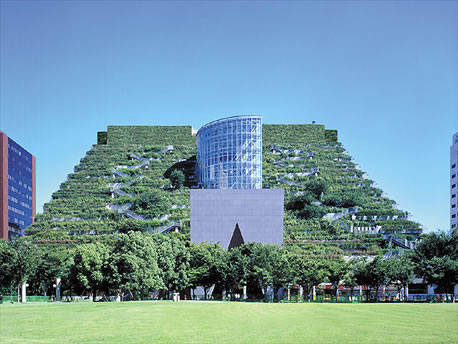
From going green Planters can be incorporated on the building balconies and roof tops. Creepers can be planted along the building facades.
This greatly improves on the aeshtetic appeal of the buildings and at the same time keeps the building internal spaces cool. In other developed countries, City Councils have come up with bye-laws to ensure that live plant materials are included in the buildings. In Nairobi, we do not have such bye-laws yet but this should not stop developers puting up new buildings in Nairobi from ensuring that their buildings become ‘green’ literally.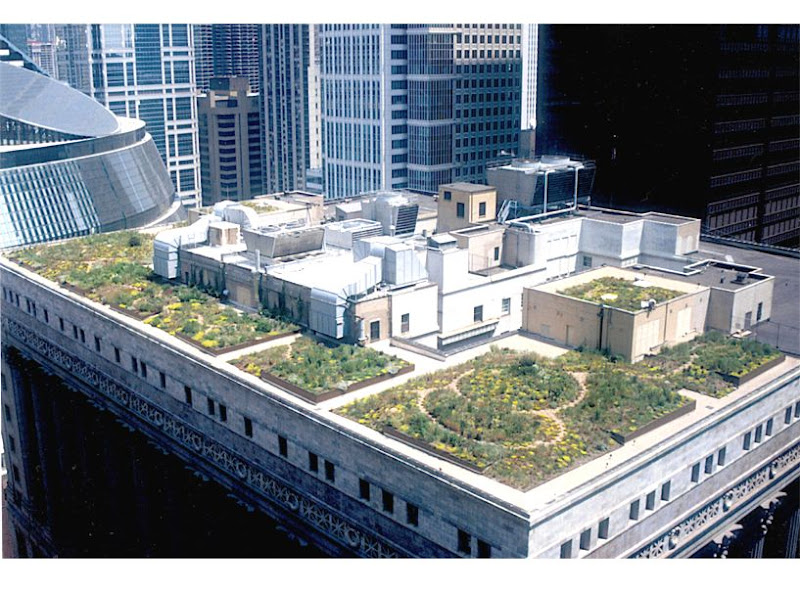
From going green A good example of a roof garden is the Chicago city hall building-roof garden above, owned by the City of Chicago, Dept of Environment,U.S.A.
Recycling of Water.
The developers coming up with new buildings should ensure that during the initial design, plumbing and drainage works for gray water [water from the kitchen sink and showers] is separated from Foul water [water from the toilets]. This ensures that water from the kitchen and shower is drained to a separate system where it can be stored and used to water the vegetaition in and around the buildings.
Only the foul water from the toilets should be drained to the City Council sewer system.
Once the gray water is harvested, it ensures that the gardens on the roofs , balconies and lawns will be watered at a very low cost and remain green all year out. This in turn increases the value of the property .Great Opportunity
The South East Commercial Park offers a great opportunity to make Nairobi ‘green’. Its very rare for such an opportunity to bring itself up in Cities whereby major building design decisions such as use of BIPV walling, solar street lighting and separate plumbing for gray water are included in the buildings.
Most Cities around the world are fully developed using older architectural design and construction methodology so its very expensive for them to embrace such new architectural designs and construction methodologies. For example, to intergret BIPV Solar walling or plumbing to an existing building, you will need to pull down walls, drill holes through concrete slabs ,re-do the electrical wiring to conform to solar electruictity, re-design the entire plumbing system e.t.c.
This is very cumbersome and not very cost –effective .
Therefore, such ideas are best incorporated into the buildings during initial architectural design such as the current opportunity at South East Commercial Park.
During the initial architectural design, Architects will also be able to add other efficient designs wthin the building such as use of Natural light and ventilation within all rooms hence saving on energy required for Air Conditioning and lighting.Conclusion.

From going green Above picture:A climbing plant on Zone Control’s office building at Håga in Haninge.
The time to bring about these changes is now. Developers within South East Commercial Park should seize this golden opportunity to give Nairobi City a new ‘green’ outlook. This can be done by carefull selection of their Architect who will advice them on ensuring the above issues are addressed fully within their buildings.
Francis Gichuhi Kamau B.Arch. U.o.N M.A.A.K[A] Registered Architect
www.a4architect.com