Month: July 2014
-
The ‘most photographed house in Africa’ is slated for demolition. Sign the petition to save it.
The ‘most photographed house in Africa’ is slated for demolition. Sign the petition to save it.


The saddest part is that it is not necessary to bring down the house.
African Heritage House PHOTO: Luis Franceschi
ADVERTISEMENT
Journalist Andrew Hilliar of FRANCE 24 visited the African Heritage House and interviewed Emma Too and Alan Donovan, who are fighting to save it. The article below was published some days ago. I reproduce it here with the contributors’ consent.
Kenyans are rallying online to save Nairobi’s legendary ‘Heritage House’ from being demolished to make way for a modern railway line. The House – which is claimed to be themost photographed in Africa– is a museum of ancient wonders that showcases the continent’s extraordinarily rich past.
African Heritage House was built by American-born Alan Donovan. It stands overlooking Nairobi National Park; inside, roughly 6,000 pieces of African art from around the continent are on display. Activists say the house should be considered a national heritage site.
Yet the government’s latest project to boost Kenya’s ailing infrastructure has left African Heritage House at risk of being demolished.
Under the current plans, a new railway linking the capital with the port city of Mombasa would cut right through the house – skirting Nairobi National Park and leaving the house earmarked for demolition.
Donovan told FRANCE 24 that the development comes as the Kenyan government wasactively consideringmaking the house a protected site.
“Heritage House is based on the mud architecture of Africa: most African countries are represented. I give tours of the house, offer overnight stays, and host events, like weddings.
It’s unique in the world. It’s very difficult to find these crafts and artefacts nowadays, because many of the people that made themdon’t make them anymore. The whole premise is to show people how they can live by taking inspiration from African architecture and décor, and by not importing things that are foreign – like so many people sadly do here.
I want to show people that they should look first for inspiration from their own continent. My goal is to make Heritage House into a trust for the people of Kenya. We would have students in African studies every year that would be living there and doing research on the artefacts. But while one side of the government considers making the house a protected site, the other side wants to build a railway line through it.
Emma Too is a former model for African Heritage, the company that Alan founded together with the late Joseph Murumbi, former Vice President of Kenya, to showcase African art and crafts, and a frequent visitor of African Heritage House. She has started an online campaign to save it.
“Since I once worked for African Heritage, someone sent me an article explaining what the government’s plans were. I thought it was outrageous – why can’t the government make an alternative route? We live on a continent so divided by tribes and problems, but this is a collection that brings cultures together under one roof.
People who don’t have the opportunity to travel around Africa can go to Heritage House and learn about African culture there. It’s not just Alan Donovan’s house; it’s a museum. There are musical instruments, woodcarvings, fabrics, West African artefacts, and much more.
So I decided to create a hash tag –#SaveAfricanHeritageHse– to rally Kenyans on Twitter to support the cause. We want to make it marked as a national heritage site by the cultural ministry, that way it would be protected.
I understand why the government wants to build a new Standard Gauge Railway. This railway would be much more modern. The old one was built by Indian labourers more than 100 years ago. So they’re rebuilding the railway to provide a link to the coastal ports.
With a more modern infrastructure they can transport cargo. However, we need to be able to make compromises. We shouldn’t promote progress by destroying our heritage. The house already has the old railway line in front of it, but the new railway would go right through it.”
Andrew Hilliar, Emma Too and Donovan are right. African Heritage House is one of those artistic icons that future generations have a right to enjoy. They will find there all the vanished art their predecessors cherished. They will feel the nostalgia the Italians feel when contemplating the rundown Coliseum and the Leaning Tower of Pisa, or Egyptians the Gates of Memphis, or Spaniards the Sagrada Familia in Barcelona.
It is strange, perhaps absurd or impractical, but every society needs nostalgia over those strange treasures. Future generations will judge harshly anyone who destroyed art, even in the name of development.
I’ve written before that the railway project cannot be stopped because of one house. But this is no ordinary house. The saddest part is that it is not necessary to bring down the house. The Chinese engineers could easily bypass it. It only requires a word from the President, and a little bit of negotiation between the contractor and the KWS.
Can this house be saved?
Write a comment below, visit the house, sign the petition athttps://secure.avaaz.org/en/petition/President_of_Kenya_SAVE_AFRICAN_HERITAGE_HOUSE/?pv=14.
Visit the Facebook page and tweet #SaveAfricanHeritageHse .
Dr Franceschi is the Dean of Strathmore Law School. Lfranceschi@strathmore.edu Twitter: @lgfranceschi
http://mobile.nation.co.ke/blogs/-/1949942/2379964/-/format/xhtml/-/rpe0mq/-/index.html
-
Prefabricated housing in Kenya. 2014
Prefabricated housing in Kenya is gradually becoming more and more common as time goes by.
High rise buildings.
High rise commercial projects using Pre Engineered Steel structures are now coming up e.g opposite Nairobi Baptist Church next to City Mortuary, there is an upcoming building with the frame structure made of steel. Also, around Yaya in Hurlingham, there is a high rise structure with the supporting structure made of steel.

Most other high rise buildings in Nairobi are still using reinforced concrete for the structure. Reinforced concrete is concrete mixed with steel.

Pre engineered prefabricated buildings are mainly of a commercial nature.
The cost of pre engineered building frame is around kes 15,000 per m2, same as cost of reinforced concrete building. Commercial buildings have costs per m2 for complete buildings stretching all the way to es 60,000 per m2. This means that the structural component, whether pre engineered steel or reinforced concrete, is only 25% of the overall cost of construction. To make any significant savings, architectural design and cost engineering will need to be worked on for other building elements apart form supporting frame structure eg finishes, roof, windows, doors etc.
Residential Buildings.
In Kenya, there are wooden, concrete, form concrete and sandwich steel type of prefabricated buildings.
Wooden prefabs.
The Judiciary recently did prefabs using wood. University of Nairobi also has wooden prefab student accommodation.

Wooden prefab buildings cost around kes 25000 per m2, slightly more expensive than normal stone buildings which can be constructed for same quality at same price.
Foam concrete prefab.

These are cement based wall panels and cost around kes 1800 per m2, more than the cost of stone walling with plaster which costs around kes 1500 per m2.
Steel sandwich panels.
These are mainly seen around the Chinese contractor offices where they are doing highways eg Thika road, Southern Bypass near Carnivore.

The cost of a house built using these steel sandwich is same as cost of a stone house.
These are cheap and low costing their country of manufacture, eg China. The cost of import duty, freight and road transport to Nairobi makes them to be same cost as stone houses . In China, these cost around kes 8,000 per m2 for a house. When they reach Kenya, this cost goes to around kes 25,000 per m2, same as for a stone house.
Quality comparison.
Prefab buildings usually have lower quality compared to stone houses. Their ability to keep buildings warm or cold when the weather is harsh is less than for a stone building.
Their ability to give perceived security is less than for stone buildings since intruders can easily remove the panel form the outside.
The ability to readily find labor and replacement material is low compare to stone whereby each hardware shop readily has repairing materials and local fundis have the technical know-how.
Developers who have recently sold buildings constructed using prefab methods have of late had to deal with occupants pressuring them to give them solutions on how to carry out repairs since the technical know-how is scarce and materials not easily and locally available.
Labour costs.
Prefabricated buildings are usually an attempt to reduce labour costs in buildings. In developed countries, labour costs are high. In Australia , for instance, brick layers earn more than doctors. Prefabricated buildings in such countries will therefore bring the cost of construction down considerably.
In Kenya, the labour laws are not strict, hence construction labour is still low. A fundi is paid around kes 1000 per day to build a 15m2 wall, meaning cost per m2 for labour is kes 65. This is very low, hence most people preferring to use manual labour and construct with stone than using prefabricated materials. As the years progress and labour laws become strict, manual labour will become expensive and that’s when there will be a large switch to prefabrication as people look for cheaper ways to build their houses. Currently, labour costs are 20 to 30% of total building costs in Kenya.
In USA, labour costs are on average 50% of material costs.
With such high labour costs, it makes more sense to use prefab methods in USA than in Kenya for now until labor costs increase considerably as they will in due time.
Francis Gichuhi Kamau, Architect.
info@a4architect.com
Francis Gichuhi Kamau, Architect.
info@a4architect.com
-
Average Cost per m2 of construction in Kenya.
Cost per m2 of construction in Kenya is determined by various factors as described below and varies from a low of kes 15,000 to a high of kes 70,000 per m2.
Location and target clientele.
Where the building is located, if its a low, middle or high class neighborhood, this will determine where the cost per m2 lies within the graph of between kes 18,000 to kes 70,000 per m2.
Buildings located in low income neighborhoods eg Kayole cost on average around Kes 15,000 per m2 .
Buildings located in middle class neighborhoods eg Kitengela, Buruburu cost around kes 30,000 per m2.

Buildings located in high clas neighborhoods such as Westlands and Upper hill cost around kes 70,000 per m2 to construct.

Height and storeys.
Buildings that are only 1 storey high, eg bungalows, warehouses etc cost less since there is minimal use of steel and concrete for reinforcement compared to buildings that are several storeys high.
Bungalows usually have the main stone structure walling as the roof support hence cheaper to construct. High rise structures usually have complex foundation types eg raft foundations which are expensive to build.
High rise structures also have concrete columns, and deep beams for support, costing much more than low rise structures.

Cost engineering and Architectural design.
Buildings can be architecturally designed to cost less whereby the architect deliberately carefully selects and analyses various building materials and building technologies to save on cost.

A building like the above hotel, which looks elegant and expensive, will cost the same or less as the one below, which looks cheap.

The Eka hotel exterior walls are rendered using textured paints, which costs around kes 400 to kes 800 per m2.
The lower hotel in Buruburu has walls rendered in clay bricks, which cost more, at around kes 1200 per m2.
The main stone wall costs the same for both.
The reason that one looks more elegant than the other is due to architectural design and cost engineering, whereby the Eka hotel shape has been carefully designed so as to look appealing to the eye, look balanced, less busy without color clashing, thereby unleashing the Feng Shui positive energies within.
The other Buruburu hotel has not been architecturally analysed, whereby we have window shapes clashing, hence looking unbalanced, with some windows having arches while others are rectangular. The top roof line is also unbalanced.
The end result is that one developer has used more money to build, which has not fully brought about aesthetic appeal, hence commanding less revenue compared to the other developer who has used less money but more of architectural cost engineering design, hence commanding higher revenues.
Francis Gichuhi Kamau, Architect.
-
Container Partitioning Costs.
NO DESCRIPTION UNIT QTY RATE AMOUNT 40 FT CONTAINER TO AZZURI PRELIMINARIES Transport 0 120,000.00 – – Electricity for the works 0 5,000.00 – – Used 40 foot HQ container 0 – – Total for Preliminaries – WALLING Carefully cut existing steel container wall to create window opening size 800 x 1200mm 6 4,500.00 27,000.00 Carefully cut existing steel container wall to create door opening size 800 x 2100mm 5 6,000.00 30,000.00 Total Walling 57,000.00 WINDOWS Supply assemble and fix by an approved Sub-Contractor the following purpose made powder coated anodised aluminium sliding,
hinged or fixed composite windows in approved sections minimum 45mm wide complete with all coupling mullions and transomes and frames and handles, lever, finger pulls, pins, catches, stays, hinges, approved locking devices and other accessories where applicable, fixed at predetermined positions, including ‘snap-on’ glazingbeads; (glass measured separately).Note: All frames are size 80 x 40mm Window size 800 x 1200mm overall in two fixed panels and two vertical sliding panels all panels with frames for glazing 6 20,000.00 120,000.00 5mm Thick laminated clear sheet glass and glazing to aluminium with aluminium beads (measured separately) in panes exceeding 2.50 sm but not exceeding 3.00 sm m2 2 2,000.00 4,000.00 4mm Thick tinted glass in panes exceeding 1.00 square metres but not exceeding 1.50 square metres m2 1 1,200.00 1,200.00 Total Windows 125,200.00 DOORS Supply assemble and fix by an approved sub-contractor the following purpose made aluminium powder coated doors in approved
sections including ‘snap-on’ glazing beads,5 No. silencer pads per opening casement, building insteel frame lugs to jambs, plugging and screwing head and cill to and bedding frames in steel frame and and pointing in approved mastic externally, oiling, easing adjusting.Note:-All doors to include integral hinges, locks and handles -All door frames are size 150 x 50mm. Door size 900 x 2100mm 7 50,000.00 350,000.00 Supply and fix the following ironmongery to timber as per “Union” catalogue or other equal and approved Three lever mortice door lock complete with pair of stainless steel furniture and complete with pair of keys 1 8,000.00 8,000.00 Total Doors 358,000.00 WALL FINISHES 2 coats paint. m2 80 800.00 64,000.00 – Partitions lm 48 1,200.00 57,600.00 Total Wall Finishes 121,600.00 FLOOR FINISHES Polish m2 30 1,000.00 30,000.00 Total Floor Finishes 30,000.00 EXTERNAL FINISHES Scrub to remove dust, fill up joints with approved filler, prepare and apply[spray paint] three coats plastic emulsion paint externally to existing container wall surfaces m2 80 800.00 64,000.00 Total External Finishes 64,000.00 CEILING FINISHES 2 coats paint m2 30 800.00 24,000.00 Total Ceiling Finishes 24,000.00 ELECTRICAL INSTALLATIONS Lighting points wired with 1.5 mm2 x 3 cables in concealed P.V.C.. conduits with all accessories excluding light fitting and switches for one way. 2 650.00 1,300.00 The following in light fittings 1 x 36 W 1200 mm fluorescent fittings 2 2,500.00 5,000.00 13 A Ring socket outlet points wired in 2.5 mm2 x 3 single core copper cables in concealed 20mm diameter PVC conduits set in masonry and reinforced concrete slab 2 650.00 1,300.00 13 A Single socket outlets as crabtree or equal and approved 2 400.00 800.00 Suppy and install internally mounted High Wall split A/C as ‘LG’ or other equal and approved 0 120,000.00 – – Suppy and install standard size Fire extinguisher 0 15,000.00 – Total Electrical Installations 8,400.00 FINAL SUMMARY PRELIMINARIES – WALLING 57,000.00 WINDOWS 125,200.00 DOORS 358,000.00 WALL FINISHES 121,600.00 FLOOR FINISHES 30,000.00 EXTERNAL FINISHES 64,000.00 CEILING FINISHES 24,000.00 ELECTRICAL INSTALLATIONS 8,400.00 Sub-Total 788,200.00 Add Contingencies (Say 5%) 39,410.00 Total Estimate 827,610.00 -
Upper Hill Nairobi. 0.8 acres feasibility and return on investment.
Cost Item Kshs % Land 240,000,000.00 17.85714286 Preliminary 13,500,000.00 1.004464286 Construction 900,000,000.00 66.96428571 External Works 45,000,000.00 3.348214286 Contingency 18,000,000.00 1.339285714 Professional fees 72,000,000.00 5.357142857 Project Management fees 18,000,000.00 1.339285714 Marketing 5,100,000.00 0.379464286 Financial Charges 32,400,000.00 2.410714286 Total 1,344,000,000.00 100 Financing Plan Kshs % Developer 444,000,000.00 33.03571429 Debt Finance 900,000,000.00 66.96428571 Presales 225,000,000.00 16.74107143 Total 1,344,000,000.00 116.7410714 PROFIT TOTAL SALES FOR15000m2 UNITS WHEN CONSTRUCTED 2,250,000,000.00 TOTAL EXPENDITURE 1,344,000,000.00 NET PROFIT 906,000,000.00 % Profit Margin 67.41071429 Take home ammount including land. 1,146,000,000.00 rent total monthly 18,000,000.00 yearly rent 216,000,000.00 ROI 6.22 -
BRICS countries launch $100bn development bank
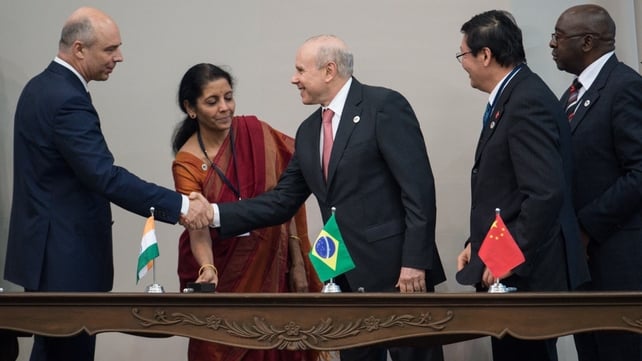
Leaders of the BRICS emerging market nations have launched a $100bn development bank and a currency reserve pool in their first concrete step toward reshaping the Western-dominated international financial system.The bank aimed at funding infrastructure projects in developing nations will be based in Shanghai, and India will preside over its operations for the first five years, followed by Brazil and then Russia, leaders of the five-country group announced at a summit.
They also set up a $100bn currency reserves pool to help countries forestall short-term liquidity pressures.
The long-awaited bank will be called the New Development Bank.
It is the first major achievement of the BRICS countries – Brazil, Russia, India, China and South Africa – since they got together in 2009 to press for a bigger say in the global financial order created by Western powers after World War Two and centred on the International Monetary Fund and the World Bank.
The BRICS were prompted to seek coordinated action following an exodus of capital from emerging markets last year, triggered by the scaling back of US monetary stimulus.
The new bank reflects the growing influence of the BRICS, which account for almost half the world’s population and about one-fifth of global economic output.
The bank will begin with a subscribed capital of $50bn divided equally between its five founders, with an initial total of $10bn in cash put in over seven years and $40bn in guarantees.
It is scheduled to start lending in 2016 and be open to membership by other countries, but the capital share of the BRICS cannot drop below 55%.
The contingency currency pool will be held in the reserves of each BRICS country and can be shifted to another member to cushion balance-of-payments difficulties.
This initiative gathered momentum after the reverse in the flows of cheap dollars that fuelled a boom in emerging markets for a decade.
“It will help contain the volatility faced by diverse economies as a result of the tapering of the United States’ policy of monetary expansion,” Brazilian President Dilma Rousseff said.
“It is a sign of the times, which demand reform of the IMF,” she told reporters at the close of the summit.
China, holder of the world’s largest foreign exchange reserves, will contribute the bulk of the contingency currency pool, or $41bn.
Brazil, India and Russia will chip in $18bn each and South Africa $5bn.
If a need arises, China will be eligible to ask for half of its contribution, South Africa for double and the remaining countries for the amount they put in.
China’s official Xinhua news agency, citing unidentified sources at the Chinese Finance Ministry, said the new bank would give developing countries a greater say in the international financial order, a theme President Xi Jinping struck ahead of the summit.
The new bank “will promote the global system of economic governance to develop in a just and fair direction,” the agency said.
Negotiations over the headquarters and first presidency lasted until the eleventh hour due to differences between India and China. The impasse reflected the trouble Brazil, Russia, India, China and South Africa have had in reconciling stark economic and political differences that made it hard for the group to turn rhetoric into concrete action.
“We pulled it off 10 minutes before the end of the game. We reached a balanced package that is satisfactory to all,” a Brazilian diplomat told Reuters.
Negotiations to create the bank dragged on for more than two years as Brazil and India fought China’s attempts to get a bigger share in the lender than the others.
In the end, Brazil and India prevailed in keeping equal equity at its launch, but fears linger that China, the world’s No 2 economy, could try to assert greater influence over the bank to expand its political clout abroad. China, however, will not preside over the bank for two decades.
Facing efforts by leading Western nations to isolate Russia for annexing Crimea and stirring revolt in eastern Ukraine, the BRICS summit provided President Vladimir Putin with a welcome geopolitical platform to show he has friends elsewhere, economic powers seen as shaping the future of the world.
The BRICS abstained from criticising Russia over the crisis in Ukraine and called instead for restraint by all actors so the conflict can be resolved peacefully.
http://www.rte.ie/news/business/2014/0716/631078-brics-development-bank/
-
Tanzania. Manta Resort: Underwater Room – Tour & Review
http://youtu.be/Uzzt1x2rzc4