Author: A4KENYA

  • INTERIOR DESIGN: OFFICES , RESTAURANTS, HOTELS AND RESIDENTIALS

    INTERIOR DESIGN: OFFICES , RESTAURANTS, HOTELS AND RESIDENTIALS
    ****Happy Valentines Day***
    How an interior space is designed in the interior communicates strongly to the customers.
    Each particular space should be designed to communicate about the products or services that they are selling. This in turn results to better profits at the end of the day.
    COFFEE HOUSES
    For example, a coffee shop should be designed in such a manner that makes the customers feel relaxed. Warm dark colors and textures should be used. Direct brightly colored lights should be avoided. Careful choice of wall, floor and ceiling finished should be done. The finishes should be preferably natural such as natural stone flooring, Jerusalem stone cladding and rustic uncut wooden members tied together with sisal ropes.
    Shiny materials such as glazed ceramic tiles should be avoided. Glass should be used only where necessary to create the ‘large space’ appearance.
    Research has proven that dark matt colors and textures when used in restaurants tend to make people stay longer hence an increase in sales. Likewise, shiny bright colors make customers uncomfortable hence shorter stays leading to less profit.
    A clear practical example of this is the Java coffee house off Koinange Street. The interior design has used dark matt colors resulting to a very ‘comfortable’ feel. The result is that the restaurant is mostly full throughout the day and enjoys a large number of customers even in the off-peak hours.
    Near the Java coffee house, there is a coffee house which has not fully utilized interior design factors. This coffee shop is usually quite empty in the off-peak hours.
    This clearly proves the power of interior design In attracting customers for restaurants.
    SHOPS
    Interior design can transform even the dingiest of places into works of art.
    A good example is the Safaricom shops dotted all around the country.
    Some Safaricom shops are located in dilapidated buildings in dusty downs. Once the shop is designed and constructed, it clearly changes the ‘aura’ of the place and makes the place look classy.
    The interior and shop façade of the once dilapidated building is transformed into a gem.
    In these shops, a theme usually is followed on walls, floors, ceilings, displays and furniture.
    The current Safaricom theme has rounded edges. The use of rounded edges makes the customers feel relaxed.
    A similar rounded-edges theme is also very common in European phone-shops.
    These themes keep changing over time to avoid monotony.
    For Safaricom to keep a large lead in the Kenyan telephony sector, they invest heavily in creative architects and interior designers. Their opponents will have a long way before they catch up until a time when they realize that the impact of well-designed interiors has a great effect on the net profit of their businesses.
    OFFICES
    Interior design for office spaces such as banks and insurance companies also help to create a sense of stability and efficiency.
    Most banks in Kenya invest heavily in interior design for this purpose.
    Older banks such as Barclays and Standard know the importance of good, creative interior design more than newer banks.
    If you enter into any banking hall of some banks such as Barclays, Diamond Trust, Shelter Afrique , Stanbic,I&M, NIC, Fina or Standard, you will see that nothing is left for chance in the interior design. All floor tiles and patterns are carefully chosen, no color clashing, all the bank’s logos are carefully placed and careful choice of materials has been done. Each banking hall is a masterpiece by itself.
    This is because the banks place architecture and interior design highly and value the fact that interior design alone is a very important factor in making sure that the bank gets good profits.
    Their selection of architects and interior designers is therefore carefully done on the basis of how creative the architects are.
    Some other banks do not have creative interior design. This is very evident in that if you enter such banking halls, you will see some levels of poor workmanship, logos placed haphazardly, floor tiles with patterns not following any sequence, un-creative design of the counters and many more ‘small’ flaws here and there.
    The net effect is that they make less profit compared to their counterparts who have invested in creative interior design.

    CONCLUSION
    Its time the Kenyan private sector employed competition in procuring architecture and interior design services.
    This way, creative genius is able to be unlocked which in turn will result to greater profits.
    In Countries such as South Africa and Australia where most design jobs are awarded through competition, it’s very evident since no two buildings look like each other and most buildings are a work of art by themselves.
    Even small residential 1 bed roomed houses are very creatively designed. The net effect is a country that looks organized and appealing to look at. This creativity is only unlocked through design competition whereby several architects are invited to design a particular space, then the best design is selected.
    Francis Gichuhi

    Architect.
    info@a4architect.com
    www.a4architect.com
    +254721410684

  • COMMERCIAL PROPERTY IN UPPER HILL, NAIROBI

    COMMERCIAL PROPERTY IN UPPER HILL, NAIROBI

    Land value is approximately KES 200,000,000 per acre=KES 50,000 per square meter.
    Assuming 50% ground coverage on construction for 10 floors, this will be approximately 2000m2 x 10 floors =20,000 m2.
    The fraction of the cost of land within the built up area will therefore be KES 200,000,000 divide by 20,000m2 =KES 10,000 per m2.

    Cost of construction.

    The average cost of construction for a high-rise building in Nairobi is KES 60,000 per square meter.
    Estimated cost of construction for 10 storey building will be KES 60,000 X 20,000m2 =KES 1.2 Billion.

    The total cost of construction will be cost of land plus cost of construction = 60,000 plus 10,000 =KES 70,000 per square meter.
    Total cost of the project will be KES 1.2 Billion plus KES 200,000,000[Land] =KES 1.4 Billion.

    Return on Investment.

    Office sale value is approximately KES 13,000 per square foot=KES 130,000 per square meter.
    Total sales from 10 storey building will be KES 130,000 per square meter x 20,000 square meters = KES 2.6 Billion.
    The profit margin is KES 130,000 minus KES 70,000 =KES 60,000.
    Profit will be KES 2.6 Billion – KES 1.4 Billion =KES 1.2 Billion

    This represents an 85% Return on Investment hence a very viable option to develop offices for sale.

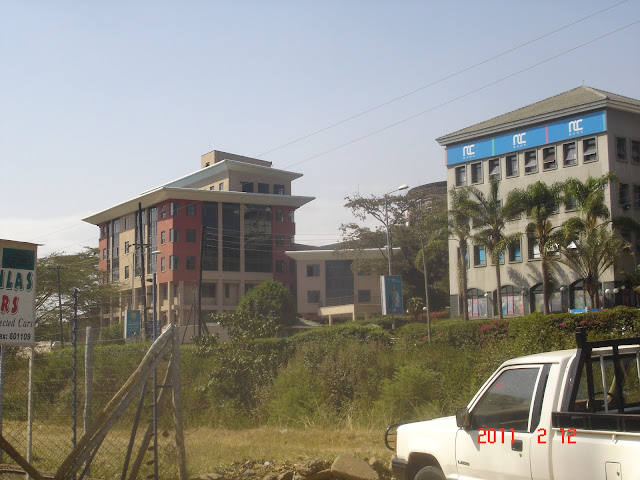
    NEXT TO NIC BANK HOUSE, UPPER HILL

    From Upper Hill

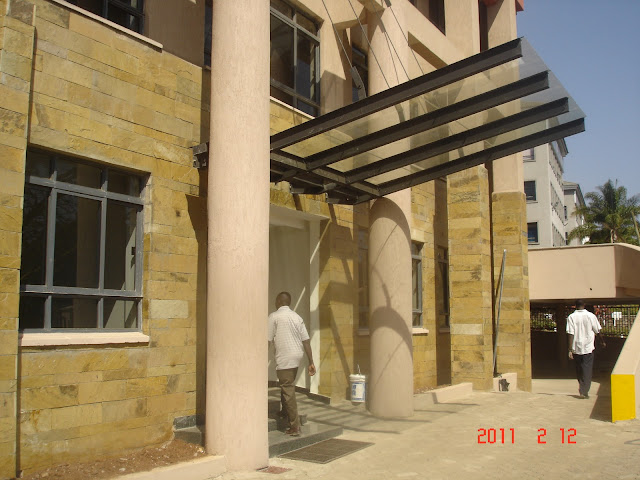
    This building has a front façade clad in natural stone.

    From Upper Hill

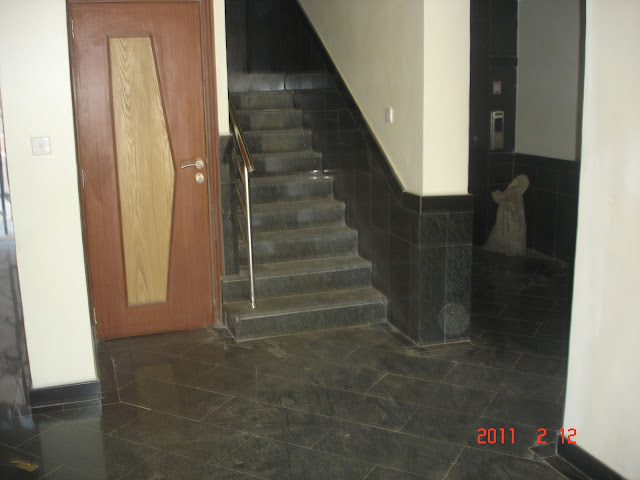
    The interior floor is finished with Granite tiles.

    From Upper Hill

    The windows are made of UPVC.

    From Upper Hill

    Available space: 3rd floor-3800 sq. ft.

    Ground Floor-1400 square feet.

    Rent: KES 120 per square foot sharing kitchen and toilets.
    KES 140 per square foot with own kitchen and toilet.

    Parking available.

    GEMINIA INSURANCE BUILDING, UPPER HILL
    This building is located opposite the Embassy of Japan and Coca Cola Africa Headquarters.

    From Upper Hill

    Available space-2,500 sq. ft.
    Rent: KES 100 per square feet.
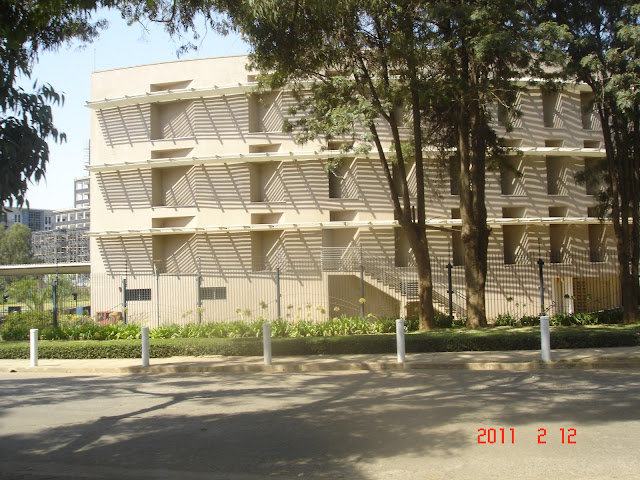
    The building is arguably one of the best designed in Nairobi.

    From Upper Hill

    The architects used a school of thought popularly known as ‘deconstruction’ in architecture circles.
    See more about deconstruction on Wikipedia here
    http://en.wikipedia.org/wiki/Deconstructivism

    Deconstruction is a modern style whereby the building is designed to avoid the usual and normal vertical and horizontal planes that we are used to seeing. The walls, ceilings and all other surfaces are tilted slightly off the usual plane.
    In Geminia Insurance building, this theme has been used on the exterior and interior partitioning.

    From Upper Hill

    The floors are finished with granite tiles.

    From Upper Hill

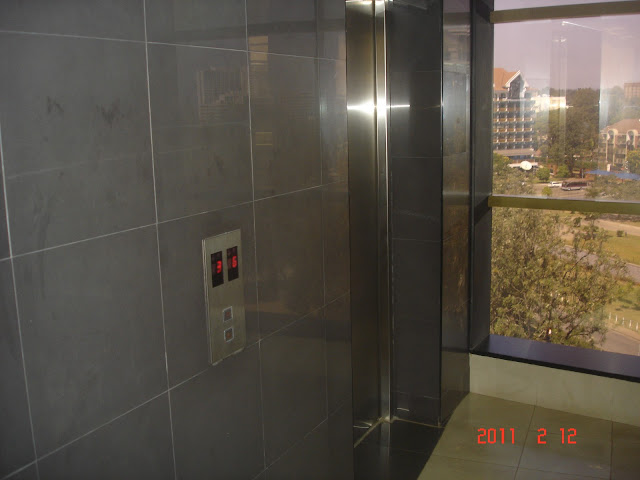
    Walls around the lift lobby are finished with glazed tiles

    From Upper Hill

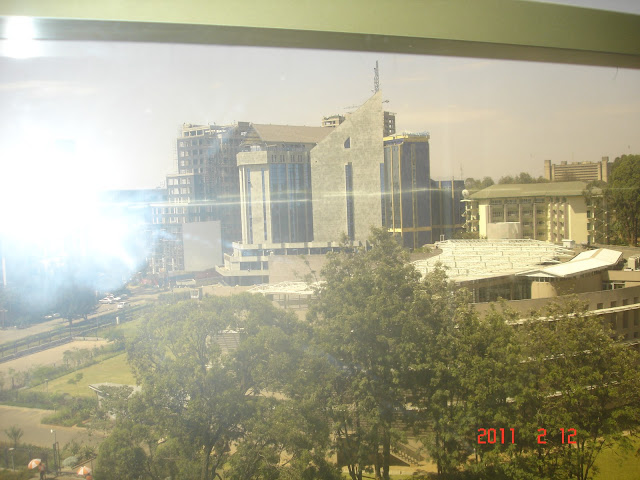
    There are beautiful vista views from the building towards the surrounding Upper Hill architecture.

    From Upper Hill

    The neighbors include the Coca Cola Africa headquarters.

    From Upper Hill
    From Upper Hill
    From Upper Hill
    From Upper Hill

    Francis Gichuhi Kamau

    Architect.

    info@a4architect.com

    www.a4architect.com

    +254721410684

  • COMMERCIAL PROPERTY IN WESTLANDS, NAIROBI

    COMMERCIAL PROPERTY IN WESTLANDS, NAIROBI

    Land value is approximately KES 200,000,000 per acre=KES 50,000 per square meter.
    Assuming 50% ground coverage on construction for 10 floors, this will be approximately 2000m2 x 10 floors =20,000 m2. The fraction of the cost of land within the built up area will therefore be KES 200,000,000 divide by 20,000m2 =KES 10,000 per m2.

    Cost of construction.

    The average cost of construction for a high-rise building in Nairobi is KES 60,000 per square meter.
    The total cost of construction will be cost of land plus cost of construction = 60,000 plus 10,000 =KES 70,000 per square meter.

    Return on Investment.

    Office sale value is approximately KES 13,000 per square foot=KES 130,000 per square meter.
    The profit margin is KES 130,000 minus KES 70,000 =KES 60,000.

    This represents an 85% Return on Investment hence a very viable option to develop offices for sale.

    WOODVALE PLACE, WESTLANDS

    From Westlands Buildings

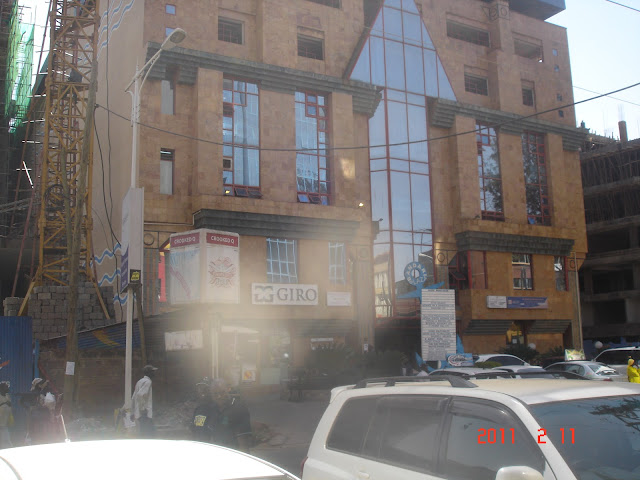
    This building has a front façade clad in natural brick.

    The interior floor is finished with pvc tiles.

    From Westlands Buildings

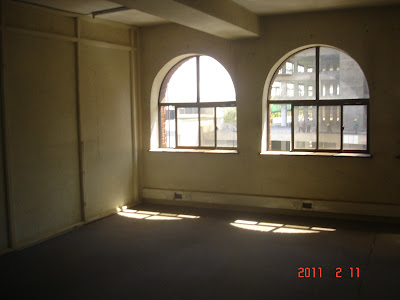
    The windows are arch shaped.

    From Westlands Buildings

    Available space: 3rd floor-1500 sq. ft.

    From Westlands Buildings

    Rent: KES 70 per square foot.

    Street parking.

    From Westlands Buildings

    BANDARI PLAZA, Woodvale groove, Westlands.

    From Westlands Buildings

    Available space-3,800 sq. ft.

    FORTIS TOWER-Woodvale Groove.

    From Westlands Buildings
    From Westlands Buildings

    This building is under construction and the office spaces are up for sale.

    RELIANCE CENTRE-Woodvale Groove.

    From Westlands Buildings

    This is a newly completed modern building.

    Available space: 3rd floor. 1000 square feet.
    Rent: KES 100 per square foot.

    Features:

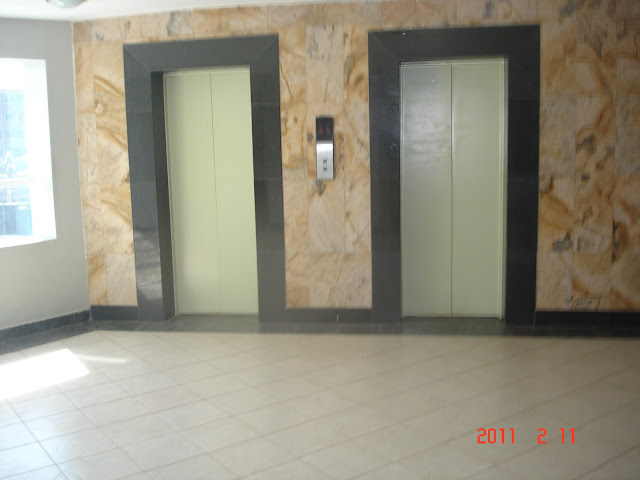
    Lift Lobby finished in Marble.

    From Westlands Buildings

    Entrance Lobby finished in marble and Granite tiles.

    From Westlands Buildings

    Modern exterior appearance.

    From Westlands Buildings

    3 modern lifts.

    From Westlands Buildings

    Finishes.
    Floor-ceramic tiles

    From Westlands Buildings

    Windows-UPVC windows

    From Westlands Buildings

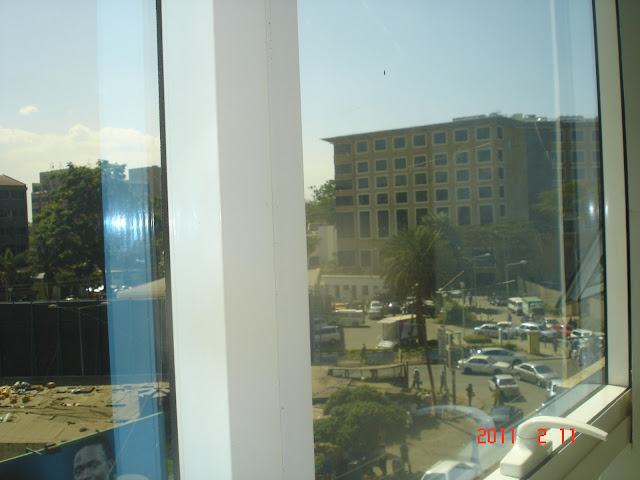
    Views: overlooking the prestigious Sankara Hotel

    From Westlands Buildings

    Francis Gichuhi Kamau

    Architect.

    info@a4architect.com

    www.a4architect.com

    +254721410684

  • BEST LAND PRICES AROUND NAIROBI, KENYA.PRICE KES 600,000 to KES 700,000 PER ACRE.KES 80,000 per 1/8th

    BEST LAND PRICES AROUND NAIROBI, KENYA.PRICE KES 600,000 to KES 700,000 PER ACRE. KES 80,000 per 1/8th

    Currently the best land value around Nairobi is to be found in the area between Mombasa road on one side, Kangundo road ,Eastern Bypass on the other and Kangundo-Machakos road on the end.
    In this area is where the Greater Eastern Bypass is currently being constructed.

    PREVIOUS BEST LAND PRICES

    In the last two years[2008-2010], the best and value was to be found along the current Eastern Bypass between Mombasa Road and Thika road passing through Njiru. Land price was around KES 150,000 to KES 200,000 per acre when there was no all-weather road. When the road construction began, the price rose steadily. Now that the road construction is complete, land price next to the Bypass is around KES 8 to 10 million. This price keeps rising on the daily as demand creeps in.

    CARDINAL RULE IN BUYING LAND

    People who saw the light earlier on and bought while the land price was KES 150,000 are now laughing all the way to the bank.
    The cardinal rule in investing in land is simple: Research on whether there are plans by the Government to put in infrastructure, buy when there is no infrastructure and sell when infrastructure is in place.
    A kilometer of tarmac road costs around KES 50,000,000 to put up. This means that its only the Government that can afford to put up tarmac roads therefore, land value will appreciate along the tarmac road as opposed to off the tarmac road.
    This is why an acre of land in Kitengela next to the tarmac at KES 30,000,000 is more expensive than an acre of land closer to Nairobi-Syokimau, 2 km off the tarmac going for KES 10,000,000.
    Areas such as Ongata Rongai and Kitengela were once good buys 10 years ago when there was no infrastructure. Currently, an acre of land in Rongai less than 1km from the tarmac costs around KES 20,000,000 and that is if you are lucky to find it.
    People who bought this land 10 years ago got the best deal.

    TAKE ADVANTAGE NOW

    The Greater Eastern Bypass is currently being constructed.
    Plots around this area which is easily accessible to Nairobi CBD [approximately 40 to 60 km from Nairobi [ CBD] currently cost between KES 600,000 to KES 700,000 per acre and KES 80,000 per 1/8th.

    Once the Bypass construction is through, the plots will definitely shoot up to KES 8 to 10 million per acre just like the ones along the now-complete Eastern bypass.

    Currently, we have several 1 acre parcels along the Greater Eastern bypass for sale for between KES 600,000 to KES 700,000 per acre and KES 80,000 per 1/8th acre plot.Offers to buy are invited.
    Call +254 721 410684 to arrange for viewing and purchase.
    Francis Gichuhi
    Architect.
    info@a4architect.com
    +254721410684

  • ARCHITECTURAL MASTERPIECE VERSUS JUST ANOTHER BUILDING: UNLOCKING REAL ESTATE VALUE THROUGH DESIGN.

    ARCHITECTURAL MASTERPIECE VERSUS JUST ANOTHER BUILDING: UNLOCKING REAL ESTATE VALUE THROUGH DESIGN.

    An architectural masterpiece is a building that has been carefully designed by the architect to bring out a particular uniqueness.
    Buildings such as the Sydney Opera House constructed between 1957 and 1973 and designed by Architect Jorn Utzon from Denmark are masterpieces that will forever become major landmarks due to their unique designs.
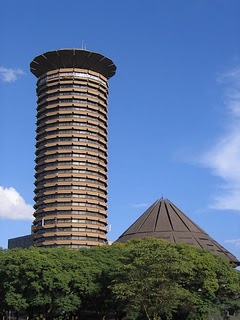
    An example in Kenya is the Kenyatta International Conference Centre which has graced the covers of postcards for years since it was constructed.

    From Rahimtulla natural stone finishes

    The KICC building was designed by Norwegian Architect Karl Henric Nostoric in 1967 . The architect was inspired by the traditional African architecture, mainly the hut . The late president Jomo Kenyatta was also instrumental in guiding the architect regarding the African concept.
    This brought out a unique Architectural masterpiece which has unanimously won the hearts and eyes of many Kenyans to be the best designed high-rise building in Nairobi.
    The use of just one colour and rough texture on the exterior that looks close to the traditional African adobe house increases the aesthetic appeal in that its comfortable to look at-it does not look too ‘busy’ like other high rise buildings that have multi colours and textures on the exterior.
    The perfect balance achieved through the shape of the tall structure versus the pyramid also helps in creating the aesthetic appeal.
    No other building in Nairobi CDB can hold a candle to KICC.
    UNLOCKING VALUE
    Buildings that have been designed to be unique usually give better returns to their owners in terms of rents.
    Since the buildings are attractive, they will always have a higher demand for rent hence the rent shoots up. Most well-to-do institutions require such buildings which are landmarks in themselves . This helps in their marketing since their customers can easily relate their location hence more business. It in turn works out as a win-win situation between the land lord and the tenants in that the land lord charges a higher rent while the tenants have more customers due to their prestigious and conspicuous physical address.
    ENHANCING PROPERTY VALUE
    Developers who acquire land in an area that is generally viewed as undesirable can use architectural design to enhance the value of their real estate.
    A good example is the Motor World Centre at the Jogoo road/Landhies road roundabout. The area has several unkempt buildings that would not fetch competitive rents in the market place. The Motor World Centre has been uniquely designed to be very attractive therefore its true potential is realized even though its surrounded by the un-maintained buildings.
    RESIDENTIAL REAL ESTATE
    Residential buildings designed uniquely always attract more tenants than the ordinary ones. In Kenya, unfortunately, the housing deficit is approximately 100,000 units per year .This means that even poorly designed buildings will attract tenants. In other countries such as South Africa where the housing deficit is not high, its design that sells. The well-designed houses will sell faster than the badly designed ones. Therefore, most developers in these countries usually put a lot of emphasis on design to be able to attract buyers and tenants.
    Since buildings last for tens of years, its advisable for a developer to request their architect to come up with a unique design since as time passes by, the housing deficit keeps reducing so there will come a time where the design will be the single most important factor in attracting good rents.

    Francis Gichuhi
    Architect
    info@a4architect.com
    254721410684

  • 5 STEPS TO CONSTRUCTING YOUR DREAM HOUSE . THE DIAMOND HOUSE PLAN : 2 BEDROOMED:

    5 STEPS TO CONSTRUCTING YOUR DREAM HOUSE .
    THE DIAMOND HOUSE PLAN : 2 BEDROOMED:

    [youtube http://www.youtube.com/watch?v=T11zCMvZsWg?rel=0&w=480&h=360]

    Click below for Free Youtube Movie Downloaders
    Firefox.
    Internet Explorer
    Opera

    INTRODUCTION
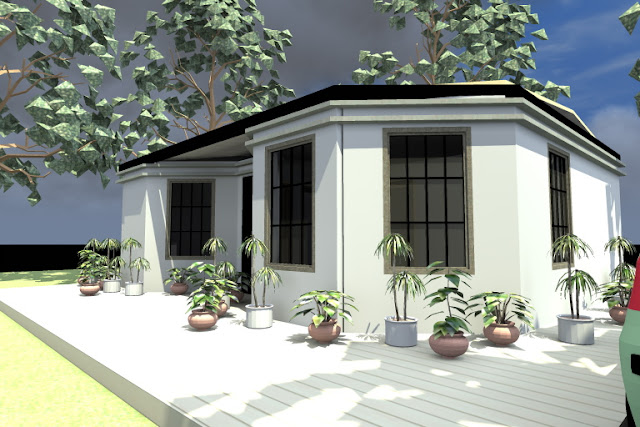
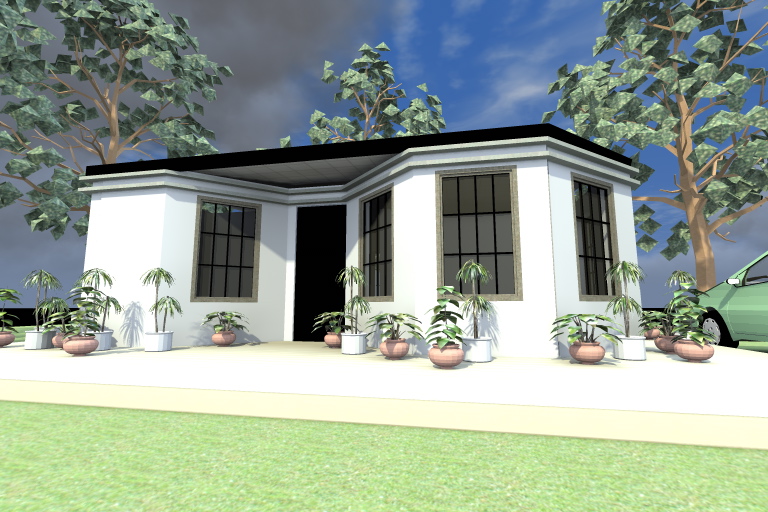
    The Diamond house plan is inspired by the Botswana Diamonds and was designed by www.a4architect.com to offer the most efficient housing solutions to the people of Haiti after the 2010 earthquake.
    The Diamond House is made of materials readily available in every hardware shop in Kenya. The efficiency is attained through unique architectural design and construction technology.
    The walls are made of the usual masonry quarry stone or interlocking stabilized soil blocks,roofs made of the usual iron sheets, doors from the usual wood door Kenyan manufacturers and window frames from the usual aluminum/Louvre systems.

    From DIAMOND HOUSE FLAT ROOF

    https://picasaweb.google.com/s/c/bin/slideshow.swf

    THE DIAMOND HOUSE PLAN©.

    Origin of the name.
    The Diamond house plan design is inspired by the Botswana Diamonds and was designed by www.a4architect.com to offer the most efficient housing solutions to the people of Haiti after the 2010 earthquake.
    The Diamond House is made of materials readily available in every hardware shop in Kenya. The efficiency is attained through unique architectural design and construction technology.
    The walls are made of the usual masonry quarry stone or interlocking stabilized soil blocks,roofs made of the usual iron sheets, doors from the usual wood door Kenyan manufacturers and window frames from the usual aluminum/Louvre systems.

    [youtube http://www.youtube.com/watch?v=E0Mj13V7fTk?rel=0&w=420&h=315]

    PAYMENTS
    To purchase the Diamond House Plans, click here for further explanation and cost breakdown.

    2 BEDROOMED VERSION FRONT VIEW

    DIAMOND HOUSE PLAN© PHASED RESIDENTIAL HOUSE CONSTRUCTION.

    DIAMOND HOUSE PITCHED ROOF VERSIONhttps://picasaweb.google.com/s/c/bin/slideshow.swf

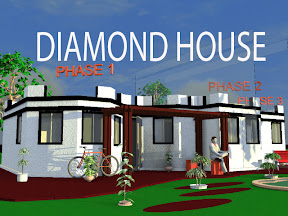
    This is whereby the architect has designed the Diamond house plan in such a manner that the house occupants can continue adding more rooms in future as their needs increase.
    The house starts with 2 bedrooms which can easily be added to become 3 bedroomed .
    See the house below designed by www.a4architect.com for more information.

    DIAMOND HOUSE FLAT ROOF VERSIONhttps://picasaweb.google.com/s/c/bin/slideshow.swf

    As the family size grows, the house also grows concurrently.
    This architectural design aids greatly in planning for the future.
    The beauty about this design is the fact that one can start with the low priced 2 bedroomed house. After a period of time as the space need increases, the 3 bedroomed unit is added .
    In this design, the occupant pays for the exact space that they require in that if the occupant only requires just 2 bedrooms for the time being, that’s the only space they pay for.
    In the era of the 21st Century, its important that consumers make decisions that avoid unnecessary waste of money and resources .

    HOW TO REDUCE CONSTRUCTION COST BY OVER 100% AND STILL MAINTAIN HIGH QUALITY:DIAMOND HOUSE PLAN:

    From Haiti House Plan

    PART 1:SUBSTRUCTURE :FOUNDATIONS
    Construction material cost has been steadily increasing over the years.
    5 years ago[2006], the average construction cost in Nairobi for a medium –priced building was KES 15,000 per square meter.
    Currently,[2011] this cost has increased by 68% to an average of KES 22,000 per square meter for the same.
    The trend does not seem to be slowing down any time soon.
    Therefore, we need to think outside the box to keep costs low and still maintain the same or oven higher quality of construction.
    This can be achieved by using ingenious methods of cost-cutting from the foundation stage through to the finishes.

    FOUNDATION
    On average, foundation costs approximately 10% of the total cost of construction.
    The main works in a foundation are
    1.excavation
    2.Reinforced concrete works[foundation footing and ground floor slab]
    3.Masonry walling to ground floor level
    Reinforced concrete works
    This consists of concrete reinforced with twisted steel.
    A cubic meter of concrete on average takes 7 bags of cement and will cost a minimum of KES 8,000.
    A cubic meter of masonry stone consists of 75 stones of 300mm long by 200mm wide. Each stone costs an average of KES 25. This estimates to approximately KES 25 X 75= KES 1,875.
    This is approximately 75% cheaper than concrete.
    The reinforced concrete foundation footing can be replaced with masonry walling to achieve this great saving.

    Ground Floor slab.
    On average, a reinforced concrete ground floor slab costs KES 1,200 per square meter.
    Masonry walling laid horizontally can replace this slab. A square meter of masonry walling using masonry stones costs KES 400. Add KES 100 for cement plaster and labour and this brings it to KES 500 per square meter. This constitutes a savings of nearly 45%.
    Old colonial houses built in the early 1900s in Kenya utilized these cost-cutting methods and are still standing to date.
    A good example is the Officer’s Mess at the National Youth Service Bahati Farm in Nyandarua.
    Another excellent example is the Hyrax Hill tourist site office at Nakuru town pictured below.

    From Window design

    The foundation footing and floor slab is made of masonry walling and it still stands to date, nearly 100 years from the day it was constructed.

    Conclusion.
    With the use of masonry to replace reinforced concrete on foundation footing [75% savings] and ground floor slab [45% savings], this will greatly save on the overall foundation construction costs.

    PART 2: SUPERSTRUCTURE[Walling, Doors, Windows, Roof]

    The Diamond House type has been designed by www.a4architect.com to reduce over 200% of construction costs in the superstructure[walling, windows, doors, roof].
    Waling.
    Internal walling is designed to carefully reduce the costs of internal wall plaster through design. In each room, the machine-cut stone walling is plastered on only two sides. The other two sides are keyed and left natural or painted to come up with a rough texture that matches well with the overall interior decor of the house. This automatically reduces over 50 % of internal wall finishes mainly plaster and paint.
    The 2 bedroom Diamond House Plan has approximately 100 square meters of internal wall surface. If half of the surface is unplastered , this will result to a savings of KES 10,000.
    If half the internal wall surface is not painted, this will result to a further savings of KES 10,000.
    This is a classic example of using interior design as a tool for saving costs since a room looks better when some surface is of a different texture and colour form another.
    Wall to Ceiling Height.
    A high wall height means that there is more surface area for walling, plaster and paint. The Haiti House Plan has a 2.4meter wall to ceiling height. This helps to reduce any unnecessary wall height hence bringing the costs significantly down.This results to a 20% reduction in the costs of walling, plaster and paint.
    Windows.
    Window costs have been reduced by using the louvre window system.
    A 1meter squared louvre system wil cost up to KES 2,000 including labour.
    A foot length of 6 inches thick louvre glass 5mm thick goes for KES 50 . A Pair of louvre blades go for KES 80. The Haiti house plan windows are approximately 1 meter squared in size. With the louvre system on half the length, this will be 75 KES x 7 pieces for glass =KES 525. For the window louvre system, this will be KES 80 per pair x 7 = KES 560. The total will be KES 1085 plus fixed glass KES 350 =KES 1435.Add 20 % for labour and transport to site =KES 1722.
    This represents over 60 % reduction on costs compared to using the common steel casement windows.
    Doors.
    Use of colour to articulate the flush door frames and leafs will go a long way in saving costs. The overall colour scheme of white versus black can be used to articulate the door opening with the door leaf painted white with a black door frame.
    A standard flush door costs KES 1800 plus KES 900 for the frame =KES 2700.
    Roof.
    The Diamond house design employs a ‘flat’ roof as a design and also to reduce costs. The flatter a roof is, the less the surface area that it covers.
    The roof slope of 6 degrees looks flat to the eye but is in fact 6 degrees in slope so as to drain the water to the gutter system.
    This design makes the Diamond house plan look unique and results to over 50% in roof costs saving.
    The Diamond house design has a roof covering 45 square meters.
    The flat roof also ensures that there is less timber for roof support since the walling will support the main roof trusses hence a further savings on roof timber costs.
    Using gauge 30 roofing sheets which retail at KES 260 per square meter or gauge 32 roofing sheets retailing at KES 215 per square meters, the roofing costs will be KES 260 X 45M2 =KES 11,700 for gauge 30 and KES 9675 for gauge 32 which is lighter.

    [youtube http://www.youtube.com/watch?v=IDbb2ivWmh0?rel=0&w=425&h=349]

    CONSTRUCTION COSTS BREAKDOWN:DIAMOND HOUSE PLAN-2 BEDROOMED VERSION

    PROPOSED RESIDENTIAL DEVELOPMENT :DIAMOND HOUSE,2 BEDROOMED
    www.a4architect.com

    APPROXIMATE BILLS OF QUANTITIES

    GROUND FLOOR

    Bill No. 1
    SUBSTRUCTURES
    (ALL PROVISIONAL)

    Excavate foundation trench depth not exceeding 1.5m commencing from reduced levels m3 43 200 8600

    Excavate pit depth not exceeding 1.5m commencing from reduced levels m3 45 200 9000

    Extra over excavations for excavation in soft rock m3 10 1670 16700

    Return, fill and ram selected excavated material around foundations. m3 45 130 5850

    Load and cart away surplus excavated material from site m3 45 360 16200

    30mm Thick murram blinding to surfaces of hardcore m2 45 80 3600

    Chemical anti-termite treatment executed complete by an approved specialist under a ten (10) year guarantee to surfaces of blinded hardcore m2 45 250 11250

    Natural coursed stone obtained from an approved quarry, jointed and bedded in cement and sand (1:3) mortar
    200mm Thick walling FOOTING m2 64 835 53440

    200mm Thick walling m2 64 835 53440

    200mm Thick walling SLAB m2 45 835 37575

    12mm Cement and sand (1:3)render on stone or concrete plinths m2 21 200 4200

    Prepare and apply two coats black bituminous paint to rendered concrete or stone surfaces m2 21 300 6300

    Total Carried to Summary 226,155.00

    Bill No.2
    SUPERSTRUCTURE WALLING

    200mm Thick approved local quarry machine-cut load bearing natural stone walling bedded and jointed in cement and sand (1:3) mortar m2 80 1169 93520

    Approved horizontal damp proof course to B.S. 743 laid under walling (measured nett – no allowance made for laps) including leveling bed

    200mm Wide m 50 140 7000

    Precast concrete (1:2:4) bedded, jointed and pointed in gauged mortar

    200 x 200mm Lintel reinforced with and including 2No. 12mm mild steel rods m 5 580 2900

    Total Carried to summary at end 103,420.00

    Bill No.3
    WINDOWS

    250 x 50mm Thick precast concrete (1:2:4) sunk, weathered and throated window cill cast in convenient lengths, reinforced as necessary, bedded, jointed and pointed in gauged mortar and finished smooth on all exposed surfaces m 10 420 4200

    Prime Grade Wrot mahogany or equal and approved hardwood

    125 x 12mm Weather or window board with two labours plugged m 10 334 3340

    Pelmet boxes in prime grade wrot mahogany as before

    50x25mm Bearer plugged m 10 100 1000

    150x25mm Pelmet top fixed to bearer m 10 300 3000

    150x25mm Pelmet fascia with three labours fixed to top m 10 300 3000

    150x25mm Thick,150mm long pelmet end with three labours No 10 50 500
    —————————-

    Note: All windows with openable frames at top to have mild steel hood with a 30mm gap infilled with mosquito gauze.

    Supply, assemble and fix the following purpose-made steel Louvre window systems including glass

    Window size 1000 x 1500mm overall No. 4 3000 12000

    Window size 500 x 1500mm overall No. 4 1500 6000

    Total Carried to summary at end 33,040.00

    Bill No.4
    DOORS

    Wrot Mahogany framed frames and finishings

    40 x 125mm Beading with one labour m 40 334 13360

    20 x 40mm Moulded glazing bead m 40 180 7200

    15 x 15mm Moulded quadrant. m 40 30 1200

    15 x 32mm Moulded architrave. m 40 180 7200

    50 x 200mm Frame with one labour plugged. m 40 334 13360

    External door No. 1 10000 10000

    45mm (Finished) flush doors to B.S. 459 Part 2 faced both sides with external quality plywood and hardwood lipped on all edges

    Door size 900 x 2100mm overall comprising 1 No. opening leaf No. 4 3300 13200

    Glazing

    Approved quality ordinary clear sheet glass and glazing to timber with beads (measured separately)

    6mm Thick in panes not exceeding 0.10 square metres m2 1 1000 1000

    Supply and fix the following ironmongery to timber as per “Union” catalogue or other equal and approved

    100mm Pressed stainless steel butt hinge Prs 5.0 200 1000

    Two lever mortice door lock complete with pair of stainless steel furniture and complete with pair of keys No. 4 1670 6680

    Three lever mortice door lock complete with pair of stainless steel furniture and complete with pair of keys No. 1 2000 2000

    Rubber door stop fixed to concrete floor, or masonry walling with and including 38mm rawl bolt No. 4 300 1200

    Prepare and apply one coat “Crown” or equal and approved aluminium wood primer before fixing on backs of wood surfaces in contact with masonry, concrete or plaster girth exceeding 200 but not exceeding 300mm m 40 30 1200

    Prepare stain to approval with timber guard and apply three coats matt “Crown Tuffseal” or other equal and approved polyurethane varnish to woodwork to be executed by an approved sub-contractor

    Surfaces girth exceeding 200mm but not exceeding 300mm m 40 90 3600

    General surfaces of woodwork m2 20 300 6000

    Prepare, prime with “Crown Two Pack” or equal and approved zinc plumbate primer and paint one undercoat and two gloss finishing coats of “Crown Solo Ultra Super Gloss” or equal and approved oil paint on metal work generally m2 10 300 3000

    Total Carried to summary at end 91,200.00

    Bill No. 5
    ROOF STRUCTURE, COVERING, RAINWATER GOODS AND FINISHES

    The following in Grade 1 structural timbers, sawn cypress pressure impregnated as described

    The following in 5No. double pitch roof trusses with nailed connections, 4.50m span and 1500mm rise including hoisting and fixing 2.700m metres above finished floor level

    50 x 150mm Rafters m 50 350 17500

    50 x 150mm Struts m 7 350 2450

    50 x 150mm Tie beams m 50 350 17500

    —– End of Trusses —–

    The following in Grade 1 structural timbers, sawn cypress pressure impregnated as described

    50 x 150mm Common rafters (Provisional) m 7 350 2450

    50 x 150mm Hip rafter (Provisional) m 6 350 2100

    50 x 150mm Purlin (Provisional) m 7 350 2450

    50 x 150mm Ridge m 7 350 2450

    75 x 150mm Wall plate fixed to concrete or block wall with and including hoop iron fixing cramps at 450mm centres. m 50 350 17500

    ——————
    25 x 300mm Wrot, treated cypress fascia or barge board m 12 350 4200

    Roof Covering

    steel roofing sheets Gauge 30 m2 45 500 22500

    Half round approved ridge to match roofing sheets m 7 250 1750

    Rain water gutter m 14 700 9800

    Eaves

    12 x 100mm Tongued and grooved wrot cypress eaves boarding nailed to brandering (measured separately) m2 10 950 9500

    50 x 50mm Sawn cypress brandering m 60 200 12000

    Total Carried to summary at end 124,150.00

    Bill No.6

    EXTERNAL FINISHES

    Extra over machine cut stone walling for pointing in neat shallow recessed vertical and horizontal joints m2 51 200 10200

    12mm Thick external cement and sand (1:4) rendering finished with wood float m2 5 300 1500

    Prepare and apply three coats white-wash externally to masonry stone surfaces m2 51 300 15300

    Total Carried to Summary 27,000.00

    Bill No.7
    FLOOR FINISHES

    Cement and sand (1:3) screed trowelled hard and smooth with steel trowel

    40mm Thick bed m2 45 450 20250

    32mm Thick bed to receive ceramic tiles m2 45 400 18000

    20mm Skirting 125mm high with rounded top edge and coved angle at junction with paving. m 100 60 6000

    300 x 300 x 8mm Approved glazed ceramic floor tiles fixed with an approved adhesive on screed floor including pointing with matching coloured cement m2 45 2000 90000

    Total Carried to summary at end 134,250.00
    Bill No.8

    INTERNAL WALL FINISHES

    12mm (minimum) Two coat lime plaster comprising 9mm first coat of cement and sand (1:4) and 3mm second coat of cement and sand lime putty on walls finished smooth with a steel trowel on concrete or stone walls m2 100 300 30000

    150 x 150 x 6mm Coloured ceramic wall tiles fixed to backing (measured separately) with an approved adhesive on walls and pointed with coloured anti-fungal cement m2 10 2000 20000

    The whole of the following to be executed by an approved sub-contractor

    Prepare and apply one undercoat and three coats of “Crown Solo” or equal and approved plastic emulsion paint on plastered walls internally m2 100 300 30000

    Total Carried to Summary 80,000.00

    Bill No. 9
    CEILING FINISHES

    Ply wood Ceiling board m2 45 650 29250

    The whole of the following to be executed by an approved sub-contractor

    Prepare and apply one undercoat and three coats of “Crown Solo” or equal and approved plastic emulsion paint on plastered soffits internally m2 45 300 13500

    Ditto but to timber surfaces not exceeding 100mm girth m 80 30 2400

    Total Carried to Summary 45,150.00

    Bill No. 10
    SANITARY FITTINGS

    Supply and fix only the following sanitary fittings as supplied by “Doshi” or equal and approved complete with all necessary unions, taps cistern and traps and shall include all connections to cold and hot water, waste fittings and fixing to blockwork

    1200 x 500mm Double Bowl, Double Drainer Stainless steel sink fixed to Concrete worktop complete with 32mm chromium plated waste fittings brass with seal and cleaning eye 13mm pillar tap and blanking cap plug and chain stay No. 1 8350 8350

    White vitreous wash hand basin size 580x425mm complete with 32mm chromium plated waste fittings brass with seal and cleaning eye 13mm pillar tap and blanking cap plug and chain stay No 1 5000 5000

    Low level wash down white vitreous china low level WC suite comprising of pan, ‘P’ trap, ceramic seat and cover, ceramic cistern and all necessary fixing to reinforced concrete slab No 1 8350 8350

    Approved quality ceramic wall-mounted toilet roll holder to match tilework No 1 835 835

    Approved quality ceramic wall-mounted soap tray to match tilework No 1 835 835

    Chrome plated towel rail 600mm long complete with mounting accessories. No 1 835 835

    Total Carried to Summary 24,205.00

    MAIN SUMMARY
    1 Substructures 226,155.00

    2 Superstructure walling 103,420.00

    3 Windows 33,040.00

    4 Doors 91,200.00

    5 Roof 124,150.00

    6 External finishes 27,000.00

    7 Floor Finishes 134,250.00

    8 Wall Finishes 80,000.00

    9 Ceiling Finishes 45,150.00

    10 Sanitary Fittings 24,205.00

    11 PROVISIONAL SUMS[wiring, Septic tank-plastic] 100,000.00

    Sub Total 988,570.00

    Total Estimate 988,570.00

    5 STEPS:
    1. Acquire your land

    You can check online for available land in your areas of choice anywhere in Kenya. Common plot sizes in Kenya are 33 feet by 66 feet, 50 feet by 100 feet[1/8th acre], 100 feet by 100 feet[1/4 acre], half acre and 1 acre sizes.
    Land prices vary depending on location. Areas further from the city such as Estern Bypass, Ruiru, Kitengela, Athi River,Kiserian ,Limuru,Thika, Katani land price is much lower than areas around the City.

    2. Choose a house plan here www.a4architect.com

    This house design is flexible in that you can start with the 2 bedroomed version and once your family size grows, add extra rooms while still maintaining the same design to make the unit a 3 bedroomed house.
    This house plan has also utilized a concerted effort to reduced construction costs on all elements used in the construction of a house, all the way from foundation until the final finishes of the house.

    From Haiti House Plan

    3. Finance:Construction Loan or Personal Savings.

    Once you have selected the Haiti house design and have secured land, we arrange construction loan documentation[Approved Plans,Land Ownership Document, Personal or Company details, Bills of Quantities, Feasibility study and Business Plan] and introduce you to Construction finance banks of your choice : Banks fund construction projects with the land on which the house will be located and the building being constructed forming the collateral hence easier to get financing.

    4. Employ a Building Contractor.

    For simple residential houses, a labour contract is most desirable. This is whereby the house owner gets into a contract with a specialized builder for labour only. The house owner supplies all materials needed and the builder supplies labour .The contract can be divided in stages such as foundation, walling, roofing, doors, windows e.t.c to enable ease of administration.

    5. Construction process supervision to completion.

    Once the house owner has signed a contract with the builder, the construction commences with the supervision of an architect to ensure that the project runs smoothly. Once completion is complete, a completion certificate is issued by the architect to enable the relevant Local Authority prepare an Occupation Certificate to legally mark the house as fit for human habitation.

    Arch. F. Gichuhi. B.Arch.U.o.N.

    info@a4architect.com

    721410684
    CURRENT CONSTRUCTION COST RATES
    http://ujenzibora.com/nahinga/?p=1203
  • HOW TO REDUCE CONSTRUCTION COST BY OVER 200%. PART 2. SUPERSTRUCTURE[Walling, Doors, Windows, Roof]

    HOW TO REDUCE CONSTRUCTION COST BY OVER 200%.

    [youtube http://www.youtube.com/watch?v=T11zCMvZsWg?rel=0&w=480&h=360]

    Click below for Free Youtube Movie Downloaders
    Firefox.
    Internet Explorer
    Opera

    PART 2. SUPERSTRUCTURE[Walling, Doors, Windows, Roof]

    From DIAMOND HOUSE FLAT ROOF

    INTRODUCTION
    The Diamond house plan is inspired by the Botswana Diamonds and was designed by www.a4architect.com to offer the most efficient housing solutions to the people of Haiti after the 2010 earthquake.
    The Diamond House is made of materials readily available in every hardware shop in Kenya. The efficiency is attained through unique architectural design and construction technology.
    The walls are made of the usual masonry quarry stone or interlocking stabilized soil blocks,roofs made of the usual iron sheets, doors from the usual wood door Kenyan manufacturers and window frames from the usual aluminum/Louvre systems.

    From HAITI HOUSE FLAT ROOF

    The Diamond House type has been designed by www.a4architect.com to reduce over 50% of construction costs in the superstructure[walling, windows, doors, roof] through use of efficient ‘GREEN ARCHITECTURE’ sustainability concepts.

    [youtube http://www.youtube.com/watch?v=E0Mj13V7fTk?rel=0&w=420&h=315]

    Walling.
    https://picasaweb.google.com/s/c/bin/slideshow.swf
    THE DIAMOND HOUSE PLAN

    From Haiti House Plan
    From Haiti House Plan

    Floor Area: 45m2 .

    HAITI HOUSE PLAN

    Internal walling is designed to carefully reduce the costs of internal wall plaster through design. In each room, the machine-cut stone walling is plastered on only two sides. The other two sides are keyed and left natural or painted to come up with a rough texture that matches well with the overall interior decor of the house. This automatically reduces over 50 % of internal wall finishes mainly plaster and paint.

    DIAMOND HOUSE PITCHED ROOF VERSIONhttps://picasaweb.google.com/s/c/bin/slideshow.swf

    The 2 bedroom Diamond House Plan has approximately 100 square meters of internal wall surface. If half of the surface is unplastered , this will result to a savings of KES 10,000.
    If half the internal wall surface is not painted, this will result to a further savings of KES 10,000.
    This is a classic example of using interior design as a tool for saving costs since a room looks better when some surface is of a different texture and colour form another.
    Wall to Ceiling Height.
    A high wall height means that there is more surface area for walling, plaster and paint. The Diamond House Plan has a 2.4meter wall to ceiling height. This helps to reduce any unnecessary wall height hence bringing the costs significantly down.This results to a 20% reduction in the costs of walling, plaster and paint.

    DIAMOND HOUSE FLAT ROOF VERSIONhttps://picasaweb.google.com/s/c/bin/slideshow.swf

    Windows.
    Window costs have been reduced by using the louvre window system.
    A 1meter squared louvre system will cost up to KES 2,000 including labour.
    A foot length of 6 inches thick louvre glass 5mm thick goes for KES 50 . A Pair of louvre blades go for KES 80. The Diamond house plan windows are approximately 1meter squared in size. With the louvre system on half the length, this will be 75 KES x 7 pieces for glass =KES 525. For the window louvre system, this will be KES 80 per pair x 7 = KES 560. The total will be KES 1085 plus fixed glass KES 350 =KES 1435.Add 20 % for labour and transoprt to site =KES 1722.
    This represents over 60 % reduction on costs compared to using the common steel casement windows.

    [youtube http://www.youtube.com/watch?v=IDbb2ivWmh0?rel=0&w=425&h=349]

    Doors.
    Use of colour to articulate the flush door frames and leafs will go a long way in saving costs. The overall colour scheme of white versus black can be used to articulate the door opening with the door leaf painted white with a black door frame.
    A standard flush door costs KES 1800 plus KES 900 for the frame =KES 2700.
    Roof.
    The Diamond house design employs a ‘flat’ roof as a design and also to reduce costs. The flatter a roof is, the less the surface area that it covers.
    The roof slope of 6 degrees looks flat to the eye but is in fact 6 degrees in slope so as to drain the water to the gutter system.
    This design makes the Diamond house plan look unique and results to over 50% in roof costs saving.
    The Diamond house design has a roof covering 45 square meters.
    The flat roof also ensures that there is less timber for roof support since the walling will support the main roof trusses hence a further savings on roof timber costs.
    Using gauge 30 roofing sheets which retail at KES 260 per square meter or gauge 32 roofing sheets retailing at KES 215 per square meters, the roofing costs will be KES 260 X 45M2 =KES 11,700 for gauge 30 and KES 9675 for gauge 32 which is lighter.
    CONCLUSION.
    According to the Nairobi City Council planning department, the current construction cost per square meter is KES 22,000.
    Therefore, the Diamond House plan design represents a large percentage in savings on construction costs.

    To obtain the Diamond House Plans, click here for further explanation and cost breakdown.

    Francis Gichuhi Kamau
    info@a4architect.com
    www.a4architect.com
    +254721410684

    From DIAMOND HOUSE FRONT TYPE

    CURRENT CONSTRUCTION COST RATES
    http://ujenzibora.com/nahinga/?p=1203
  • HOW TO CHOOSE BETWEEN DESIGN OF A HOUSE FOR SALE COMPARED TO A RENTAL HOUSE

    HOW TO CHOOSE BETWEEN DESIGN OF A HOUSE FOR SALE COMPARED TO A RENTAL HOUSE

    From HAITI HOUSE FLAT ROOF

    Before design works commence, check with the local Authority Planning department to find out how many levels are allowable for construction.
    For example, areas such as Syokimau are only allowed for 1 single family unit in a 50 x 100 plot. Areas such as Utawala Embakai are allowed for multi family development in 3 levels.

    THE DIAMOND HOUSE PLAN

    From Haiti House Plan
    From Haiti House Plan
    From Haiti House Plan

    Floor Area: 45m2 .
    The units can be for rent or for sale. Most banks in Kenya give up to 85 % financing on units for sale and around 70% financing for rental units.
    The time period to recover the money invested in sale units is shorter, usually 1 year while the time taken to recover the monies in rental units is longer-usually 5 to 10 years.

    DESIGN OF THE UNITS

    On the 2 bedroomed rentals, these are usually smaller [70 sq.m] so as to make them more affordable for rent. If the rental units are bigger, this will cost much more hence to recover the costs, the rents go higher.

    When the rents go higher, the house lacks tenants. Investors who construct units without prior consultation with their architects are more likely to make mistakes such as having rental units of very large floor area for the given location.
    For example, rental units in middle income areas such as Kitengela and Ngong should be in the range of 60 to 70 m2. This makes the construction cost smaller and hence a rent of KES 15,000 can cater for the initial construction cost. Investors who put up larger units for rent, say 100 m2 and above will be forced to increase the rents to recover their costs of construction. The houses will stay vacant for many months and when they get tenants, the tenants will not stay for more than 2 months before they move to a house that charges a lower rent that is the average for the given area. The land – lord will be forced to lower his/her rent while still giving the tenants more house-space than the surrounding neighboring plots. This means it will take them over 30 years to recover their costs which is not viable.

    Likewise, if an investor builds small rental units[50 to 70m2] in high income areas such as Lavington, he/she will not recover their true value since the tenants in such areas require much space and can afford to pay for the extra luxury of having larger rooms.

    COST OF CONSTRUCTION

    Rental units are not built as intricate as sale units. The finishes are moderate so as to reduce costs. Sale units are built to perfection and the materials are more expensive. This is because people are more specific and choosy when it comes to buying houses than renting. If a sale house is built with lower quality materials, average design and average workmanship, the investor risks being stuck with a house that can not be sold or he will be subjected to selling it below market value.
    A sale house should have a very unique design and very keen workmanship so as to fetch good returns to the investor.

    Frank Gichuhi.
    Architect.
    www.a4architect.com

  • HOW TO SUBDIVIDE 1 ACRE OF LAND IN KENYA FOR HOUSING PURPOSES.

    HOW TO SUBDIVIDE 1 ACRE OF LAND IN KENYA FOR HOUSING PURPOSES.
    There are 2 methods to subdivide 1 acre of Land in Kenya.
    Method 1.Surveyor.
    This method you use a land surveyor to subdivide the land into 1/8th acre plots. In most local authorities in Kenya, the minimum plot size is 1/8th acre in size. This method usually brings about 7 parcels of 1/8th acre plots per acre.
    Method 2. Architect
    In this method you use www.a4architect.com to come up with a housing estate scheme and have it approved by the relevant local authorities . Titles are then issued under sectional properties act. This method produces an average of 14 plots per acre.

    Method 1. Surveyor

    Costs:

    Assuming Land is within Thika Municipal Council near Mangu High School Area:

    If survey is Mutation:
    Consulting Land surveyor: KES 14,000 per plot
    Ministry of Lands: KES 1000 per plot.
    Total per plot: 15,000
    Total per acre=KES 105,000

    If Survey is Cadastral[most urban areas]:

    Consulting Physical Planner: 2,000 per plot.
    Municipal Planner 1,000 per plot.
    Lands Officer: 2,000 per plot
    District Surveyor: 1,000 per plot.
    Consultant Surveyor: 40,000 per plot.
    Total per plot:46,000.
    Total per acre[7plots]=KES 322,000.

    Average sales revenue[7plots @ KES 800,000 per plot]=KES 5.6M less KES 322,000[Survey fees] =KES 5,278,000.

    In this method, the land owner hires a Registered Physical Planner and Land Surveyor to come up with a subdivision report to be presented to the relevant Local Authority for approval.
    The report is presented in the council meeting and discussed by the technical commitee. Here, suggestions such as ceeding some land for social ammenities such as schools , plot size ,road size are heard.
    Suggestions such as whether the roads to be murram grade or tarmac are heard.
    The Physical Planner and Land Surveyor will then go back to the drawing board and ammend the subdivision plan to conform to the council suggestions.
    Once the council is satisfied with the subdivision report by the Physical Planner and the Surveyor, the Council Planner issues a letter approving the subdivision of land as per the surveyed plots and sets out conditions that the land owner should meet before the Ministry of Lands issue titles to the plots.
    Such conditions include issues such as infrastructure development[roads, water, storm water drainage, sewer, comunication]. In most cases, the council allows the land owner to be issued with 30% of the title deeds so that he/she can sell them off to finance infrastructure development.
    Once all the conditions for subdivision as stated in the subdivision approval letter are met, the council inspects and issues a letter allowing the Ministry of Lands to issue all the remaining titles.
    The land owner takes the letter to the Ministry of Lands to begin processing individual land title deeds.
    This ensures that no lands in Kenya will be subdivided into smaller plots without infrastructure development such as roads and sewers being put in place by the land owner.
    This is mainly enforced to the letter in subdivisions around Nairobi CBD. Subdivisions further from Nairobi CBD sometimes circumvent this requirement and titles are issued without any infrastructure whatsoever .

    Advantages.
    In this method, the buyers of the 1/8th acre plots can construct what they want so long as it conforms to the local authority requirements.
    Disadvantages.
    The land owner can not subdivide the land into sizes less than 1/8th hence less profits.

    Method 2. Architect.

    Costs:

    Assuming Land is within Thika Municipal Council near Mangu High School Area:

    Architectural Plan Approval fees:First 1000 square feet charged @ KES 1,500. Subsequent 100 square feet are charged at KES 1,000 .
    House floor area: 130m2 =1,300 square feet. Council charges for 1,300 sq.ft =KES 4,500.per unit.
    Public health/Physical Planning fees: KES 10,000
    www.a4architect.com consulting fees per plot= KES 40,000
    Total for 1 plot= KES 54,500.
    Total for 14 plots=KES 763,000

    Average sales revenue[14plots @ KES 800,000 per plot]=KES 11.2M less KES 763,000[Survey fees] =KES 10,437,000 per acre.
    This method earns approximately 100% more revenue sales per acre than the Survey method.

    Check this similar project nearby selling at KES 800,000 per plot.

    http://www.propertyunit.com/detail/1981/

    In this method, the land owner hires a registered architect such as www.a4architect.com to come up with a housing estate design.
    The architect submits the drawing to the local authority planning department [development control section]. Here,the project is subjected to a technical commitee discussion where issues such as space for social ammenities, size of roads , house unit design , building code conformity, sewerage disposal are analysed.
    Any suggestions and recommendations are then relayed upon to the architect for ammendments. Once the architect ammends the design to conform to the council requirements, the council approves the development.
    The architect comes up with sectional titles under the sectional properties act.
    An acre can on average produce 14 units.
    Advantages.
    The land owner can have more plots to sell under sectional title[14 plots] as opposed to certificate of title[7 plots].
    The plot buyers do not have to apply for plan approvals once they buy since this has already been done.
    The plot value rises higher since the area becomes controlled in development since buyers can only build the specified building design with minor amendments.
    Such an example is the estates next to Imara Daima, off Mombasa road whereby once someone buys the plot, they are issued with the architectural plans to guide them on how to build.
    Disadvantages.
    Some plot buyers would like to buy a plot and develop flats or smaller units for rent. In this scenario, its not possible unless some part of the scheme had been pre-designed for highrise buildings.

    Francis Gichuhi
    Architect.
    www.a4architect.com
    +254721410684

  • 5 STEPS TO ACQUIRING YOUR DREAM HOUSE IN KENYA

    5 STEPS TO ACQUIRING YOUR DREAM HOUSE IN KENYA

    1. Acquire your land

    You can check online for available land in your areas of choice anywhere in Kenya here. Common plot sizes in Kenya are 33 feet by 66 feet, 50 feet by 100 feet[1/8th acre], 100 feet by 100 feet[1/4 acre], half acre and 1 acre sizes.
    In some areas the local Authorities have zoned them for only one residential unit per plot. Such areas around Nairobi are Karen, Muthaiga, Runda, Kahawa Sukari, Syokimau along Katani Road and Kitengela Chuna Housing estate.

    2. Choose a House that you like on www.a4architect.com

    Each person has a particular taste and liking for a particular design.
    When choosing a house, select a design that you honestly like. This helps to give the necessary morale, drive and boost through the tedious process of acquiring a house.

    Budget is also very important in selecting the house design. Most Construction finance banks in Kenya,namely Shelter Afrique Bank, KCB SnL, Housing Finance, Coop Bank and Consolidated Bank give between 70% to 90 % of the total cost of construction. You will require to fund the remaining 10 % to 20% of the cost of construction. They usually require you to fund the small bit so as to get you commited and involved in the project so as to ensure that the project commences and moves on smoothly to completion without the house owner loosing interest.

    3. Finance:Construction Loan

    Once you have selected a house design and have secured land, we arrange construction loan documentation[Approved Plans,Land Ownership Document, Personal or Company details, Bills of Quantities, Feasibility study and Business Plan] and introduce you to Construction finance banks of your choice : K.C.B SnL, Housing Finance, Coop Bank or Consolidated bank for financing. If your project value is larger than KES 80 million, we introduce you to Shelter Afrique Bank.

    Shelter Afrique bank has introduced a new product into the market whereby they work on a Joint Venture agreement with the developer/land owner to come up with a housing estate for sale then they share the profits or losses. The project value must be higher than KES 80 million.
    We will arrange for all Local Authority approvals for Architectural design, Structural design and for large housing schemes, infrastructure design[roads, storm water drainage, sewer and water reticulation, street lighting& telecommunication].

    We will also arrange for Bills of Quantities prepared by Registered Quantity Surveyors.

    We also do a feasibility study and Business Plan to establish Project Viability. This is also a requirement for financing by Banks.
    Once we compile all documentation required by Banks for financing, we arrange and facilitate for a meeting between the customer and the bank .

    4. Employ a Building Contractor.

    Peruse the Construction Contract here

    http://www.a4architect.com/2010/04/15/standard-tender-document-for-procurement-of-works-building-and-associated-civil-engineering-worksconstruction-contract/

    and The Construction Contract Agreement here

    http://www.a4architect.com/2009/11/12/sample-construction-contract-agreement/

    and sign.

    We furnish the potential house owners with construction contracts to be signed between them and the selected contractors.
    Throughout the construction process, we facilitate and chair construction site meetings bi-monthly or monthly between the house owner , various consultants and contractor as we track the project step by step. This ensures that all parties involved, namely the house owner and contractor are able to have issues addressed timely and problems amicably arbitrated throughout the construction process using Best Practices.

    5. Construction process supervision to completion.

    Once Bank finances the project, supervision of the works commence untill satisfactory completion. Satisfactory completion of a construction project is determined once the house owner is satisfied with the works carried out by the contractor and reported as such in the site meeting chaired by www.a4architect.com. www.a4architect.com then releases a Completion certificate to the contractor marking the end of the construction to the satisfaction of the house owner. This document is also forwarded to the Local Authority for application of an occupation certificate to show that the house is complete and ready for human habitation as described in the Kenyan Laws[Building Code].

    Francis Gichuhi
    Architect.
    www.a4architect.com