Category: A4architect

a4architect posts

  • Constructing Steel Prefabricated housing on Leased lands in Kenya.

    The need for habitable space is ever increasing as the population keeps growing. Demand for land has also increased exponentially as the population increases, leading to very high land buying costs. The influx of international land buyers into Kenya has not made it easier, hence very high land appreciation especially around Nairobi.

    Solution.

    Leasing land as opposed to buying it is a good method of enabling access to our housing needs. Space needs such as for office use, gym, residential usage can all be solved using prefabricated housing.

    Steel prefabricated housing is easily demountable after the lease is over, hence more superior than cement board prefabricated housing, which is somehow permanent.

    Steel Prefab.


    Cement board prefab.


    Steel prefab construction methods, on top of being lower in cost, have the added advantage of ease of being dismantled and transported to a different location once the lease is over.

    Standard lease period.

    The average lease period in Kenya is 5 years and 3 months, which is very sufficient to enable anyone to use their leased land for residential or business purposes profitably.

    The beauty of leased land constructing is that there is always more land available to lease once the existing lease expires.

    Kenya Land Laws.

    Kenyan land laws are such that its easy for land owners to profit from speculation, thereby encouraging alot of land being held idle , which in turn leads to a high demand for land which eventually resorts to high land values. This means, for Kenyans to access land profitably for residential and business use, buying it at the high prices means that they outprice themselves in the market since the cost will be pushed towards the sale products hence out pricing themselves from the market. A good solution to this is leasing the land at low prices then constructing using steel prefabricated technology method so as to enable them to be profitable.

    Steel Prefab sales.

    Steel prefabricated housing is available for sale at www.a4architect.com. For sale inquiries, email info@a4architect.com.

    Francis Gichuhi Kamau, B.Arch. U.o.N.

    0721410684

  • Bedsitter/Office Prefab House cost in Kenya.

    Prefabricated housing can be used as an extra additional office space or bedsitter and placed within an existing compound. This can be rented out for extra income or used when a family unit increases in size.


    Shipping containers vs Prefabs.

    Current options for such additional spaces in Kenya are from use of shipping containers. These usually have a disadvantage in that they are more costly since additional cost to insulate their inside , cut windows and doors and hire forklifts and trailers to transport them push their costs to around kes 400,000 for a 20 ft container.

    There is also the additional risk to health since most of the used shipping containers get decommissioned after transporting harmful substances and chemicals.

    A slightly larger prefab house compare to the 20 ft container costs approx. kes 350,000. This is well insulated from vagaries of weather through the steel sandwich roof and wall panels.


    Bedsitter/Office room prefab portability.


    The prefab room , at a cost of kes 350,000 has the added benefit of being easily dismantled and moved to another location. This is especially beneficial for those who want to increase liveable space within leased or rented properties.

    With such a unit, someone can simply rent or lease space in their desired neighbourhood and set up the room to be used as office, bedsitter or store, depending on their space requirement.

    With the ever increasing cost of land in Kenya, such an option will enable people to save alot as opposed to buying expensive land since lease/rent of vacant land is quite low compared to sale price. For example, an acre of land in Karen is approximately kes 60 million. The same acre rents for kes 100,000 or less per month, hence much more profitable to rent/lease the land than to buy.

    For purchase inquiries of steel prefab houses, contact info@a4architect.com.

    Arch. Francis Gichuhi Kamau,

    0721410684.

  • Steel Prefab Houses Durability and Safety in Kenya

    Prefab houses available in Kenya are mainly in the steel sandwich panels or cement board sandwich panels.

    Cement board sandwich panels cost much higher hence suitable for high cost housing. Steel sandwich panels cost much lower hence suitable for middle cost housing.

    Estates such as Greenspan in Athi River have been constructed using cement sandwich prefab panels.

    Steel Sandwich panels.

    These have an advantage over cement panels in that they are lower in cost and they are also easily dismounted and moved to a different location if need be.

    Cement sandwich prefabs.


    Steel Sandwich prefab.


    Steel prefab panels are made using high quality galvanized steel, with a minimum of Gauge 28 Thickness, which has a lifespan of over 20 years and for construction in Nairobi where its far from the salty humid coastal weather, the steel can last a lifetime.

    In terms of security, the steel panels are joint to the steel frame using bolts, hence providing a rigid secure frame which is not easy to break into.


    Compared to the normal stone house types, the security features are more or less the same, considering that in normal stone  houses, the roof and ceilings are easily accessible to intruders by removing the roof cover material. In steel prefab housing, the bolting of the wall and roof panels to the structure gives it an extra security feature.

    Availability.

    Steel prefab houses are available for sale at www.a4architect.com. Any designs depending on the buyer’s requests can be done then the whole house shipped from China to the site in panels and steel support structures. These panels can then be joint together at the site to form the house.

    For enquiries into purchasing steel prefab houses, contact info@a4architect.com, tel. 0721410684.


    Arch. Francis Gichuhi Kamau,

    B.Arch. U.o.N. M.A.A.K[A]

  • LONGONOT VIEW

    LONGONOT VIEW


    Longonot Gardens is an exclusive gated community which is located right at the heart of Longonot town. It is accessible via Nairobi-Naivasha Maai Mahiu highway.

    Its located at a walking distance to Mt Longonot crater and Longonot National park.


    It comprises of 15 plots each 1/8th of an acre.

    Controlled Development.

    The house design and construction shall be guided through www.a4architect.com for buyers to enjoy maximum utility from their property.


    For inquiries, call 0721410684 or visit us at our offices.

  • LONGONOT GARDENS


    Longonot Gardens is an exclusive gated community which is located right at the heart of Longonot town. It is accessible via Nairobi-Naivasha Maai Mahiu highway.

    Its located at a walking distance to Mt Longonot crater and Longonot National park.


    It comprises of 15 plots each 1/8th of an acre.

    Controlled Development.

    The house design and construction shall be guided through www.a4architect.com for buyers to enjoy maximum utility from their property.


    For inquiries, call 0721410684 or visit us at our offices.

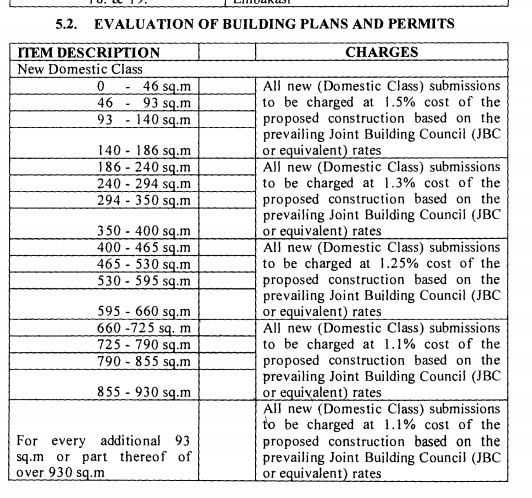
  • Nairobi County Government Building Plan approvals

    ncc building plan approvals


    http://kenyalaw.org/kl/fileadmin/pdfdownloads/Acts/TheNairobiCityCountyFinanceAct2013.pdf

  • Solution to Nairobi City Flooding.

    Yesterday 12th May 2015, Nairobi residents took practically the whole night to get home from work due to flooding caused by heavy rains.
    There are several factors that contribute to flooding such as below.

    1. design and maintenance of storm water drainage infrastructure.

    Design and maintenance of storm water drainage infrastructure is the responsibility of Nairobi County Government. The Civil Engineering department at Nairobi County usually comes up with designs and maintenance solutions. Nairobi storm water and sewer drainage has a national grid, similar to the electricity grid, that drains towards Ruai area. All parts of the city and its suburbs are supposed to have their drainage designed to fit into the national grid for storm water to drain towards Ruai. For large land subdivisions in Nairobi, the County Government requires the developer to submit the storm water designs to County Engineers for approval to check if the design fits well. When this checking method fails, we have developers designing and directing their storm water drainage anyhowly, causing a grid lock, pun intended, hence flooding.Periodic maintenance of the drainage channels is also useful to prevent flooding.

    Some storm water drainage channels are huge, eg the ones draining water from State House road through to Uhuru Park. Someone can stand tall and walk through the underground channels. The design of the storm water drainage determines the volume of the water to be transported which in turn determines the size of the drainage chanels.

    2. Zoning controls to reduce surface water runoff through Ground Coverage control.

    Nairobi County Government has the responsibility to zone Nairobi infrastructure developments to control the amount of surface left open to the sky. In Karen, for example, the Ground Coverage is 25% and in CBD, its 80%, meaning, one can only build 25% and 80% of the ground floor surface, leaving the rest of the percentage open to the sky.

    This ground coverage control helps to soak in rain water into the ground, reducing the volume of the runnoff. With lower ground coverages, leaving more land space unbuilt,this will reduce the surface runoff. So as to make this practical since demand for land is high, the County Government can allow for high rise buildings to be constructed, over 5 storeys, so as to compensate for the land left open to the sky, hence mitigate the issue of excess land demand.

    3. Height of building from ground level.

    Buildings and roads in areas prone to flooding such as South C, South B and Ruai should be built at least 1 meter from ground level. The foundations should also be raft of pile types that do not get affected by soggy grounds. Perimeter walls should have weep holes to let water out to prevent build up of pressure. Walls without weep holes should be made using reinforced concrete strong enough to withstand water pressure. This will prevent walls collapsing from water pressure as was seen yesterday where 9 people lost their life in South B Mosque area.

    4. Conservation of water through dams.

    Nairobi County should work closely with Kiambu county to create and design storm water drainage that eases of into man made dams for collection to be used in the dry periods. Storm water is easily directed to a particular path then easily collected. Natural water storage situations such as dams , lakes, marshes have all been destroyed around Nairobi. The Southern Bypass near Kikuyu town cuts right through Ondiri swamp, releasing water that has been naturally stored in the swamp for thousands of years. This water then easily finds its ways into Nairobi City, creating flooding problems. Runda area also have natural swamps which have all been drained away to pave way for roads and human settlements, releasing water stored for centuries down stream.

    Since human population expansion is inevitable, National Environment Management Authority should become strict to prevent encroachment into lakes, rivers and swamps around Nairobi. County Government should also in a way help nature by creating dams and water ways that can hold this excess water .

    Francis Gichuhi Kamau, Architect.
    info@a4architect.com
    +254721410684

  • 700 km Kenya-Somalia Border wall construction.

    Kenya Government has recently proposed to construct a 700km boundary wall to separate Kenya from Somalia.

    Assuming its a stone wall, the surface area will be 700km x 7m height=4.9 million m2 of surface. Assuming the average rate per m2 for wall construction of kes 1000 per m2, this will budget at kes 4.9 billion.

    Source of stone.

    Juja area of Nairobi is the source of machine cut stone for the whole of Kenya, sometimes spreading to parts of Uganda and Tanzania. Other parts of Kenya have machine cut stones but the stones are too hard to cut hence unfeasible, with low production eg Kiserian, Kitengela, Athiriver, Kedowa-Kericho and Coast region.
    The Juja stone is quite soft, hence easy to cut using machines. Cost of each stone varies from kes 55 shillings per piece in 30 km radius from Juja to kes 100 per piece in areas 500 km away from Juja.

    Construction time.
    Assuming construction time of 30 minutes for 1 m2 of stone, 4,900,000m2 of stone will take 279 years to construct, day and night . Therefore, unless mechanization process comes in whereby time for 1m2 of stone surface is shortened to say 15 minutes, the time taken will be 15 minutes x 4,900,000m2=73.5 million minute=1.2m hours=51,000 days=139 years.

    Therefore, stone wall will take literally forever to construct, hence a faster method such as razor wire chain link fence on concrete posts would be more appropriate.

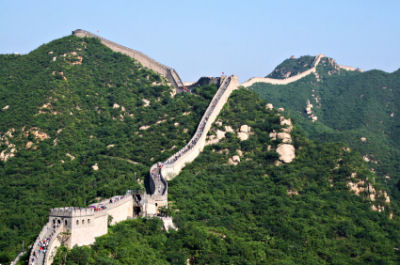
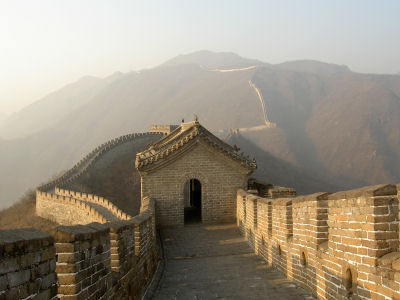
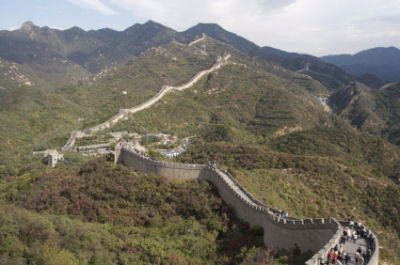
    The Great Wall of China, which is 6000km long took approximately 1700 years to build from 220BC to 1700 AD during the Ming Dynasty (1368-1644).

    The wall was constructed to keep China safe from Mongolians led by Genghis Khan, which was not as successful since Genghis Khan and his army demolished part of it, which was later rebuilt using stronger materials.

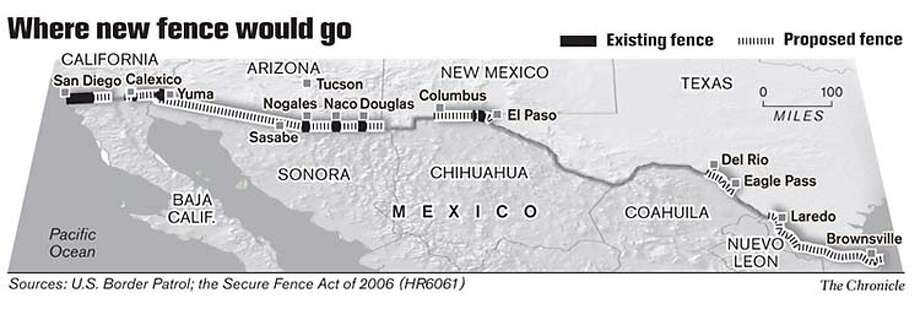
    USA-MEXICO Boundary wall.

    This wall is 3000km long and constructed using barbed wire , chain link fence, steel and concrete posts.

    The fence is estimated to cost usd 49 billion.

    Assuming its 7 meters high, the surface area is 7m x 3000km=21million m2.
    Cost per m2 =kes 200, 000 per km.

    Budget.
    The Kenya-Somalia wall budget is kes 23.6 billion . This is roughly kes 4,800 per m2 which is enough to construct to completion, including watch towers,gates, telecommunication equipment and maintenance.

    Francis Gichuhi Kamau, Architrect.
    info@a4architect.com
    0721410684

  • High Strength Concrete use in Kenya. Athi River Mining Cement presentation.

    Early this week on Tuesday 14th April 2015 there was a presentation by French Architect Thierry Bogaert on High Strength Concrete and its advantages. This was at Athi River Mining Cement company’s new offices at Westwood Park, Ring road, near Westgate in Westlands, organised by Athi River Mining Company Managing Director Mr Pradeep Paunrana who had invited me for the event.

    The usual cement available in the Kenyan market has an average strength of Class 32.5. Athi River Mining cement has a wide range of strengths available, including Class 32.5, 42.5 and 52.5 cement.

    This class 42.5 and 52.5 strength cement which is much stronger than the usual class 32.5 found in hardware shops around the country has numerous advantages as listed below.

    1. Saving on plinth area usable space due to low volume and foot print. With a stronger concrete mix, for the same support, the columns will be thinner hence suitable for internal spaces where thin columns are much appreciated e.g social halls, churches, lecture halls etc.

    2. Savings on form work. Since the columns and beams will be much thinner for the same strength, the form-work needed to support the wet mix will have less surface area, ensuring a considerable savings towards construction costs.

    3.Reduction of overall building self weight. With stronger cement used, the columns, beams and slabs can be thinner, hence lighter, meaning the overall building weight is reduced hence lower costs of construction achieved.

    4. For open spaces eg halls, lecture rooms and churches, stronger cement can enable longer spans in between columns, freeing much needed space for increased visibility.

    5. Strong cement allows for higher water permeability and minimal chances of cracking.

    6. High strength cement enables very high rise tall structures to be constructed safely.

    With the introduction of class 42.5 and 52.5 strength cement by Athi River Mining cement company, Kenya’s construction sector is set to change dynamically for the better as developers tap in to the added benefits for their projects.

    Francis Gichuhi Kamau, Architect.
    info@a4architect.com
    0721410684