Category: A4architect

a4architect posts

  • SOLAR POWER BUILDING INTERGRATED PHOTO VOLTAIC BIPV IN KENYA

    SOLAR POWER BUILDING INTERGRATED PHOTO VOLTAIC BIPV IN KENYA
    Kenya receives 4 to 6 KW per day of solar power. Source
    http://www.google.co.ke/url?sa=t&rct=j&q=how%20much%20is%20electric%20power%20consumption%20in%20%20nairobi%3F&source=web&cd=8&ved=0CF8QFjAH&url=http%3A%2F%2Fwww.afrepren.org%2Fproject%2Fgnesd%2Fesdsi%2Fafrepren.pdf&ei=HCc-T5rABoGp0QXHxOCrDw&usg=AFQjCNG_C9rqtnRJzAlNJwIobgosLDfmGg

    Assuming a m2 of solar panel in Kenya can produce approximately 2KW per day assuming 10 hours of daylight since Kenya is right in the middle of the equator.
    Source
    http://www.moodia.com/article/solar-energy-calculator

    SURFACE AREA.

    Kenya covers 582,000 Km 2 of surface area.
    Nairobi Covers 696km2 of surface area.
    Source
    http://en.wikipedia.org/wiki/List_of_cities_proper_by_population
    Assuming 1% of this area is used for solar power harvesting, this is 7km2.
    This translates to 7,000,000 m2 of solar powered surfaces.
    Assuming each m2 of surface produces 2KW per day, 7 ,000,000 m2 of surface will therefore produce 14,000,000 KW each day.
    Assuming Nairobi consumes 50% of Kenya’s electric power, source http://www.mbendi.com/indy/powr/af/ke/p0005.htm
    Current 2012 Kenya National demand 1215 MW per day-6am to 9pm.
    Nairobi consumes-50% of Kenya’s power hence 5,000,000 KW per day
    SURPLUS.
    After producing 14,000,000 KW through solar panels, there will be a surplus of 9,000,000 MW which can be used for other sources.
    Francis Gichuhi Kamau, Architect.
    info@a4architect.com

  • Interlocking Stabilised Soil Blocks-Eco-Friendly construction in Kenya.

    Interlocking Stabilised Soil Blocks-Eco-Friendly construction in Kenya.

    The use of Interlocking Stabilized Soil Blocks technology is slowly increasing in Kenya.
    More and more Kenyans are becoming aware of the eco-friendly, pocket –friendly method of construction and choosing it over the usual masonry stone or Mabati iron sheet walling.
    The first time I came across the technology, I found it stranger than fiction that soil stabilized with some cement can form into a solid hard rock seconds after compression . It sounded more like magic. The soil block when submerged into a bucket of water overnight together with a masonry stone and then lifted shoulder high and left to fall freely, will still not break. However, strange enough, the masonry stone will break into two after the same fall.
    I have been in the construction industry for over 10 years but still fund this technology hard to believe. For laymen, it’s even harder to imaging that soil can be compressed to create a block just as hard as stone.

    Thika Super Highway.

    The recently completed Thika road is also based on Stabilized soil block technology. This is based on the American Standard as opposed to the usual British Standard of roads we are used to in Kenya where the base is made of several layers of compacted hardcore. In Thika road, the base is made of Stabilized Soil as opposed to hardcore. This is the method that the world is working towards since its better and more cost-effective.

    Good to tame spiraling Inflation in Kenya.

    stabilised soil block wall

    Currently, the current rate of inflation in Kenya is 18%. This has resulted in bank interest rates being higher than 18% and in some cases as high as 30%. Kenya spends approximately 30% of its foreign exchange on oil importation. To prevent this inflation from going higher, the Ministry of Finance/Trade should work out policies that prohibit importation of construction material such as steel/Mabati/cement so that Kenyans can be pushed to think outside the box and utilize solutions available such as use of Interlocking Stabilized Soil Blocks and efficient house design such as Diamond designs.

    http://www.a4architect.com/diamond-house-plan-cost/

    Advantages.

    Aesthetic appeal.

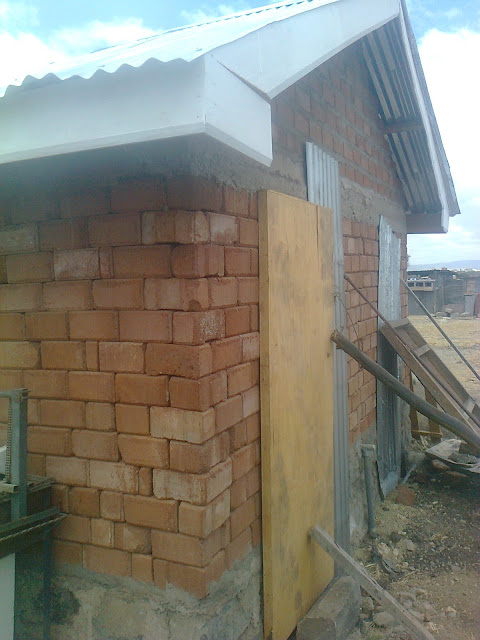
    Interlocking Stabilised Soil blocks are aesthetically appealing. They bring out a rustic natural appearance to the house walling. The type of soil determines the eventual wall colour.
    White bricks.

    From February 17, 2012

    Whitish soil can be used to produce whitish coloured bricks while reddish soil can be used to produce reddish colured bricks.

    Red bricks.

    From February 17, 2012

    These can be mixed together to form a particular pattern depending on the house owner’s taste.

    Cost.

    The cost of constructing using Stabilized Soil blocks is lower than costs associated with using iron sheets for walling. Gauge 30 iron sheet costs KES 400 per m2 plus timber support structure at KES 300 per m2= KES 700 per m2.
    Masonry stone walling takes 13 stones per m2, each stone costing KES 50=KES 650. Add joining mortar @ KES 200 per m2=KES 850
    http://www.a4architect.com/topic/timber-steel-prices-in-kenya-2012/
    Contractors who build the stabilized soil blocks construct at an average of KES 500 per m2.
    Someone can opt to hire the block making machine and if their land already has the soil, use a cost of between KES 250 to KES 400 per m2. This marks over 100% savings compared to Mabati iron sheet or Stone walling. Strange enough, Mabati waling cost is nearly the same as stone walling when all costs are carefully calculated and added up.

    Eco-friendliness.

    Interlocking Stabilized soil blocks saved the environment from degradation. The manufacture of Mabati iron sheet roofing costs a lot of addition to the carbon footprint into the environment. Stone quarries also degrade the environment and a lot of diesel fuel is used by the stone cutting machines and transport Lorries as opposed to Interlocking stabilized soil blocks which can be constructed at site if the soil is favorable.

    Types of Stabilized Soil blocks.

    https://picasaweb.google.com/s/c/bin/slideshow.swf

    There are hand-made soil blocks and diesel-powered soil pressing machines.
    The quality of the soil blocks depend on how careful the soil pressing is done and how careful the soil quality is analyzed so as to enable proper cement mixture.
    Soil is tested for slumping ratio then the results are used to determine the ratio of cement into the soil depending on the soil type.

    Architectural designs.

    Architectural designs should also be customized to enable for Interlocking Stabilized soil block use. The Diamond house type range http://www.a4architect.com/diamond-house-plan-cost/
    has been customized to enable use of the soil blocks.
    The foundation is lighter hence less expensive.
    Diamond House Foundation.
    The picture below is an example of how the Diamond House foundation works

    From February 17, 2012
    From February 17, 2012

    The roof is also lighter and designed to avoid the ‘Bernoulli effect’ due to wind pressure hence the building will last longer without any cracks due to roof forces.

    Francis Gichuhi Kamau, Architect.
    info@a4architect.com
    +254721410684

    /a/a

  • Prayer of Saint Francis of Assisi

    Prayer of Saint Francis of Assisi
    Lord, make me an instrument of your peace.
    Where there is hatred, let me sow love;
    where there is injury,pardon;
    where there is doubt, faith;
    where there is despair, hope;
    where there is darkness, light;
    and where there is sadness, joy.

    O Divine Master, grant that I may not so much seek
    to be consoled as to console;
    to be understood as to understand;
    to be loved as to love.
    For it is in giving that we receive;
    it is in pardoning that we are pardoned;
    and it is in dying that we are born to eternal life. Amen

  • loan for building a flat in kilifi,kenya

    I have a plot 40*60 in kilifi settlement scheme of which i want to build flats for rentals,i don’t have enough cash to start the project,will you be of any assistance?

    saeed Mina.

  • Floating City & Houses

    Floating City
    http://static.discoverymedia.com/videos/components/dsc/d77d8c2efe0dffd141f0513060daa72253822678/snag-it-player.html?auto=no

    Floating Houses
    http://www.ecoboot.nl/artikelen/floating_houses.php

    With the sea level rising as a result of global warming, the low-lying Netherlands is fighting back for more space by building communities on water.

    Ever thought of buying a house you could move with you?
    Recognising the growing scarcity of building ground in the Netherlands, a Dutch construction company has started building houses on water. The houses, made of wood and lightweight aluminium, are linked to each other by walkways but can be detached from the surrounding neighbourhood and individually moved by tugboats.

    For centuries the Netherlands has fought against invading water with land fills, dams and dykes. But the philosophy is changing in the wake of global warming, blamed for the 20 cm-rise in sea-level over the last century. Instead of driving out the water, the Dutch is trying to live on it. And since we are getting more and more rain, we are having more and more water in this country which is fifty percent below the sea level as you know, and so we have developed this concept of building villages on the water, Ooms Bouwmaatschappijs marketing director, Gijsbert van der Woerdt told Reuters.

    The company Ooms Bouwmaatschappij has built the first eight of the planned 500 floating houses on the outskirts of Amsterdam, capital of the worlds third most densely populated country. The houses are designed to withstand gales and can be located up to 100 metres from the shore.

    Spoken comments:
    Gijsbert van der Woerdt

    Interest in the novel mode of living, a natural progression from the ubiquitous houseboats, has been keen. There are about 5,000 names on the waiting list for the accomodation that sells for between $180,000 and $500,000.
    Doctor Dorien Vluchter and her husband Ari Mashiach took a day off to visit the floating estate with their child.

    “I have never thought about the possibility and it just appears to me very interesting that something is floating on the water. And the freedom, maybe eventually we can take the house some place else. I think that is more interesting than moving, now you just move your whole house”, Vluchter said. Her husband was more sceptical.
    “I can imagine that the water is kind of calming, something very quiet and nice to look at. On the other side, I think, well it is just water, so I cannot open open the door and play in the garden with my daughter, so I don’t know”, Mashiach said.

    Spoken comments:
    Dorien Vluchter
    Spoken comments:
    Ari Mashiach

    Spoken comments: Frits Schoute A Dutch academic is taking this idea further and has been searching for ways to colonise the sea. Frits Schoute, a former professor at Delft University, is working on a stabilising platform that allows communities to live in the middle of oceans, unaffected by waves.
    “We are working on solutions for stabilising a platform and making some kind of barrier around it, such that it is ultimately comfortable to live on the sea”, Schoute said.
    Schoute expects people to start living and working on these full-scale platforms by 2020, with floating cities being established in 2050. The world will be a very different place.

  • Sun City Resort

    Sun City Resort

    http://www.sa-venues.com/attractionsnwp/nwp-sun-city.htm
    Deep in the rugged bushveld, in the heart of an ancient volcano, lies the world’s most unique resort, the internationally acclaimed Sun City. The Resort has a unique heartbeat and an African rhythm of its own and is unlike any other Resort destination in the world. This is pure fantasy and your every desire is met.

    There are four world-class hotels including the magnificent Palace of the Lost City that glitters like a jewel beneath the African sun, brilliant in its rain forest surroundings and luxurious in its detail and design. Adjoining the Resort, is the beautiful Pilanesberg National Park, which will delight game viewers as it is a malaria free zone and home to the “Big 5” (Buffalo, Elephant, Leopard, Lion and Rhino).

    The Sun City resort has amazed the international community with its glamorous casinos, gourmet restaurants, extensive sports facilities and star studded spectaculars. The full variety of entertainment on offer ranges from slots to safaris; the theatre extravaganza to a games arcade for children; horse riding to golf; the Valley of Waves to The Lost City … whatever it is you’re looking for, you’ll find it at Sun City.

    Sun City Resort
    Valley Of The Waves
    Valley Of The Waves
    The Legend

    The Palace of the Lost City is a fantasy world of Africa ‘s jungles, cliff-tumbling gardens, streams, waterfalls, swimming pools, and al fresco entertainment areas. Legend tells us that the Palace of the Lost City was built as the royal residence of an ancient civilisation of South Africa, but was destroyed by an earthquake. It has now been restored to its former glory and offers splendid accommodation in the most sumptuous surroundings in South Africa.

    Sun City Resort
    Location

    Sun City Resort is set in the stark ruggedness of the North West Region of South Africa, and is surrounded by mountains and the untamed majesty of the African bushveld. It is a wedge-shot away from the Pilanesberg National Park, where elephants, rhinos, lions and antelope roam freely.

    Sun City Resort
    Facilities at Sun City

    Valley Of The Waves – Overnight visitors to any of the hotels at the Sun City Resort have free access to the Valley of the Waves. This is the most advanced water park in South Africa. A large lagoon dominates the scene with a wave machine capable of generating 1.8 metre waves every 90 seconds. This water park has five exhilarating flume rides. From the aptly names Temple of Courage swimmers drop a heart stopping 17 metres down a chute and under a bridge before splashing into a small pool at the foot of the slide. For the less adventurous visitor to the Sun City Resort why not take a ride on the ‘Lazy River’.

    Watersports and Activities – A variety of sports activities may be enjoyed at Sun City. Year round good weather in this part of South Africa, ensures that Tennis, squash, swimming, golf, mountain biking, horse riding, and parasailing are all on offer throughout the year. Sun City has laid out spectacular jogging trails. Sun City’s Gym and Health spa keep you perfectly toned, and a beauty treatment is the perfect way to wind down after a workout. A wide range of water sports including Water-skiing, Parasailing and Sunset Cruises can be enjoyed at the Resort’s Waterworld.

    Sun City Nightlife and Entertainment – The Super Bowl is Africa ‘s finest venue for concerts. Stars such as Queen, Bryan Adams, Frank Sinatra and Rod Stewart have performed at this 6,000 seat arena. This arena is also one of South Africa ‘s favourite venues for beauty pageants and sporting The Sun City Resort spectacular is famed throughout South Africa as a glamorous & sophisticated theatre production. This stage revue pulsates with energy and is well known for spectacular sets, trapeze acts and glorious costumes.
    http://www.sa-venues.com/attractionsnwp/nwp-sun-city.htm

  • How a Hot Air Balloon Works

    How a Hot Air Balloon Works
    By [http://ezinearticles.com/?expert=Mischa_Weston-Green]Mischa Weston-Green

    The working of a hot air balloon is actually much simpler then you could imagine. The basic workings of a hot air balloon are based on the fact that heated air rises in cooler air because it is lighter. Because hot air rises it means that it can’t escape from the bottom of the envelope.

    There are 3 main parts to a balloon:

    The envelope – This is effectively the balloon, which is the fabric where all the hot air is contained in order to lift the balloon, vital for hot air balloon rides! All the heated air is stored in this area to lift the balloon, as the air in here cools, the burner is used to heat it up.

    The Burner – This is where the air in the envelope is heated. The pilot controls the amount of heat which propels the balloon, in order to ascent the pilot increases the flame which is shot up into the envelope.

    The basket – this is where the pilot and passengers stand during a balloon ride, surrounding them with breath-taking views. This is usually made from wicker, which works well because it is sturdy, flexible, and relatively lightweight. This flexibility absorbs some of the impacts on landing so the passengers don’t feel the impact force.

    The burner uses propane gas to heat up the air which essentially is what keep the balloon in flight. It must be fired regularly throughout rel=nofollow [http://www.goballooning.co.uk/]hot air balloon flights in order to keep the balloon stable. You might be wondering how the balloon moves from side to side? Well, it’s very simple. The wind blows in different directions, depending on the altitude the balloon is at, so in order to move around, the pilot simple ascends of descends to the right height and will be blown along by the wind.

    The final step of any hot air balloon ride is the descent; this is equally as simple as the rest of the flight! There is a valve at the top of the balloon which is covered by a piece of fabric. When the pilot decides it is time to descent he simple pulls on a chord which opens the value. This lets cool air into the envelope which lowers the temperature inside the balloon, slowly bringing it back down to earth.

    Of course all this depends on the weather, balloons cannot fly in rainy or windy conditions as it will damage the balloon and make for unsafe flying. In order to check this pilots send up a pilball to double check the safety of the wind, and to check which direction the balloon is going to take off.

    Go Ballooning have over 100 launch locations throughout the UK providing [http://www.goballooning.co.uk/]hot air balloon flights for customers, you may be looking for hot air balloon rides London or many of our other launch locations.

    Article Source: [http://EzineArticles.com/?How-a-Hot-Air-Balloon-Works&id=6174654] How a Hot Air Balloon Works

  • Baloon Advertising For Balooning Sales

    Baloon Advertising For Balooning Sales

    Author: John Smi

    Let’s face it: most small- and medium-sized companies don’t have huge advertising budgets. Traditional media, such as print, television, and radio advertising are far too expensive. And, for those businesses that rely on walk-in traffic, Internet advertising won’t reach the intended audience. Thankfully, there’s another advertising medium that’s incredibly effective for a variety of businesses: advertising balloons.

    Advertising balloons – also known as advertising blimps and advertising inflatables – are an incredibly cost-effective method of gaining the attention of passersby and turning prospects into customers. Starting at slightly over $100, the cost of an advertising balloon can be recouped in no time at all.

    There are several different types of advertising inflatables. Advertising blimps have the traditional blimp shape, but come in a variety of sizes. They are easily customizable with a company logo, special message, or unique combinations of colors. Advertising blimps can be large enough to attract attention from miles away, or small enough to catch the eye of a trade show attendee. Larger advertising blimps can even be lit at night to garner notice 24 hours a day.

    Round advertising balloons are also attention-grabbers. Again, they come in all sizes and can be flown high above the ground, acting as traffic magnets for a business’ location.

    A business can also buy a pre-made advertising inflatable, such as one in the shape of a hot air balloon that says, “Grand Opening.” Eye-catching shapes and colors are sure to attract customers. Similarly, dancing balloons (also called wind dancers) are eye-catching. Inflated with a cold air blower, dancers will delight both adults and children. However, they’re generally made with a light material that doesn’t hold up well in sunlight or strong wind. For that reason, a tarp should always be placed under a wind dancer.

    When you order custom balloons, you first need to think through the various elements that will give your advertising balloons maximum impact. Here are attributes to consider:

    Lettering: If readability is important, stay with a small number of letters on one or two lines. Determine the distance at which you want your advertising balloon to be read. For maximum impact at 30 feet, for example, letters that are three inches high will suffice. On the other hand, letters that are 12 inches high have maximum impact at 120 feet but are still readable at 525 feet.

    Colors: There are specific color combinations that will give your advertising balloon more impact. Black lettering or art against a backdrop of yellow, white, or orange is the most effective, followed by blue on white, white on green, green on white, red on white, and white on red.

    Like everyone else, you probably look up when you see an advertising balloon in the sky. Just imagine how much recognition you can get from your business from the relatively small investment of an advertising balloon!

    Article Source: http://www.articlesbase.com/business-articles/baloon-advertising-for-balooning-sales-1878374.html

    About the Author

    To learn about arm nerves and femoral nerve pain, visit the Nerve Damage Symptoms website.

  • Eco-friendly houses for hostels and apartments

    I would to know more about the eco-friendly houses and their implementation. Currently I have a close relative who would like to build a good viable hostel for students but its due completion due to finances. I have seen about your KES 80,000 house design and was interested.

    Moreover, the house design I have in mind or like to request from you, has two floors. Can it be firm? Although my relative has built one floor (Ground floor), he wishes to continue with the other floor and finish. Can it be done at a lower cost? The area is situated at Kahawa along Thika Road. If possible you can write to him via email: digivillecomm@gmail.com


  • Timber & Steel prices in Kenya 2012

    Cypress: 2×2: KES 25 per foot.
    4×2: KES 60 per foot.
    Mukima: 2×2: KES 20 per foot.
    4×2; KES 40 per foot.
    Cpress: 6×1:KES 36 per foot.
    Mukima: 6×1: KES 23 per foot
    Plywood: KES 300 per m2.
    Barbed wire:
    610m@ KES 5,000
    480M@ KES 3,800
    Barbed wire Nails @ KES 200 per kg.
    Iron Sheet:
    Gauge 30 prepainted box/curved profile.IT4 2m-900=KES 600 per m2
    Gauge 30-2m kes560=KES 373 per m2
    Gauge 32-2m 480=KES 320 per m2