Hotel Real Estate investment.
Sale price per room commencing at kes 1.2m.
See details here
http://www.a4architect.com/discuss/


Hotel Real Estate investment.
Sale price per room commencing at kes 1.2m.
See details here
http://www.a4architect.com/discuss/
Glass use in buildings has many uses. The obvious being allowing light into the building and enabling people to see in and out of a building while keeping elements of weather at bay.
Bullet proof glass.
Security.
Bullet proof glass enables buildings to be secure.
Bullet proof glass has 2 glass layers combined. One layer is soft while the other is hard. The softer glass prevents the glass from shattering.
One layer is made from polycarbonate material while the other is made from ordinary glass. These 2 layers are joint together through a process called lamination.
Bullet proof glass has a thickness varying from 19mm to 76mm.
The thicker the glass, the more resistant it is to more powerful guns.
There is also one way bullet proof glass that allows bullets to pass through the glass from one direction and stops bullets from penetrating through the glass from the other direction. These are used whereby the occupants of the room protected by the bullet proof glass might want to return back the fire.
Such glass is mainly used in cars and banking halls .
Toughened glass.

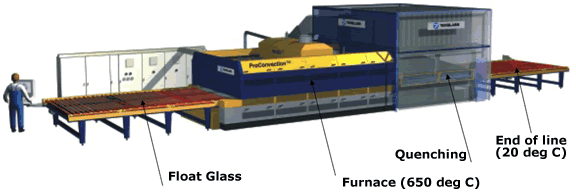
This is made when ordinary glass is put through a 650 degrees hot furnace for several minutes. It’s then rapidly cooled to a temperature of 20 degrees.
The heat causes the glass outer surfaces to expansion and the inner parts into tension.
This causes the glass to turn into small crumb like pieces when broken due to the residual tensile and compressive forces stored within the glass.
These stored forces also make the glass around 5 times as strong as ordinary glass.
Uses.
Its most commonly used in side and rear windows of cars.
Disadvantage.
Toughened glass can not be reworked once its taken through the process of toughening. No chiseling, grooving or cutting can occur since any incision tends to allow the massive energy stored inside the glass through the heating and cooling process to be released through breaking into thumbnail pieces.
Toughened glass has the same effect as dropping molten glass in a bucket of cold water. The molten glass forms into a tear drop shape called the Prince Rupert’s drop. The larger head end is usually very strong and can withstand strong blows while the tail end is very weak and any slight force causes the whole drop to shatter immediately due to the high energy stored within it.

Toughened glass currently costs around kes 8,000 per m2 in Kenya.
Laminated Glass.
This was invented in 1903 by French chemist Edouard Benedictus through an accident. A glass flask coated with plastic cellulose nitrate fell but did not break.
Benedictus then fabricated a glass plastic composite in order to reduce car accidents caused by broken glass.
To date, car windscreens use laminated glass for the safety reason.
Also, most shop fronts and areas where broken glass can come in contact with people usually have laminated glass due to its high safety level.When broken, it sticks together.
A typical laminated glass is usually 2.5mm glass, 0.38mm polycarbonate laminate in between, then a 2.5mm thick glass at the end, making a sandwich.
The polycarbonate sandwich in the middle can be replaced with decorative patterned cloth material or any other material to create interesting effects.
The sandwich material makes it hard to cut, hence the laminated glass sizes need to be exact when being used in architectural projects.
Laminated glass blocks UV rays and also is very effective in sound proofing, due to the sandwich material in between.
Window film on Glass.
This is a thin layer of film applied on one side of the glass surface.
Uses.
1. Helps prevent UV rays from the sun from entering the building.
2. Ensures privacy while bringing in light, through use of tinted film or obscured film.
3. Enhances aesthetics through use of patterned film.
4. Prevents glass from injuring people in case of breakage.
5. Prevents easy break ins from burglars.
6. Helps to control glare.
Francis Gichuhi Kamau, Architect.
info@a4architect.com
Current Real Estate investments in Kenya have return on investment within 14 to 18 years.
Lets look at curent available options around Nairobi.
Syokimau.
The average 2 bedroomed apartments for sale go for kes 4m.
These attract rents of kes 25,000 per month.
This gives a return on investment of 13.3 years.
Ngong road, Racecourse area.
The average 2 bedroomed apartments here sell for kes 6.5m.
These can attract a rent of kes 40,000 per moth.
This translates to a return on investment of 13.5 years.
In other words, if one spends their money on the average Nairobi property on sale, they will recover their money back after 13 years, from here is where they can start calculating the profit in rent.
A4architect investment solution.
A4architect.com has come up with real estate investment solutions that make possible for investors to return their investment within a maximum of 6 years.
After research on the most cost effective methods to invest in Real estate in Kenya, the solutions have led to conception of a Motel project along the Southern Bypass near Thogoto town.
30 room hotel.
The concept is simple. Its a 30 roomed hotel whereby each of the 30 rooms will be translated and represented by 1 share.
Investors will then buy 1 room which is equivalent to 1 share from a Limited Liability company registered under the Companies Act of Kenyan laws.
The 1 share can then be resold at a profit, or transferred to another owner in case of inheritance or can act as collateral in case of borrowing.
Appreciation in value.
This 1 share bought will immediately start appreciating in valuue with the current high property appreciation rates around Nairobi.
The investor will then immediately start increasing their wealth as the property value goes up.
Monthly income.
This 1 share that translates to 1 hotel room will then start to earn monthly income for the benefit of the investor.
Assuming minimum rate per night at kes 1,000, and a 60% occupancy rate per month, this 1 share will guarantee a monthly income of kes 18,000. This rate of kes 1,000 shillings is on the lower side considering other hotels in the neighbourhood charge as high as kes 7,000 per night for the same sized room.
Sale price.
The initial sale price per hotel room is set at kes 1.2m.
This translates to a return on investment of 5.5 years.
This is very impressive considering that the average return on investment for Nairobi property investors is between 13 to 18 years.
The 5.5 years return is calculated at the worst case scenario since after the 1st year, the occupancy rate will go up from the 60% envisaged, to nearly 100% and the rate per night will then increase from the kes 1,000 per night up to a possible kes 7,000 per neigh as charged by the current nearby hotels.
Investors .
Potential investors can join in to the conversation at our forum here to learn more
http://www.a4architect.com/discuss/
Investors can send email to info@a4architect.com on information on joining in.
Francis Gichuhi Kamau, Architect.
info@a4architect.com
Other countries that have had to upgrade their railway lines have come up with detailed research into the options available.
See research done in Spain
http://www.vialibre-ffe.com/pdf/Track_gauge_changeover.pdf
Australia dual gauge railway.
Switzerland rail

Wallangarra, Australia
Western Australia


The trans-continental passenger train Indian Pacific, which has run between Sydney and Perth since 1970, is seen on the dual gauge track (3’6″ and 4’8.5″ – 1067 mm and 1435 mm) between Kalgoorlie and Perth (655 km) in 1976, with the loco in the scheme of the then Westrail.
Other countries that have had to upgrade their railway lines have come up with detailed research into the options available.
See research done in Spain
http://www.vialibre-ffe.com/pdf/Track_gauge_changeover.pdf
Australia dual gauge railway.
Switzerland rail
Wallangarra, Australia
Western Australia

The trans-continental passenger train Indian Pacific, which has run between Sydney and Perth since 1970, is seen on the dual gauge track (3’6″ and 4’8.5″ – 1067 mm and 1435 mm) between Kalgoorlie and Perth (655 km) in 1976, with the loco in the scheme of the then Westrail.
Stabilised Soil Block House designs in Kenya.
They require larger roof overhangs to protect the walls from rain water. They require to be slightly raised from the ground to protect the wall from ground water and moistrure. The roof design needs to be in such a way that it prevents Bernoulli effect to lift the roof upwards during strong winds.
Advantages.
Where quarry stones are not available, they are a good substitute eg Northern Kenya.
Disdavantages.
They need close supervision to ensure structural strength high quality.
In areas where quarry stone is available, where stone costs around kes 60 per piece, then the soil blocks will not have any advantage because it also costs nearly the same as stone to produce.
Soil blocks are advantageous in areas where quarry stone costs around kes 100 and above per piece .
Storeyed house construction.
Quarry stone has an advantage since it can be used to support a storeyed house without using concrete columns.
Soil blocks are only used as an infill material that does not carry any weight so in storeyed houses, the load bearing structure has to be built using concrete columns, beams and slabs.
Francis Gichuhi Kamau, Architect.
info@a4architect.com
Reasons for Building collapse in Kenya.
Reasons are whereby the developer does not ensure that the design team comprising architect, quantity surveyor, structural engineer and services engineer are involved in the supervision of the actual construction.
All the buildings that have collapsed in Kenya did not have architects and engineers involved in the supervision of the actual construction.
Other reasons could be that the Government, through the County Government planning departments that approve buildings, do not enforce the developers to have architects and engineers in the supervision of the building. The enforcement by the Planning department is mainly in the design part whereby the drawings need to be stamped and signed by the architects and engineers. This should also go a further step and ensure enforcement of involvement of architects and engineers during the actual construction.
Government institutions involved in buildings safety.
Ministry of Lands and Housing.
This Ministry licenses and regulates the Architects, Quantity Surveyors and Structural Engineers. This ministry also registers building contractors.
County Government Planning departments. These departments approve building construction works.
Research.
I have personally documented some buildings that have recently collapsed in Nairobi to find out why they collapse and what can be done to prevent this.
See the documentation here
http://www.a4architect.com/2011/09/18/why-buildings-collapse-in-kenya/
http://www.a4architect.com/2011/06/20/why-the-langata-southern-bypass-building-collapsed/
http://a4architect.wordpress.com/2012/06/14/why-the-mlolongo-building-collapsed/
Advice to potential tenants.
Potential tenants can counter check if the building design was done by registered engineers at the County Government planning department. This information is usually kept public at the planning departments.
Potential tenants can get the contacts of the engineers and architects and confirm from them if they participated in the day to day supervision of the building.
An assurance from the architects and engineers involved in the design is good enough for a potential tenant to feel safe.
Kenya Government can borrow from Australia and New Zealand , who are very strict on enforcement of building safety due to the numerous earthquakes in their locale.
Today there was an Earthquake in New Zealand whereby there were no casualties even though the earthquake was very strong, 6.3 on the Richter scale.
The most notable damage was a new sculpture erected to publicize the movie Hobbit, fell at a restaurant where luckily, no one got injured.
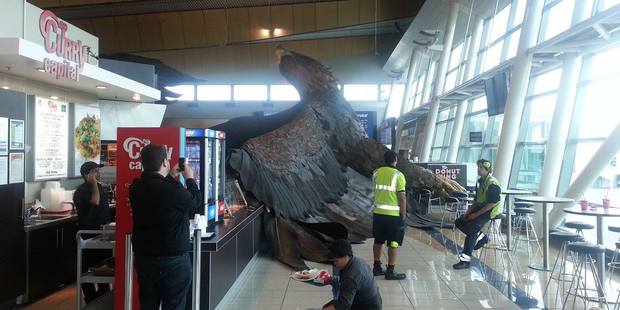
http://www.nzherald.co.nz/nz/news/article.cfm?c_id=1&objectid=11189343
Kenya’s strongest earthquake hit the Subukia/Nakuru area over 70 years ago. This means that there can be a possibility of a severe earthquake within this region. Therefore, buildings safety should not be taken lightly by the County Government responsible with ensuring the safety of Kenyans.
Francis Gichuhi Kamau, Architect.
info@a4architect.com
Technological advancement in access control of buildings especially the hotel industry have enabled the use of mobile phones to open and close doors.
Once a guest checks in at the hotel reception , he is given a toll free number to call when near his hotel room.
Once he calls the number close to the hotel room door, the door lock is designed to respond to the sound emmited from the mobile phone and opens to grant the phone owner access into the room.
https://www.youtube.com/watch?v=4yXd3wS3Acg
The hotel IT department will be able to keep changing the sounds used to open the door locks as the guests keep changing.
To prevent chances of burglers recording the phone sound then gaining unlawful entry, the phone sounds keep changing severally after a few minutes after being used to open the door. The sound is also securely encrypted.
This technology will also be explored upon for use at the proposed a4architect hotel along the Southern Bypass, Nairobi.
http://www.a4architect.com/discus/topic/joint-investment/page/4/
Francis Gichuhi Kamau, Architect.


