Month: February 2015

  • Local Construction Materials in Kenya.

    Local construction materials available are abundant. These include building sand, masonry stone, ballast, timber, cement, ceramic tiles, paint, steel rebar and clay/concrete roofing tiles.

    These offer a source of employment to hundreds of thousands of Kenyans. In the stone mining and extraction industry alone, we can guestimate at least 10000 people employed directly in Juja, 8000 people in the kiserian/Isinya/Kitengela/Rongai quarres, 10000 people in the coastlal coral stone quarries and another 10,000 people in the Kericho/Kedowa and Nakuru quarries.

    The number of people employed in the sand harvesting industry, mainly in Machakos, Kajiado and Naivasha areas is even higher. Same case with employees in the ballast extraction businesses.

    The timber industry in Kenya is also a source of livelihood to hundreds of thousands of Kenyans, from the farmers who plant the eucalyptus and cyprus trees, to the saw millers, timber yard sales people and finally to the fundis and carpenters who earn from offering specialized carpentry skills to the public.

    The cement industry is also huge. Thousands of people are employed in the limestone mines in Garissa, Pokot areas. There are also thousands employed in the gypsum mines transportation industry. The cement factories also employ a further huge number to process the cement. The cement re-sellers in the hardware shops and the fundis who work on cement products also benefit greatly from this industry.

    At least 2 million people are employed directly from the local construction materials industry form my guestimations.

    Most of the residential units in Kenya, mainly the low and middle class category, are the main consumers of the local materials. High end houses tend to have large fractions of materials coming from outside the country.

    The reason is the fact that for the low and middle class buildings, cost is of essence, and since local materials are usually of less cost than imported ones, the local materials win over in the price wars. In high end buildings, cost os not a critical consideration. Other factors such as style, fashion, aesthetic appeal, uniqueness and quality come into play.

    Of late, high end buildings have recently started to embrace local materials, with cut mazeras being in the forefront of this. The recent car park at the Junction mall is cladded with local mazeras stones. Also, the recently completed buildings along Ralph Bunche road in Upper Hill such as the Mayfair centre, have utilised Mazeras stones for the cladding in the driveway areas.

    New paint brands imported into the country such as Jotun are making headway , eating into the already established brand names such as crown paints.

    Architect Francis Gichuhi Kamau,
    0721410684.
    info@a4architect.com
  • Anti Seismic Buildings

    https://www.facebook.com/video.php?v=652855171536408&set=vb.249880261833903&type=2&theater

  • Real Estate investment in Kenya.

    Availability of Land for Real Estate Development .

    Land for Real Estate investment is available. Upmarket land for investment in Nairobi city CBD is available in Upper Hill, Westlands and Kilimani areas. Middlle class market land is available in surburbs 30 km radius from CBD in areas such as Rongai, Ruai, Ruiru and Kiambu.
    Low class land is available in areas 50km from CBD in areas such as Kamulu, Isinya, Mai Mahiu and Thika/Juja farm.

    Rate of Land in Various Counties

    Land price varies depending on location. The most expensive is Nairobi CBD land at rates of kes 400 to kes 500 million per acre. The cheapest is in areas around Kangundo and Juja farm, costing around kes 1 million per acre.

    Average Rate of Newly built Houses in Nairobi & outskirts

    Approximately 20,000 units are built in Nairobi each year, while the demand for housing is at least 200,000 units per year.

    Major Players of Real Estate Market in Kenya

    Major players in Kenyan real estate include Banks, Savings and Credit Societies/SACCOs and international investors.

    Support of Kenyan Banks for Housing Projects for Foreign Companies

    Kenyan banks support foreign companies in Real Estate investment. Kenya Government has a policy that encourages foreign investors into the Real Estate sector.

    Govt. Projects in housing for Social Developments

    Kenyan Government, through National Housing Corporation, works on housing projects within social dimensions.

    Will Federal Govt. / Counties provide land for Developers to build housing Complexes?

    Each County Government is independent in policy decisions regarding provision of land for developers. Some counties have such arrangements.

    Standard Design of Houses in Average Income Area ( 2 or 3 Bed Room )

    www.a4architect.com can come up with standard designs for houses. Fees for design services are as outlined below

    https://www.a4architect.com/about-us/fees-breakdown/


    What is the General Trend of Market in terms of Housing ( Type of Houses, No of Bedrooms, Type / material of Construction, Prices Prevailing in the Market)

    For upmarket areas eg Upper Hill, high rise mega structures of 20 floors are coming up for residential housing. For middle class areas, row housing, in maisonette design are coming up. For low cost areas, houses in own compound are coming up. Land cost and availability is the major determinant for the trend, with areas where land is expensive, having high rise structures so as to house more families within the same land hence economies of scale towards land cost.

    Do you have any contacts in Higher Levels of Banks Like : KCB /Housing Finance Kenya/ CFC Stanbic / Standard & Chartered / Barclays etc (only High officials in respective banks dealing with Housing Finance)

    Yes. We work with all major banks and have contacts at the top managerial sectors.

    Architect Francis Gichuhi Kamau,
    info@a4architect.com
    0721410684

  • Upper Hill 0.5 Acre Joint Venture

    Cost Item Kshs %
    Land 300,000,000.00 21.9170076
    Preliminary 14,080,000.00 1.028638223
    Construction 704,000,000.00 51.43191116
    External Works 105,600,000.00 7.714786674
    Contingency 70,400,000.00 5.143191116
    Marketing 48,000,000.00 3.506721216
    Financial Charges 126,720,000.00 9.257744009
    Total 1,368,800,000.00 100
    Financing Plan Kshs %
    Developer 384,480,000.00 28.08883694
    Debt Finance 704,000,000.00 51.43191116
    Presales 192,000,000.00 14.02688486
    Total 1,368,800,000.00 93.54763296
    PROFIT
    TOTAL SALES FOR 15 floors 1,920,000,000.00
    TOTAL EXPENDITURE 1,368,800,000.00
    NET PROFIT 551,200,000.00
    % Profit Margin 40.26884863
    Take home ammount. 851,200,000.00
                          275,600,000.00
    575,600,000.00
    Sale:
    2 Bedroomed                         17,000,000.00
    CAR PARKING 190 PARKING SPACES
  • National Bank of Kenya Construction Financing

    At A4architect, our architectural service includes negotiating for financing with leading Kenyan financial institutions for Joint Ventures or Construction loans.

    1. National Bank has a wide range of options for getting a home. Learn more about what NationalHomes offers.

    2. Through National Amanah, National Bank offers a Shari’ah compliant mortgage product to enable you own your dream home.

    3. If owning your own home looks like a dream, National Bank can make it come true. They are currently offering up to 80% financing in Construction Loans.

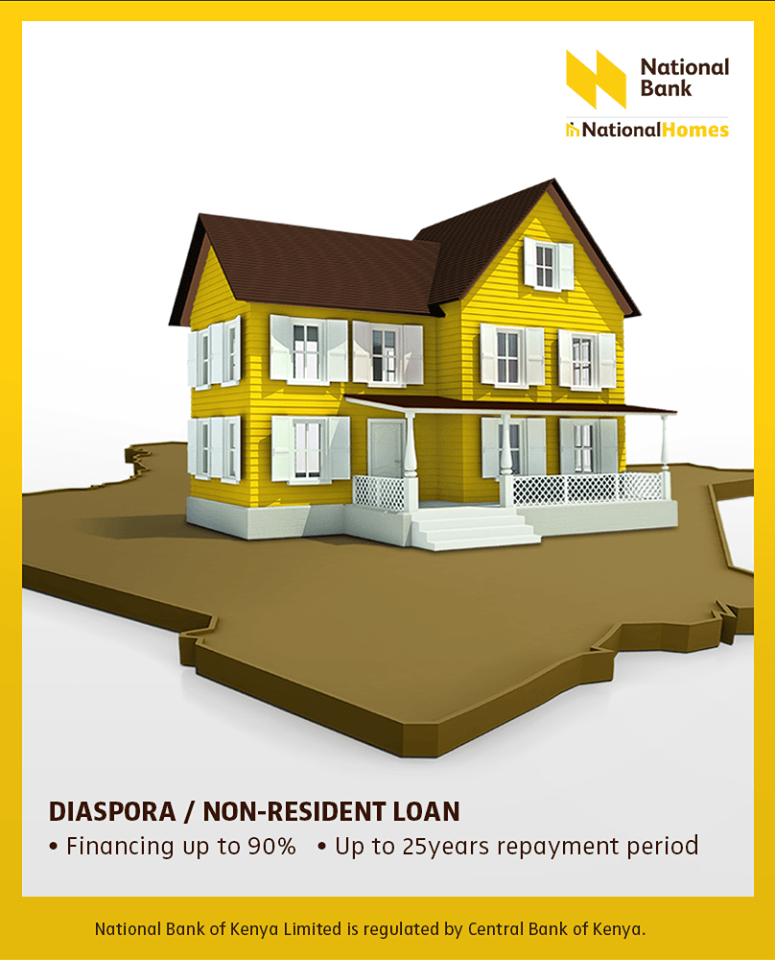
    4. Own a home away from home with National Bank Diaspora Mortgage plan. Up to 90% financing.

    Contact info@a4architect.com for more information .

    amanah

    construction (1)

    own a home