Month: January 2012

  • DIAMOND HOUSE- PHASE 2.

    DIAMOND HOUSE- PHASE 2. COST ESTIMATE: KES 750,000.
    57M2.

    COST BREAKDOWN;

    DIAMOND HOUSE- PHASE 2. COST ESTIMATE: KES 750,000.

    57M2.

    COST BREAKDOWN;

    MAIN SUMMARY

     
    Substructures        150,696.00
     
    Reinforced Concrete Frame                     –
     
    Superstructure walling          98,201.60
     
    Roof structure, covering, finishes and rainwater goods          93,760.00
     
    Windows          39,040.00
     
    Doors          56,704.00
     
    External finishes                     –
     
    Floor Finishes          10,780.00
     
    Wall Finishes          37,200.00
     
    Ceiling Finishes          44,552.00
     
    Sanitary Fittings          29,920.00
     
    CONSULTANCY FEES                     –
     
    Prime Cost and Provisional sums        145,000.00
     
     
    Sub Total      705,853.60
     
    Technical Support          42,351.22


    CONSULTANCY FEES BREAKDOWN.

    Outline proposal        7,500.00
                        –
    Scheme design      11,250.00
                        –
    Detailed design      15,000.00
    Tender action to completion      11,250.00


    NOTES.

    The foundation is based on a4architect.com’s Diamond House technology. This technology reduces costs associated with reinforced concrete by replacing Reinforced concrete in foundations with masonry walling.

    In this case, using Reinforced concrete would have costed KES 40,000. Using a4architect.com Diamond technology is estimated at KES 30,000, resulting in a KES 10,000 savings.

    The floor is masonry as opposed to the usual reinforced concrete. This results in a further savings of  KES 700 per m2.

    Roof.

    The roof pitch is as specified in the Diamond House technology.

    This represents an estimated cost of KES 13,000 per m2 inclusive of external works and accessories.

    Architect Francis Gichuhi Kamau

    www.a4architect.com

    +254721410684


  • KENYA COLONIAL ARCHITECTURE-BUILT TO LAST FOREVER.

    KENYA COLONIAL ARCHITECTURE-BUILT TO LAST FOREVER.
    The British colonial architecture spread all over Kenya was designed to very high standards.
    The buildings done in the early 1900s are still standing strong due to the design, materials and building technology used.
    MASONRY WALLING.
    A characteristic of these buildings is the hand-dressed dark grey masonry walling.
    Buildings such as Kipande house http://farm5.static.flickr.com/4067/5133373584_cf319a998b.jpg

    were designed with very intricate masonry walling patterns.
    The grey stone used is very strong and till today, no signs of cracks or failure are visible.
    The railways houses along Ojijo road near KI and Parklands sports club are also standing strong after tens of years since they were constructed.

    ojijo road

    Another masterpiece is the Lord Egerton caste in Nakuru.
    To date, no signs of cracks or failure can be seen.
    egerton castle

    TECHNOLOGY USED.
    The British used strip foundation for the foundation, hand-dressed masonry for the walling, timber trusses for the roof structure and clay tiles for roof surface.
    Labour to dress the stones to the intricate patterns was abundant from the enslaved Africans. The workmanship was so thorough and to the exact point. A quick look at the masonry stones at the corners of Kipande house still shows the razor-thin stone edges that had been shaped by hand. To achieve this, thousands of man-hours were needed so as to get this fine piece of art.
    With the current labour situation and labour laws, it will cost an arm and a leg to get the same quality since you will have to pay for all those man-hours. This is the reason that most current buildings to don’t embrace such intricate masonry stylings.
    LESSONS LEARNT.
    The buildings to date are a very good source on building construction technology. Unfortunately, with the rapid urbanization in most parts of Africa, the zoning regulations are changing rapidly hence no great need to design buildings that last over 50 years.
    These British pieces of architecture dotting Nairobi suburbs such as Upper Hill, Hurlingham have now been caught up with new planning laws that require for demolition to pave way for high-rise structures. Unfortunately, due to the good workmanship, these can last for another 50 years but they have to pave way for more high-density structures.
    The British had envisioned a much greater stay within the Kenya colony. It looks like the 1963 Uhuru was premature to them since they had not calculated this into their architecture planning.
    Architect Francis Gichuhi Kamau.
    www.a4architect.fom
    info@a4architect.com
    =254721410684

  • MOBILE INTERNET PENETRATION IN AFRICA: AN END TO LARGE GOVERNMENT EXPENDITURE?

    MOBILE INTERNET PENETRATION IN AFRICA: AN END TO LARGE GOVERNMENT EXPENDITURE?

    Africa holds the number two position after Asia as the continent with the 2nd highest mobile internet users.

    Source: http://asiancorrespondent.com/43116/asia-recognised-as-worlds-biggest-mobile-internet-user/
    http://digitaljournal.com/article/314828
    Africa has not heavily invested in physical infrastructure such as schools, hospitals and roads. This puts it in a unique position compared to other continents who have already heavily invested in these physical infrastructures. This means that Africa can afford more room for innovative mobile –internet-based solutions to augment roles played heavily by Governments.

    EDUCATION.
    In regions where African Governments have not heavily invested in building schools such as North Eastern Province in Kenya, the internet can augment the need for heavy physical investment especially in secondary and tertiary education level.

    For example, the need for students to enroll in secondary or tertiary institutions so as to learn mandatory subjects such as calculus, periodic table, human anatomy e.t.c which chances are very high that they might not use in their life. In such situations, students should be able to learn only what is of interest to them through the millions of tutorials available in the internet in written and video format.

    This will in turn lead to less Government involvement in Education sector. Students will be able to follow their passions to very detailed education levels.
    The Government can in turn assist and regulate this by changing the curriculum such that students can be able to specialize at n early age. For instance, if a student shows interest in biology, he/she can pursue the knowledge online beginning form Primary school until PhD level.

    PARLIAMENT.
    Political deliberations can be designed such that political representatives can deliberate both physically in parliament and online through forums. This will enable representatives in fur areas or on travel to equally participate in deliberations. This will also enable citizens to join in the debates and air their views.

    LOCAL GOVERNMENT.

    The use of internet portals that allow for Local Authority to communicate with building, land subdivision and other applicants online such as this http://www.a4architect.com/submit-drawings/ will go a long way in reducing Government expenditure in terms of mobilizing for transport, stationery and time.

    CONCLUSION.
    There are many other Government ministry roles that can be made more efficient through use of internet. The number is only limited by our imaginations.
    Now that Africa has not invested in heavy physical infrastructure, it’s time for new solutions to this using unique and innovative methods. This lack of physical infrastructure could be the proverbial lemon that Africa should now make lemonade with so as to make the big leap into economic prosperity.
    Architect Francis Gichuhi Kamau.
    info@a4architect.com
    www.a4architect.com
    +254721410684

  • INTERNET: SOLUTION TO AFRICA’S COMMUNICATION INFRASTRUCTURE .

    INTERNET: SOLUTION TO AFRICA’S COMMUNICATION INFRASTRUCTURE .
    Africa’s road and railway network does not link well between countries and cities.
    This hampers and slows down communication between country to country and city to city.
    In Nairobi, the traffic jam creates a perpetual grid-lock that hampers transport from one region to the other within the city.
    Transport network between African counties e.g. between East Africa -Kenya and West Africa-Nigeria is poor.
    Capital cost of laying road and rail networks is high.
    For example, the new Thika road super highway which is 48km in length cost KES 35 Billion, translating to KES 700 Million per kilometer for the 8-lane super-highway.The total length of the road can be calculated by multiplying the 48km by the number of lanes. This translates to approximately KES 100m per km per lane.
    With mind-boggling costs like these, super highway road networks will not be a common feature in African roads soon.

    COST-EFFECTIVE COMMUNICATION.

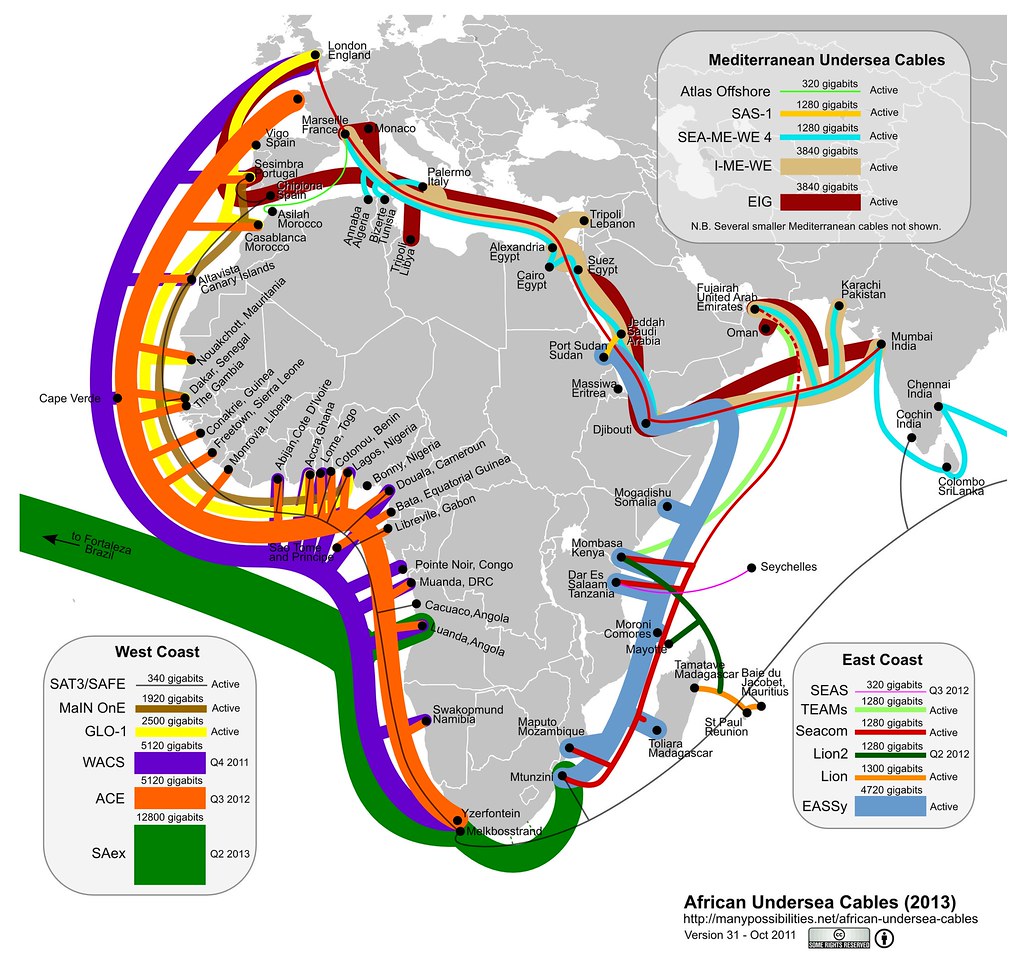
    http://farm7.static.flickr.com/6219/6220166808_7ab0aea646_b.jpg
    Under-sea cables have come to solve the communication crisis in Africa.
    Africa coastline is surrounded by 8 different Sea Cable companies, namely SACOM, EASSy, TEAMs,WACS,MainOne,GL01,ACE and SAex.
    EASSy, which is 90% Africa owned, costed KES 2.6million per kilometer. Its 10000 km long.

    The comparison in cost between road cost and fibre optic cable per km shows a very large variance.
    The amount it costs to lay the fibre-optic cables per km is affordable for most African countries.
    Internet therefore poses the best bet for communication between African countries.
    It has its drawbacks compared to road in that it does not allow for physical face-to face meetings.

    INTER-GOVERNMENT COMMUNICATION.

    Many African Governments lag behind in embracing internet communication. In Africa, internet communication is mainly between citizens communicating to each other.
    In Kenya for example, the internet users are over 8 million. Most Government ministries still don’t communicate using the internet. Some ministries have their websites down e.g Ministry of local Government http://www.localgovernment.go.ke/
    Others still have outdated info such as this http://www.statehousekenya.go.ke/government/local.htm
    Its nearly impossible to get an email reply if you contact the Kenya Government online –except if you email representatives directly through their personal email addresses.
    The Permanent Secretary in the Ministry of Information in Kenya, Dr. Bitange Ndemo is very active in online social media and promptly replies to any queries directed to the Ministry of Information.
    In Zambia, the Zambia State House website has no contact address .This means that its impossible for any one to contact the Zambian Government online.
    http://www.statehouse.gov.zm/
    Countries with working websites and prompt online communications in Africa are Uganda, Rwanda, Burundi, South Africa and Zimbabwe.
    North African countries such as Tunisia, Sudan and Egypt have their websites in Arabic hence language barrier.
    These should include a link to translate to English so that other Africans can communicate with them.
    In Nigeria, the number of citizens using the internet for communication is very high yet most Nigeria Government websites are inaccessible and will not reply to communication sent through email.

    AFRICAN CITIZENS TO DRIVE INTERNET CONNECTIVITY.

    It’s obvious that African citizens have embraced internet communication with 118 million users representing 11.5% of total African population.
    Source: http://www.internetworldstats.com/stats1.htm
    African Governments have lagged behind in offering Government communication to its citizenry through the internet.
    Advocacy towards educating Africa Governments, Kenya included, on the benefits of embracing internet as a main method of communication is crucial.

    AFRICAN CITIZENS COMMUNICATION.

    Communication between African citizens has been made efficient through the internet. The lack of Government controls and interference between internet communication has aided in increasing business between African Countries. For example, it’s possible to design a building in Senegal, Rwanda or Uganda through internet communication between an architect’s office in Kenya and the clients in the respective countries.
    The bottle neck to this efficient business communication comes in once physical meetings are planned. There are no tarmac link roads and passports are needed to move from one African country to the other. Government permit applications are also not available online-one has to be physically present to make an application. These are bottle-necks created by Governments through their slow uptake of internet communication. If they embrace IT, business will be very efficient. Online building plan and environment impact assessment portals such as http://www.a4architect.com/submit-drawings/ should be used within African Governments to aid in faster, more efficient communication.

    Architect Francis Gichuhi Kamau
    info@a4architect.com
    +254721410684

  • Miss

    • I need a 3 bedroomed container house with kitchen, bathroom/s and lounge
    • I need it to be designed including electricity, water etc
    • I need it in Kisumu
    • I need a quotation on all
    • Have my own landSmile

    By: Patricia

  • QUESTIONS AND ANSWERS ABOUT WWW.A4ARCHITECT.COM

    QUESTIONS AND ANSWERS ABOUT WWW.A4ARCHITECT.COM

    1. Tell us about your company
    www.a4architect.com offers architectural and construction project management. We also offer IT solutions for Local Governments and N.E.M.A in terms of application for approval of projects.
    2. What are some of the projects you have successfully completed?
    The most notable is the Naivas at the roundabout of Jogoo road and Outer ring road completed in 2010. Others are various residential estates and houses dotted all over Kenya. We are also in the process of starting a housing estate project in Kigali, Rwanda.
    We are about to complete Greenvile Estate, located in Syokimau. This was marketed online and once buyers booked the virtual houses, we approached Housing Finance for financing and now completion is scheduled for April 2012.
    3. You said that you do online architecture, why did you choose this path and how does it work?
    Online architecture offers an efficient method of communicating for our clients.
    Clients do not have to move from their offices/homes to contact us-they can do that online through their phones or computers at the comfort of their homes and offices.
    Online architecture works as follows:
    • Client contacts us through email/phone after visiting www.a4architct.com.
    • Client describes their needs and requirements.
    • Client receives proposal on estimated cost of project and cost of architectural consultancy.
    • Client signs contract for commencement of service between them and www.a4architect.com.This may or may not require a physical meeting. It depends on the wishes of the client. Some clients will want to meet physically at this point while others will not.
    • Client receives design and makes payment through Paypal, MPesa or directly to bank account.
    • Design process continues with exchange of information between client and www.a4architect.com until client is satisfied with the design.
    • Design is taken for approval at the appropriate Local Authority offices .This requires a physical meeting/presence between www.a4architect.com representatives and Local Authority.
    www.a4architect.com has developed a platform that will reduce the number of meetings between applicants and Local Authority .See details here
    http://www.a4architect.com/submit-drawings/
    • Construction supervision till completion takes place .This requires periodic physical site visits. Where only documentation is required, this is transmitted online to the contractor or other supporting consultants e.g engineers.

    4. Do you offer your services to locals only, or have you gone international?
    Another great advantage of offering Online architectural services is the ability to offer architectural services internationally.
    Last year we offered architectural service for construction of a building in Senegal. We have also offered online architectural services to clients in Uganda and Rwanda.
    We are currently handling a design in Kigali-where necessary, most communication is done online between www.a4architect.com ,the Client and Kigali City Local Authority One Stop Centre offices.
    5. How do you negotiate for pay without physically seeing the clients?
    Architectural services are regulated by CAP 525 of the laws of Kenya so the negotiations are minimum. It’s easy to derive the cost estimate of the project and derive the percentage required as fees. This information is done online, through telephone or face-to-face meetings.
    6. The concept is fairly new to the Kenyan market- how is it being received and what are some of the challenges you are facing in penetrating to the market?
    In the beginning, i.e early 2003 to around 2007, Kenyans were very skeptical of anything/transaction online. www.a4architect.com has emerged as a brand that offers quality service in the field of architecture .This has reduced the amount of skepticism from potential clients. Also, clients are beginning to measure the amount of time and resources they can save by reducing face-to-face meetings especially with the never-ending Nairobi traffic jam.
    With more and more Kenyans accessing the internet, and with the High Speed cable internet, more and more Kenyans are beginning to appreciate the conveniences that IT/internet offers.
    The drawback is that the majority of Clientele in Kenya are over 60 years old. Investing in construction is a costly affair .It takes people very many years to be able to amass the cash to build. The unfortunate thing is that this age group is not internet savvy. It’s quite hard to train them to communicate through IT.
    7. How do you handle the issue of trust with your clients- since you only do online business with them?

    Architectural service is broken down into smaller parts. We offer the first part of the service then the client pays after they are happy and content with it.
    After payment, we move to the next service and offer it for client consumption then we wait for payment. This procedure goes on and on till completion.
    Architectural Association of Kenya and the Board of Registration of Architects and Quantity Surveyors of Kenya need to display a list of registered architects such that it is easier for clients to counter-check with these bodies.
    As we speak, the Architectural Association of Kenya website is displaying an Arabic flag with the words HACKED BY Over-X.
    Here is the screen shot
    http://www.aak.or.ke/


    The Board of Registration of Architects and Quantity Surveyors of Kenya website has been down for the last 3 months and no one seems to notice.
    Here is the screen shot.

    Home

    With the Bodies that are vested with the role of ensuring the Kenyan public gets the best architectural services having unserviced websites, it becomes harder for our clients to ascertain our registration. It also becomes harder for us to differentiate ourselves from the thousands of quacks offering substandard services online.

    8. When and How do you supervise the progress of these buildings?
    Once the Local Authority e.g Nairobi City council e.t.c approves the building proposal, we then move to supervision of the buildings.
    Where physical presence is needed, we offer site visits. Where physical presence is not needed, we receive pictures from the contractor on site.
    9. What projects do you find easier to design using this method and which are not so compatible with the method?
    This method is good for small residential houses. This is because due to lack of economies of scale, it is more feasible for the client to consume online architectural services. Large projects are able to accommodate physical meetings due to economies of scale. Also, the level of risk involved is large so physical presence is needed.

  • Apartments

    Hi.

    I have a half acre plot . I would like to construct spacious 2 bedroom and 3 bedroom flats / apartments . So I wanted to know how flats / apartments will fit in a half acre plot .

    Regards.
    By: Naeem

  • MASONRY WALL FENCING.

    MASONRY WALL FENCING.

    Wall height can vary between a minimum of 2.1 meters to a maximum of 2.8 m high.
    Wall finishes can vary between low cost, middle cost and high cost finishes.
    LOW COST WALL FINISHES.
    This is a wall that comprises of masonry stone walling, machine cut dressed, without any pattern. This is done without a coping at the top and without any keying.
    A square meter of masonry walling is estimated at KES 800 . This cost is derived as follows:
    The cost of a machine cut stone delivered around Nairobi is KES 55. A meter squared has 13 stones.
    This totals to KES 715. Add 10% for labour and joining cement mortar. This brings to approximately KES 800 per m2.
    A good example is the walling commonly seen in low income areas such as Dandora and Kayole.
    MIDDLE COST FINISHES.
    This characterizes a wall that is made up of masonry machine cut or hand dressed stone, laid carefully with impressive workmanship. It comprises keying and masonry coping at the top. A touch of pattern is also included such as alternating stones of a different colour.
    A good example is the walling commonly seen around Kitengela, Ngong and Ongata Rongai areas.
    This is estimated at KES 1200 per m2.
    HIGH COST FINISHES.
    This comprises of hand-dressed masonry walling that is carefully patterned. Designs such as zero-jointing characterize this finish. Intricate indented patterns are also common with this type of finish.
    A good example is the masonry walling located opposite Gertrude Children’s hospital in Muthaiga.
    This is estimated at KES 2000 per m2.
    FOUNDATION.
    The average depth of a wall foundation is 1 m . This varies from region to region depending on how deed the stable ground is. Some grounds will only require a few centimeters of depth while others require many meters.
    The foundation can be constructed using Reinforced Concrete base. This is expensive since the price of cement and steel is high.
    I have developed a method whereby the Reinforced concrete is substituted with two layers of masonry walling laid across each other. This saves costs.
    WALL SUPPORT.
    Every 3 meters should be braced with either masonry walling or Reinforced concrete columns.
    Masonry walling offers a more cost-effective option as a support.
    Fence height:[m] 2.8

    1 m deep foundation
    Total wall height: 3.8

    Surface area[m2] 1219

    low cost finishes 975,200.00

    middle cost finishes 1,462,800.00

    high cost finishes 2,438,000.00

    Fence height:[m] 2.1

    1 m deep foundation
    Total wall height: 3.1

    Surface area[m2] 993

    low cost finishes 794,400.00

    middle cost finishes 1,191,600.00

    high cost finishes 1,986,000.00

    Architect Francis Gichuhi Kamau
    info@a4architect.com
    +254721410684

  • Template: Comments

    This post tests comments in the following ways.

    • Threaded comments up to 10 levels deep
    • Paginated comments (set Settings > Discussion > Break comments into pages to 5 top level comments per page)
    • Comment markup / formatting
    • Comment images
    • Comment videos
    • Author comments
    • Gravatars and default fallbacks